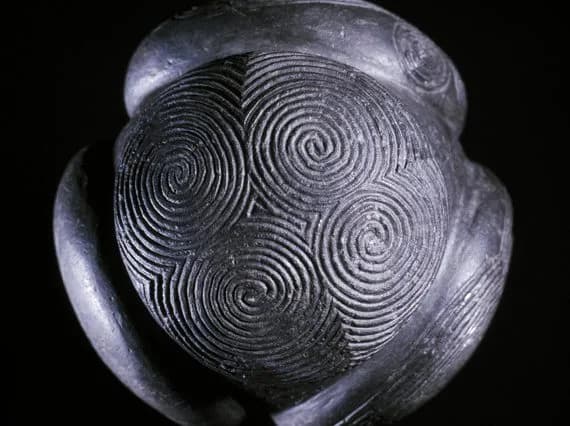
The Towie ball is about 73 millimeters across and weighs just over 500 grams. It fits in one hand.
It has four knobs. Three are carved with spirals, discs and circles, and the fourth is bare.
The traditional view
National Museums Scotland says the ball is Neolithic and dates back over 5,000 years. It is made of a black, fine-grained stone. A drain cut several feet underground on the slopes of Glaschul Hill, Towie, in Aberdeenshire, turned it up in or before 1860. The museum acquired it in 1860.
The museum says more than 430 similar objects are known and that most come from Aberdeenshire. The Scottish Archaeological Research Framework says over 400 are known and that over 90 percent were found in north-east Scotland. A museum curator later put the figure at around 525. The count depends on who is counting and when.
Dorothy Marshall catalogued 387 of them in her 1977 paper. Archaeopress describes Chris Stewart-Moffitt's 2022 book as the first study of these objects since hers.
I found no radiocarbon date for the Towie ball itself. The research framework dates the making of these balls to the centuries around 3000 BC. It bases that on tiny beads shaped like six-knobbed balls found in a tomb at Knowth in Ireland. It also points to spirals that echo Boyne Valley tomb art and to balls found at Skara Brae. The Ashmolean Museum reports that Sir John Evans thought in 1897 that Towie might belong to the Bronze Age.
The museum calls the Towie ball "first and foremost a symbol of power" and says it could also have been a fancy weapon. The research framework calls a symbol of power the most plausible explanation for the whole class, like the orb in royal regalia.
Marshall noticed that the balls are found in much the same places as the Pictish symbol stones. That once led people to call the balls Pictish. Balls found at Skara Brae now place them in the Neolithic, long before the Picts. The Aberlemno article looks at those stones.
Geometry
Three threads in Earthly Enigmas run close.
In Chapter 5 I write that the Flower of Life appears on five continents in unrelated traditions. In Chapter 14 I write that it contains the five Platonic solids. I also write that people have carved geometric signs for thirty thousand years on every inhabited continent, and spirals are among them.
In Chapter 11 I trace a chain of preservation that runs from Göbekli Tepe through Stonehenge and Carnac and the mystery schools down to Pythagoras. I grant that people can arrive at simple shapes on their own. I write that this explanation loses force for figures with precise internal constraints.
What Nobody Has Settled
Both views lean on questions the evidence cannot yet answer. Three of them stand out.
What was it for?
The Ashmolean says few of the balls are damaged or show any signs of use. Marshall counted only 29 chipped or broken among 387 and took that as a pointer that the balls were not functional. She also doubted that an owner would risk so carefully made an object in war or in the chase.
The research framework still lists blunt force injuries on skulls and microscopic use wear among its open questions. A Smithsonian report on a dig in Orkney says some remains there show skull injuries possibly caused by such tools. I have not checked that in the excavation reports.
Other readings sit beside the weapon. Ludovic Mann thought the balls were weights on early scales. Marshall says the balls do not differ greatly in weight, while CNN reports that their weights vary too much. CNN also reports Lynne Kelly's proposal that they were memory aids, which I have not checked. Andrew Meirion Jones asks whether the balls had several uses, one of them teaching.
What evidence would settle what it was for?
Why is one knob plain?
The museum describes the fourth knob as blank. Marshall found the same habit in other balls. She writes of the spiral balls that in no case are all the knobs decorated. Her two four-knobbed balls with concentric circles carry the circles on one knob only.
Jones writes that Towie is one of the balls that appears to be incomplete. In the same paragraph he writes that the undecorated knob was likely left unworked on purpose. The geologist who examined the stone for Marshall said it is soft enough to make decoration very easy.
Photogrammetry of another museum ball turned up concentric circles that dozens of scholars had missed in more than a century. I found no published close study of the Towie plain knob. I have not checked whether one exists.
What would a close look at that bare surface show?
Did someone carve geometry before the Greeks wrote it down?
Keith Critchlow and Lawlor argued, according to Jones, that the balls are models of the Platonic solids. I have not read their books. George Hart, a mathematician, writes that the dodecahedron appears among the balls long before the Greeks wrote of it.
Hart also writes that the more regular balls do not appear to have mattered more than the others. He adds that the five balls in Critchlow's photograph are not the five balls in the Ashmolean Museum, as that book says. The Ashmolean lists its own five as having 14, 7, 4, 6 and 6 bosses.
D. R. Lloyd answered in 2012 that the archaeological and statistical evidence do not support the idea. He concludes that the five regular solids were discovered in Plato's time. I read only his abstract. Jones says the forms simply arise from dividing a sphere.
The sources I read agree on the symmetry. Marshall describes balls with 25, 90 and 160 knobs, all evenly cut. The sources I read do not say the Towie ball is itself a Platonic solid, and it has four knobs.
What would show that a maker understood a regular solid, as opposed to a sphere divided evenly?
The questions I can't put down
Some questions need more room than one article gives them. Two of them keep pulling me back.
How did a spiral from the Boyne Valley end up on a stone in Aberdeenshire? The museum says the Towie symbols resemble those at Newgrange in Ireland. Marshall says the spirals can be paralleled at the tomb entrance there. The museum's curator told CNN the ball suggests contact over long distances "which we don't always give prehistoric people credit for." In Chapter 5 I list Newgrange among sites that share the same long-cycle awareness. Those sites sit in seven countries that were not in contact by any route mainstream archaeology accepts. I follow that question through Earthly Enigmas.
Were the balls made to teach? Jones calls them objects for learning how to work stone and reads their spread as a transfer of knowledge. The research framework reads the same objects as symbols of rank. In Chapter 11 I ask who stood on the other end of knowledge carried forward through the stone sites, and the Carnac article follows that chain. You can read a free sample of the book before you decide. Costa Rica's stone spheres raise a different puzzle about balls of stone. The articles section has more subjects in the same format.
Sources
- National Museums Scotland: Towie ball, a Neolithic status symbol
- Dorothy N. Marshall, Carved stone balls, Proceedings of the Society of Antiquaries of Scotland 108 (1977)
- Scottish Archaeological Research Framework, Neolithic Panel Report, 5.2.4 Special stone artefacts
- Ashmolean Museum: Carved Stone Balls from Scotland
- Andrew Meirion Jones, An Archaeology of Affect, Journal of Archaeological Method and Theory 27 (2020)
- Hugo Anderson-Whymark, Enormous petrified mulberries (National Museums Scotland blog, 2018), republished by Sketchfab
- D. R. Lloyd, How old are the Platonic Solids? BSHM Bulletin 27 (2012) (abstract only)
- George W. Hart, Neolithic Carved Stone Polyhedra (a mathematician's web page)
- Archaeopress: The Circular Archetype in Microcosm (publisher description only)
- CNN: Scotland's 5,000-year-old carved stone balls shrouded in mystery (2018) (secondary, journalist's quotation of the curator)
- Smithsonian Magazine: Polished stone balls found in Neolithic Scottish tomb (secondary)