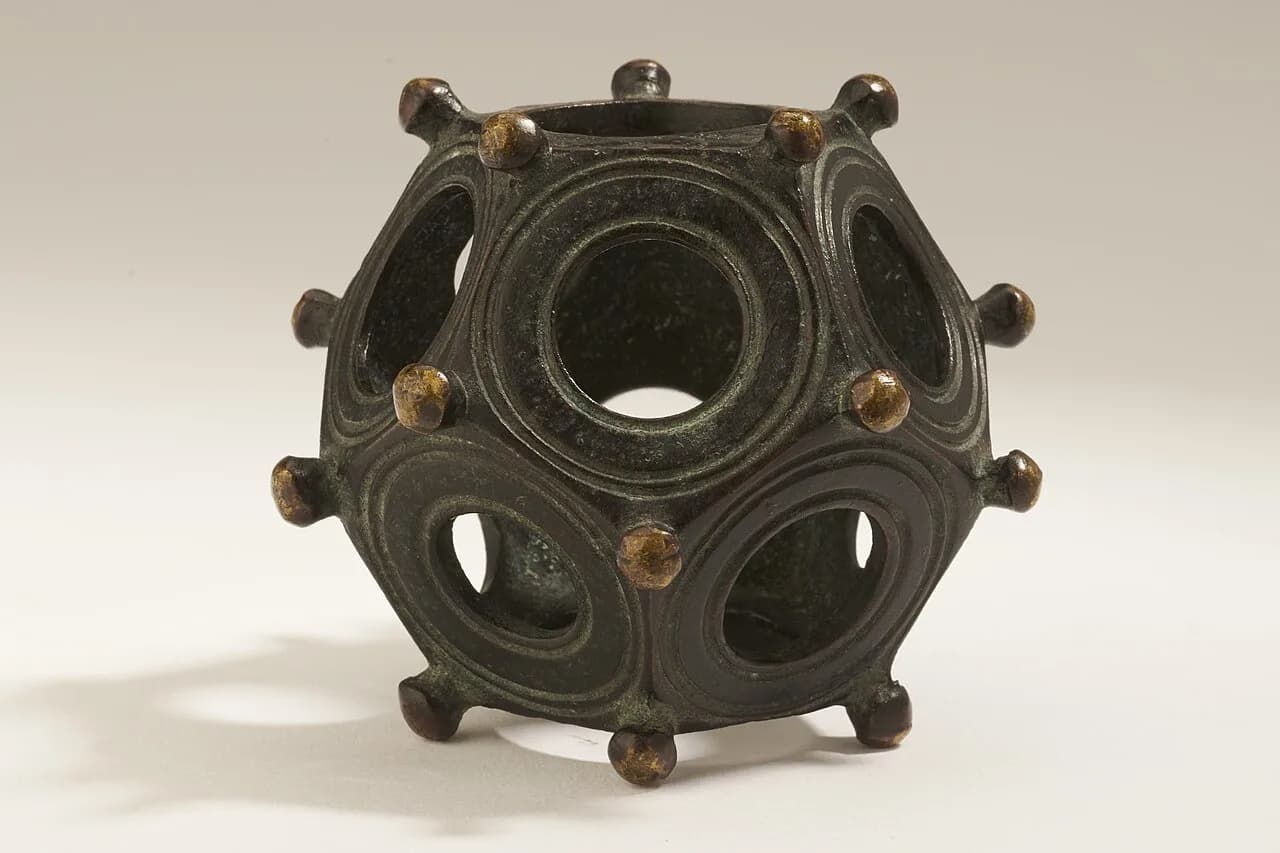
A bronze object from Jublains in northwestern France stands 59 millimeters high and weighs 81 grams. It has twelve pentagonal faces and a small ball at every corner.
Ten of the faces have a round opening and two have an oval one. No ancient text describes what it was for.
The traditional view
The Gallo-Roman Museum in Tongeren says about 120 similar dodecahedra are known from the Roman period. It describes them as hollow bronze objects between 4.5 and 8.5 centimeters across. Each has twelve pentagonal faces with a circular opening in the middle and a small sphere on each of the twenty corners.
The museum says most were found in the northwestern part of the empire, in what are now Belgium, the Netherlands, Germany, France and Great Britain. It adds that this area coincides with the Celtic world. Petra Dragonidesová writes in a 2025 paper that none has been definitely identified in present-day Italy, Africa or the former Eastern Roman provinces.
Dragonidesová writes that the ones from the western regions are typically dated by context to the second to fourth centuries AD. The first recorded find reached the Society of Antiquaries of London in 1739 from Aston in England. The report she quotes calls it "a piece of mixed metal consisting of twelve sides, with an equal number of perforations within them."
The Jublains object came from the burned layer of a small building with a cellar. In their excavation report Gérard Guillier and colleagues say it was probably used in the first half of the third century. A bronze balance lay in the same layer. They write that the dodecahedron seems to have been cast by the lost wax method and then carefully finished.
The title of their report translates as "at last a dodecahedron in archaeological context." That tells you how rarely the context is known.
What the Evidence Does Not Settle
Specialists have offered many readings and none has won. Dragonidesová counts nearly fifty. She concludes that "none of these mentioned theories have been conclusively proven."
Amelia Sparavigna of the Politecnico di Torino reads the object as a rangefinder. The Tongeren museum places it in the magical and religious sphere. The Jublains excavators leave two options open and say a shop and a diviner's den need not exclude each other.
Guggenberger and Leach published a 2025 paper that ties the objects to Platonic and Pythagorean texts. The Hunt Museum in Limerick holds a bronze example. A search excerpt from its page says most scholars agree it was a surveying instrument. I could not open the page and I have not checked that.
Where the Accounts Part
Each of these readings leans on questions the evidence cannot yet answer. Three of them stand out.
Could the holes have been a measuring scale?
Sparavigna posted an arXiv paper arguing that the common features of the objects allow her to tell that a Roman dodecahedron was probably a dioptron. A dioptron is an instrument to look through. She proposes that two opposite holes of different diameters, set a fixed distance apart, let a viewer estimate how far away a target of known size stands.
She also writes that "it does not seem that a standard or rule for these instruments existed." She says more data are needed before "any conclusion that has a statistical significance." I do not know whether the paper was peer reviewed.
Dragonidesová cites that proposal and rejects it. She writes that "the inconsistent size variations observed in both the dodecahedrons and their central openings render them unsuitable for precise measurements." The Tongeren museum says the diameters of the openings and their proportions always differ.
The Jublains report gives a sense of the variation. The openings on that object range from 10.5 to 22 millimeters and the faces sit 48 to 52 millimeters apart.
Both sides start from the same variation. What would a set of carefully recorded objects have to show before both sides accepted the result?
Does the map show where they were used?
The Jublains authors note a concentration in Gallia Belgica and the south of Gallia Lugdunensis. They write that the authors they consulted agree on the absence of the dodecahedra around the Mediterranean, and that the finds lie on former Celtic territory.
Dragonidesová adds a warning. She writes that most of the known objects were acquired through the antiquities market and lack documented information about where they were found.
She also describes fragments from Chotín and Hurbanovo in Slovakia. They lay in Germanic settlements outside the empire and were broken. She suggests they reached the settlers through raiding or by scavenging a ruined fort and that they were kept as metal to melt.
How much of the map shows where the objects were made and used, and how much shows where they were later found and reported?
What do the places they were found tell us?
The finds come from very different settings. Dragonidesová lists military camps, public baths, temples, theatres, tombs, wells and a coin hoard. She reports riverbed finds near Nijmegen, Trier and Zürich that Tibor Grüll thinks might suggest a votive purpose.
At Krefeld-Gellep in Germany a dodecahedron lay in a richly furnished fourth century woman's grave next to a bone object that looked like a handle. The Tongeren museum says one from that grave was apparently mounted like a scepter head on a bone staff. At Norton Disney in England Dragonidesová reports one in a pit with roofing fragments, pottery and animal teeth.
She writes that "even when contextual information exists, it often fails to shed light on their specific use." The Jublains authors suggest a merchant's or craftsman's shop or the lair of a diviner.
Could one use have fitted a shop, a grave, a river and a rubbish pit, or did the object change meaning with each owner?
The questions I can't put down
Some questions need more room than one article gives them. Two of them keep pulling me back.
Did anyone write it down? Guggenberger and Leach say that no contemporary description exists. They argue that several texts point to its possible inspiration, including a passage in Iamblichus's On the Pythagorean Life. They also relate those texts to the Druids' reported interest in Pythagoras. I have read only their abstract. In the book I follow a chain of preservation that runs through oral tradition and the mystery schools. I follow that chain through Earthly Enigmas.
Why does the form have twelve faces? Plato wrote in the Timaeus that "God used it up for the universe in his decoration thereof," in the 1926 translation that Dragonidesová quotes. A lead object from Geneva coated in silver carries a zodiac sign on each of its twelve faces, according to the Jublains authors. Dragonidesová also describes twelve-sided gold beads from Han period tombs at Hepu in southern China. In the book I write that the Flower of Life contains the five Platonic solids. You can read a free sample before you decide. The sacred geometry article follows the pattern further and the articles section has more subjects in the same format.
Sources
- Gallo-Romeins Museum Tongeren: Fragment van een dodecaëder
- Dragonidesová, Mysterium Insolutum: Fragments of Roman Dodecahedrons from Hurbanovo and Chotín (Študijné zvesti AÚ SAV, Suppl. 3, 2025)
- Guillier, Delage and Besombes, Une fouille en bordure des thermes de Jublains (Revue archéologique de l'Ouest 25, 2008)
- Sparavigna, Roman Dodecahedron as dioptron: analysis of freely available data (arXiv:1206.0946)
- Guggenberger and Leach, The Gallo-Roman Dodecahedron and the Receptacle of All Becoming (The Antiquaries Journal 105, 2025) (abstract only)
- Hunt Museum: Roman Empire Dodecahedron (search excerpt only; page blocked)