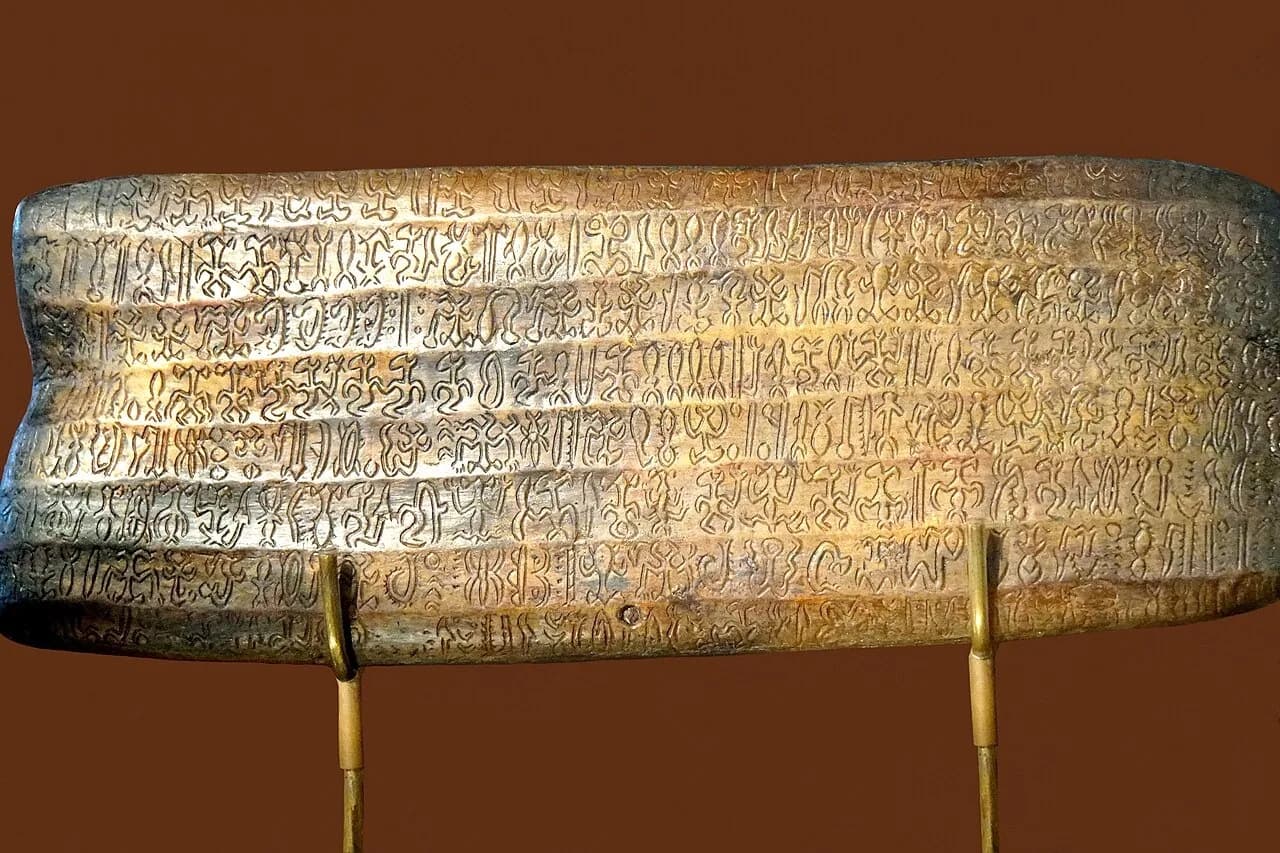
The Mamari tablet measures 29 by 19.4 centimeters and is 2.3 centimeters thick. A team that radiocarbon-dated it describes the text as neatly inscribed on both sides.
It is one of fewer than thirty carved wooden objects from Rapa Nui. No reading of its signs has won general agreement.
The traditional view
The Australian Museum calls roŋoroŋo "the ancient and sacred script of Rapa Nui (Easter Island), unique in Polynesia." It says the script has around 600 distinct glyphs, mostly human and animal forms. Text in alternate lines is rotated 180 degrees so the reader can follow it.
The museum says that according to oral tradition the script was brought to the island by Hotu Matu'a from Hiva. It was used to record "genealogies, lunar cycles, cultivation techniques, and other vital knowledge." Students first practiced on dried bark before they moved to toromiro wood.
Silvia Ferrara and colleagues write in Scientific Reports that the script is "now engraved on fewer than 30 wooden objects" and is "still undeciphered." They say its pictorial glyphs "do not resemble any known script." The closest parallels they name are motifs in ancient rock carvings on the island.
They add that complex ligatures, long linear sequences and evidence of corrections "suggest proper language notation." Paul Horley reports in the abstract of a 2009 paper that three original tablets show two-stage carving. He writes that the scribes made "only a few errors and corrections" in about 4,000 glyphs.
Production stopped in the nineteenth century. Ferrara and colleagues say the tablets "ceased to be produced in the late 1860s, after the raids." European missionaries gathered four of them in 1869 and sent them to the Bishop of Tahiti, Tepano Jaussen.
Moreno-Mayar and colleagues report that in the 1860s Peruvian slave raiders "kidnapped a third of the population." A smallpox outbreak followed and the population fell to an estimated 110. The Australian Museum lists epidemics, slave raids and missionary influence among the forces that "disrupted the transmission of indigenous knowledge."
What the Wood Does Not Settle
In Chapter 3 I describe the statues of Rapa Nui, and the article on the moai and ahu covers them, so I leave them there.
The script still raises a question the book asks elsewhere. In Chapter 5 I write that history books treat the ancient world as a series of isolated experiments. I also list Mohenjo-Daro and Easter Island among the 17 sites on Jim Alison's great circle.
The Script Nobody Has Settled
These questions stay open whichever way a reader leans. Three of them stand out.
How old is the script?
Ferrara and colleagues radiocarbon-dated four tablets kept in Rome. Their abstract says "one specimen yielded a unique and secure mid-fifteenth c. date, while the others fall within the nineteenth c. AD." The results section gives that tablet's wood a range of 1493 to 1509 cal AD at 68.3 percent probability. I quote both because the paper does.
The authors write that the result "shows that the date of the wood was some centuries earlier than the arrival of the Europeans in the 1720s." They also say that two of the tablets are made of wood that never grew on the island. One is ash, native to Europe. The other is Podocarpus, a tree native to southeastern Africa.
They conclude that those two were "fashioned from repurposed wood, thus limiting their utility in dating the tablet's production and the carvings adorning them." For the three younger tablets they write that the local population wrote on boards "coming from external sources in a period that post-dates the arrival of the Europeans." They then add that this "does not imply that the script they used was not invented."
Konstantin and Igor Pozdniakov argue from the other side. In a paper on the statistics of the script they make a point about typology. They write that "original systems of writing are not known to have come into being on distant islands" that spent "many centuries in complete cultural isolation." They go on to argue that the script is nonetheless an original writing system.
Ferrara and colleagues also report that a ceremony in 1770 is recorded in which islanders were seen "writing and practicing with a quill." A search result describes Steven Fischer as arguing that the script was inspired by the Spanish annexation ceremony of that year. I have not read Fischer's paper, because the journal page would not open for me.
A radiocarbon test dates the wood. What would date the carving itself?
Is it writing, and can anyone read it?
The Pozdniakovs open their paper with a hard line. They write that "there is no conclusive proof that we are in fact dealing with a writing system, and not with a pre-literary communicative code." Their own work then argues that it is writing. They count 52 basic glyphs, "not 600 glyphs, like Barthel's." They explain that the older catalogue included many ligatures, which are combinations of glyphs.
They read the statistics as pointing to a syllabic script. They write that such limits make it possible to "refute logographic decipherments," in which each sign stands for a word. They name the translations of Irina Fedorova and Steven Fischer as examples of the logographic kind.
Fischer, in the same field, has published readings of the tablets. I have not read his book, so I can only say that the Pozdniakovs disagree with the method. Both sides work from the same few objects.
The Pozdniakovs end with an admission. They write that "judging from the works published in recent years, we are evidently the only people in the world who cannot" propose a reading. They add that the field "is in a much worse state now than it was fifty years ago."
One passage is often treated as readable. A search listing says Thomas Barthel (1958) and Guy (1990) read a section of the Mamari tablet as a lunar calendar. The same listing says Pozdniakov (2011) and Davletshin (2012) question that reading. I have not read any of the four.
Which sign list would a reading have to be tested against?
Who decides when a reading is right?
The Australian Museum page carries the voice of Rapa Nui artist Victor Pakomio, who carved a replica of a lost tablet. He says "Expert archaeologists haven't translated it, but our oral history has preserved some knowledge." He names the cosmos and the stars. He says the tablets also recorded when to fish, plant and cut trees.
He says the script matters to his people because "it defines us and distinguishes us from other cultures." The page does not say whether anyone reads the signs today.
Pakomio says that "disaster, hunger, and abuse forced people to burn these valuable tablets just to start fires and cook fish to survive." He says "none of the original tablets remain on Rapa Nui." The museum says the surviving tablets are held outside the island.
The counts differ even on that one page. The museum text says 26 authenticated objects. Pakomio says 30 tablets. Ferrara and colleagues say fewer than 30 objects.
Pakomio describes his own tablet as "a little larger than the originals" and says it replicates one lost to fire. A photograph of a replica cannot answer questions about an original. That is why the museum names which object it shows.
A Rapa Nui repatriation program lists a digital project called Kōhau Roŋo Roŋo Matu'a. I have only seen its description in a search listing. It speaks of reconnecting the Rapa Nui people with their dispersed heritage. I have not checked whether it covers the tablets.
Who decides when a reading is right?
The questions I can't put down
Some questions need more room than one article gives them. Two of them keep pulling me back.
Did the Indus script and rongorongo have anything to do with each other? In 1932 the engineer Vilmos Hevesy set the two scripts side by side. Asko Parpola writes in his lecture on the Indus script that the similarities impressed the French Orientalist Paul Pelliot. He then dismisses the comparison with the line "The comparison is useless also because the rongorongo tablets have not been deciphered." In the book I put Mohenjo-Daro and Easter Island on the same great circle in Chapter 5. You can read the Indus seal article first and then follow the question through Earthly Enigmas.
How does writing begin? Ferrara and colleagues write that if the age of their oldest tablet means islanders invented a script without outside influence, rongorongo "could represent one of the few independent inventions of writing in human history." In Chapter 7 I write that Sumer has "a starting line" and no developmental trail. I have not checked how the two cases compare. You can read a free sample of the book before you decide. The Phaistos Disc article looks at another short inscription nobody has read. The articles section has more subjects in the same format.
Sources
- Australian Museum: Kōhau Roŋoroŋo, Talking Tablet (Rapa Nui artist Victor Pakomio)
- Ferrara et al., The invention of writing on Rapa Nui (Easter Island). New radiocarbon dates on the Rongorongo script, Scientific Reports 14 (2024)
- Pozdniakov and Pozdniakov, Rapanui Writing and the Rapanui Language: Preliminary Results of a Statistical Analysis, Forum for Anthropology and Culture no. 3
- Horley, Rongorongo Script: Carving Techniques and Scribal Corrections, Journal de la Société des Océanistes 129 (2009) (abstract only, via Crossref)
- Moreno-Mayar et al., Ancient Rapanui genomes reveal resilience and pre-European contact with the Americas, Nature (2024)
- Parpola, Study of the Indus Script (lecture text, Harappa.com)
- Mikanowski, Language at the End of the World, Cabinet 64 (journalism, secondary; read for background only)
- Hokiīŋa Rapa Nui, Ka Haka Hoki Mai Te Mana Tupuna (search listing only; the page did not load)
- Fischer, Preliminary evidence for cosmogonic texts in Rapanui's Rongorongo inscriptions, Journal of the Polynesian Society 104 (1995) (not read; the journal page did not open)
- Guy (1990), Barthel (1958), Pozdniakov (2011) and Davletshin (2012) on the Mamari tablet (not read; named in search listings)