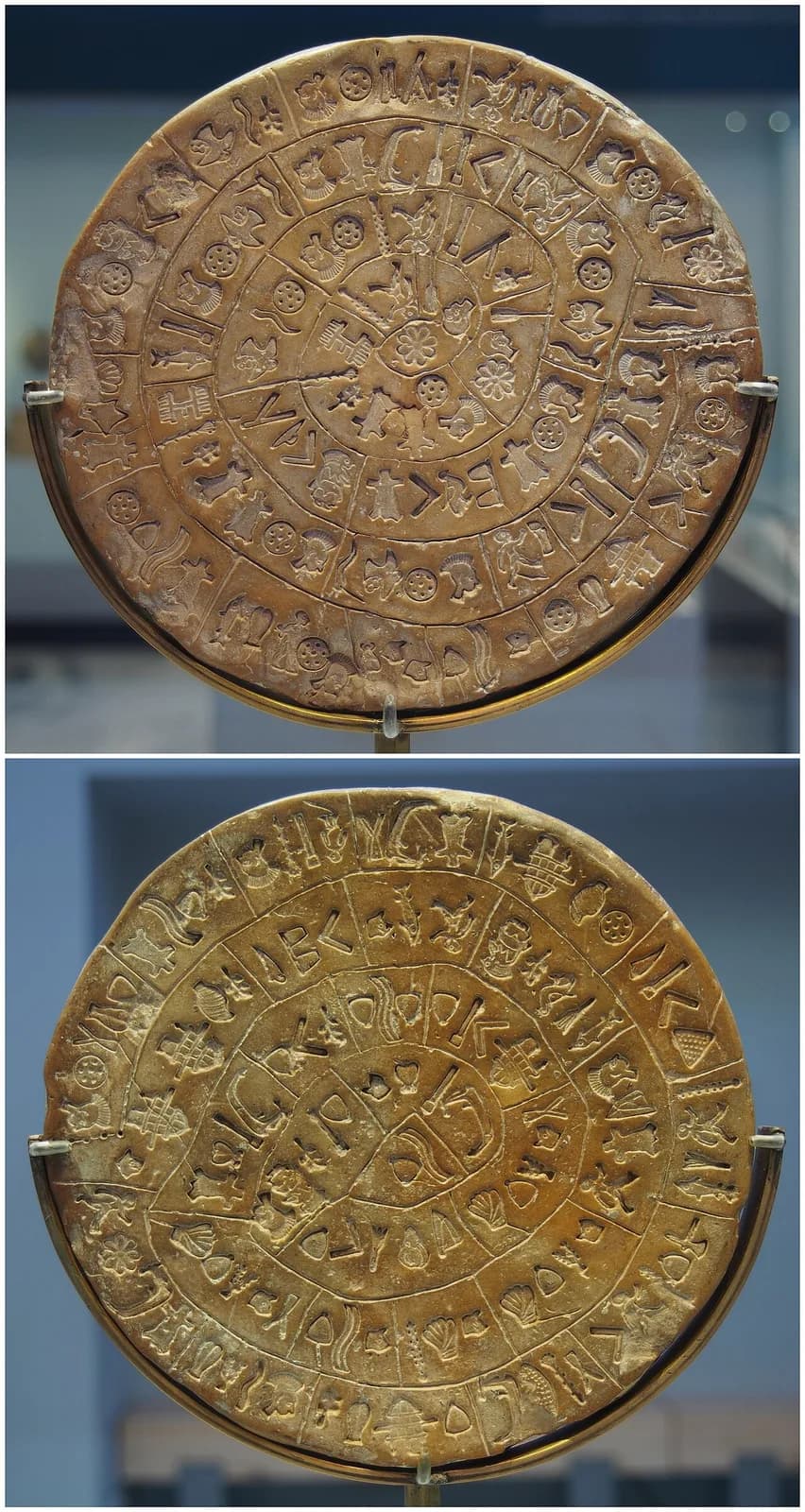
The Phaistos Disc is about 16 centimeters across. Both faces carry small signs pressed into wet clay, and the signs run in a spiral toward the center.
Italian archaeologist Luigi Pernier found it in a room of the Palace of Phaistos on Crete on July 3, 1908. No reading of it has ever been verified.
The traditional view
The Heraklion Archaeological Museum dates the disc to about 1700 to 1650 BC. Its exhibit page says both sides were impressed with tiny seals before firing, "while the clay was still wet." The signs number 241 in total and sit in 61 groups, "presumably representing words."
The museum says a vertical line with five dots on the outer edge of each side marks the beginning and the direction of reading. The text runs from the edge of the disc toward the center.
Mnamon is a guide to ancient writing systems from the Scuola Normale Superiore in Pisa. Its entry on the disc counts 45 different signs. It writes that "statistically, 45 symbols are too many for an alphabet and too few for an ideographic system," so the writing would seem to be a syllabary.
The entry also says the disc "comes from a disturbed context and is therefore very difficult to date stratigraphically." Comparisons with Minoan pottery and seals from Phaistos suggest a date in the 18th or 17th century BC.
Giorgia Baldacci of the University of Venice describes the find in the journal Ancient Near East Today. She writes that it turned up "during an evening inspection by the local foreman." She says the layer was a destruction level that had been disturbed in Hellenistic times.
Baldacci adds that fieldwork by Pietro Militello in 2013 and 2015 showed the associated pottery was largely from the beginning of Middle Minoan IIIA. That is early in the period of the later palaces on Crete.
On what the signs might say, the museum offers one reading. It writes that "the repetition of certain groups of signs, like a refrain, is the strongest evidence that the inscription is a hymn or incantation." It also says experts have not reached a definitive conclusion on the contents.
What the Clay Does Not Settle
The disc still raises the kind of question the book asks. In Chapter 5 I write that "History books treat the ancient world as a series of isolated experiments." Here is one small clay object that seems to stand alone.
Jerome Eisenberg lists signs on the disc that he says resemble Luwian, Egyptian and Hittite carvings. Whether those matches point to a forger's notebook or to Bronze Age contact is part of what nobody has settled. I have not checked any of them.
The Disc Nobody Can Check
Both views lean on questions the evidence cannot yet answer. Three of them stand out.
Is it real?
Eisenberg, the founder and editor of the magazine Minerva, argued in 2008 that Pernier made the disc himself. He writes in the article that its "exposure as the most famous fabrication of an ancient script should certainly end the long-standing controversy."
His reasons include a clean-cut edge, uniform firing, a stamped method with no other ancient example and the absence of any stamps from the site. He writes that in 16 places signs were erased and replaced, and he reads that as odd for an ancient document.
Eisenberg says only a thermoluminescence test, which dates when clay was last fired, "will finally settle this intriguing problem." He reproduces a reply from the museum director refusing his request to examine the disc and the inscribed Arkalochori axe. She wrote that the disc "because of its uniqueness is considered as non movable."
He also prints comments from scholars. Thomas Palaima is quoted as writing "I think it is likely that the disc is a forgery." Michael Coe is quoted as putting it at "95% certainty." I have not seen the original letters. Eisenberg says his article was not peer reviewed.
Stephen Chrisomalis, writing on his blog Glossographia, calls the case "highly circumstantial" and says there is "no direct evidence against Pernier." He adds that "a date from an independent lab would go a long way toward resolving my doubts."
Baldacci answers from the archaeology. She reports a nearly identical mark to the disc's sign 21, the "comb," on a bowl found in 1965. She finds a very similar one on a sealing found in 1955. She writes that a forger working in 1908 could not have copied either one, because both turned up decades later in regular excavations.
She adds that Alessandro Sanavia found comparisons for six disc signs on impressed pottery from Phaistos. Mnamon says the comparisons remove suspicion about the inscription's authenticity. National Geographic points to the Linear A tablet found nearby and to the corrected signs, which it says a forgery could not explain.
The corrected signs are one fact that both sides cite. Pavol Hnila's paper on the authenticity of the disc says in its abstract that "until these arguments are proven wrong the disk cannot be declared a forgery." I have read only that abstract in a search listing.
What would an independent date from the clay show?
Why is there only one?
Eisenberg lists his points of uniqueness. He writes that there is no other ancient "moveable type" before Gutenberg and no other large thin clay disc from the Bronze Age. He asks why none of the stamps has turned up.
Chrisomalis offers a counterweight. The Linear A clay tablets are all economic documents, and he suggests a disc might belong to a different kind of text. He asks whether the Minoans could have "chosen to preserve some forms of information permanently and not others."
Baldacci writes that "the concept of 'uniqueness' assigned to the Phaistos Disc must be reviewed." She adds that no similar artifact has turned up anywhere in the Aegean, and that the disc "remains a special artefact."
Brent Davis of the University of Melbourne says the disc's script "is found on no other object, perhaps apart from the Arkalokhori axe." The axe carries 15 signs in three columns, according to Eisenberg. He says ten look unique. He quotes Louis Godart as saying there are "no definite comparisons" between the disc signs and the three known Cretan scripts.
Mnamon calls the similarities with other Cretan writing "very uncertain." By contrast, the same guide counts "just over 360 inscriptions" in Cretan Hieroglyphic, a script that it says is also undeciphered.
Eisenberg notes that Alice Kober, in 1948, took the dotted bars as a hint that there were other discs. No other disc appears in the sources I read.
Where are the other texts, and where are the stamps?
Can anyone read it?
The museum counts 241 signs and Baldacci counts 242. I have not counted them myself. Mnamon says many attempts have been made to decipher it and that none "can be considered conclusively valid." It adds that without similar inscriptions no proposed decipherment can be verified.
Palaima gave the problem its sharpest form in a 2014 comment on the Biblical Archaeology Society site. He quotes Elizabeth Barber's 1974 handbook saying there is not enough information to prove a decipherment, "but by the same token there is not enough for anyone else to disprove it." He adds that every proposed decipherment "fails the standard of 'probability.'"
Davis says the corpus is "far too small to be deciphered in any reliable way." He argues that Gareth Owens assigned sounds by comparing the disc to Linear A, which is itself undeciphered.
Owens answered in an email to the same site. He called the disc "a genuine Minoan religious inscription in a syllabic script in an IE language." He added that "we must try both to 'read' and to try to 'understand' the text." Speaking to a Greek news agency in 2018, he said that "reading something, however, does not mean understanding it." That interview was translated from Greek by the website that posted it.
Others read it differently. National Geographic reports that Gia Kvashilava proposed in 2008 that the text is Proto-Georgian and honors a goddess named Nana. I have not checked that claim. Eisenberg's own survey of readings runs from a hymn to a calendar to a game board.
Even the size of the problem is disputed. Yves Duhoux reviewed a book claiming a decipherment in 2000. A search listing says he argues a syllabary of about 60 signs would give a better chance than one of 100. I have not read the review.
How would anyone check a reading of 241 signs?
The questions I can't put down
Some questions need more room than one article gives them. Two of them keep pulling me back.
What was it for? The museum reads the repeated groups as a hymn or incantation. Baldacci says the repetition gives "a strong indication" of a religious or magical text. She thinks the fired clay and the spiral make it likely the disc was meant for display. Eisenberg lists a calendar, a game and a court list among the guesses. In the book I ask who a made thing was meant for, most directly with the Nazca lines. You can read the Nazca article first and then follow the question through Earthly Enigmas.
Where did the script come from? Mnamon says Cretan Hieroglyphic "has no antecedents outside of Crete" and is "probably a local creation." That entry covers the neighboring script and says nothing of the disc itself. In the book I describe Sumerian writing as arriving with "no documented developmental period." I have not checked how the two cases compare. You can read a free sample of the book before you decide. The Knossos article covers the palace and its scripts, and the Enkomi tablet and the Indus seal raise the same question about other scripts. The articles section has more subjects in the same format.
Sources
- Heraklion Archaeological Museum: The Phaistos Disc
- Mnamon: Phaistos Disc (Maurizio Del Freo, 2022)
- Mnamon: Cretan Hieroglyphic (Maurizio Del Freo, 2022)
- Baldacci, The Phaistos Disk: An Enigmatic Artifact in its Cultural Context, Ancient Near East Today 9.11 (2021)
- Eisenberg, The Phaistos Disk: A One Hundred-Year-Old Hoax? Minerva, July/August 2008
- Eisenberg, Addenda, Corrigenda and Comments, Minerva, September/October 2008
- Chrisomalis, Is the Phaistos disk a phony? (Glossographia, 2008)
- Biblical Archaeology Society: Phaistos Disk Deciphered? Not Likely, Say Scholars (Palaima and Davis, with Owens, 2014)
- Archaeology Newsroom: Gareth Owens interview (2018)
- National Geographic: This ancient script has remained unsolved for over a century (2024) (journalism, secondary)
- Hnila, Notes on the Authenticity of the Phaistos Disk (Academia) (abstract only, via a search listing)
- Duhoux, How Not to Decipher the Phaistos Disc, American Journal of Archaeology 104 (2000) (not read; one point seen in a search listing)