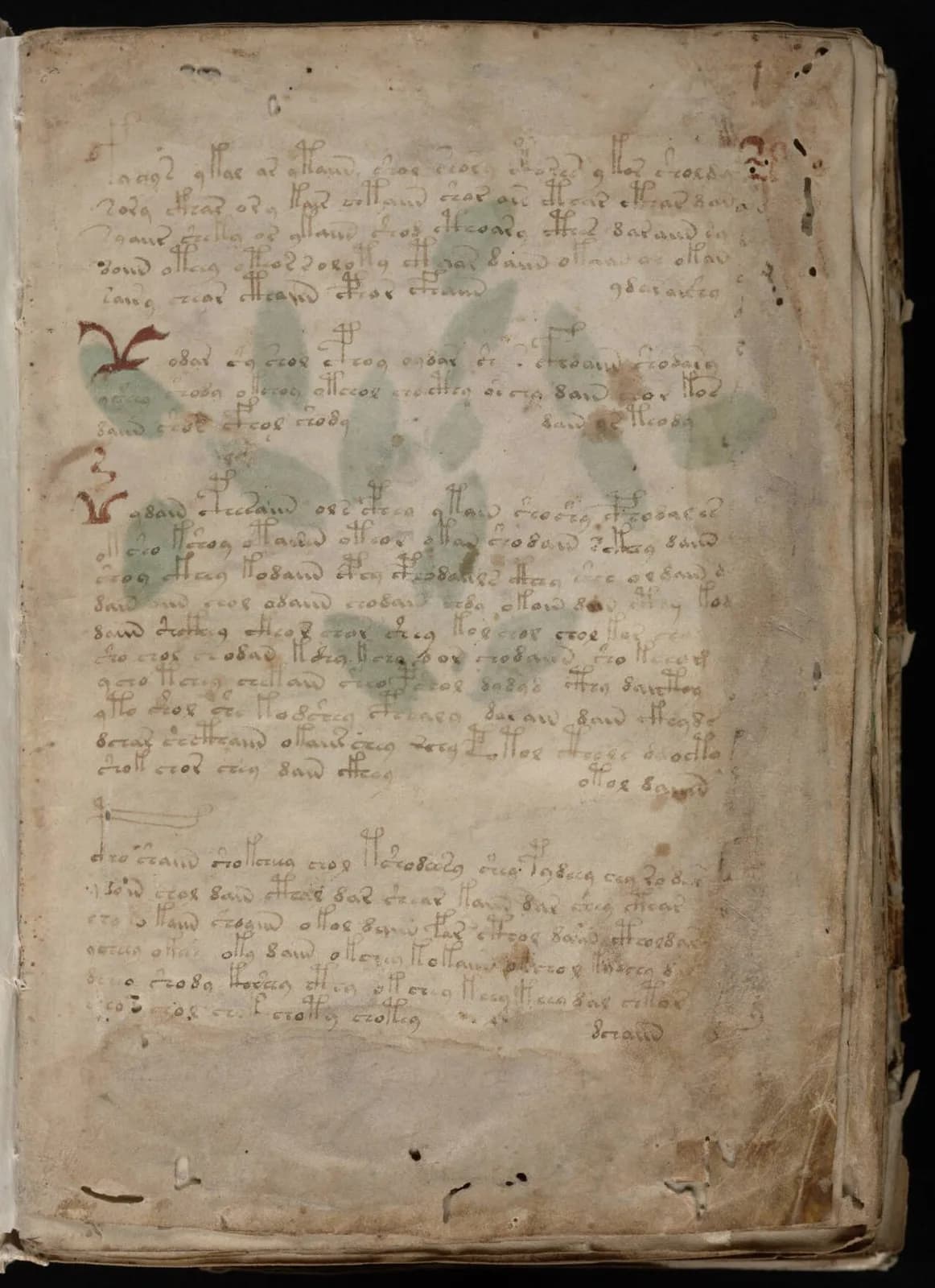
The Voynich Manuscript is a small parchment book held at Yale. The Beinecke catalog gives its size as 225 by 160 millimeters.
Its pages carry a script that has never won an agreed reading. Yale's own library says cryptographic approaches "have failed to decipher the text, if it is indeed encoded."
The traditional view
The Beinecke Library says the manuscript, Beinecke MS 408, "was produced in Central Europe at the end of the fifteenth or during the sixteenth century." It describes the book as written in an unidentified script by an unknown author.
The library lists six sections. They hold plant specimens, astronomical and astrological drawings, drawings of baths and bathing, cosmological medallions, drawings of herbs and roots, and unillustrated text. The library catalog records 102 folios, including folding leaves, and it lists leaves that are missing.
A team at the University of Arizona radiocarbon-dated the parchment. ScienceDaily carries the university's release. It says the team led by Greg Hodgins "has found the manuscript's parchment pages date back to the early 15th century, making the book a century older than scholars had previously thought."
The sampling was done in 2009 and the result announced in 2011. I took the 2009 date from the Wikipedia article on the manuscript, which I used only to locate sources, and I have not seen the lab report itself. The result was 1404 to 1438, according to Hauer and Kondrak, who cite the Arizona Accelerator Mass Spectrometry Laboratory. The Phys.org report says Hodgins took four samples of about 1 by 6 millimeters from the edges of four pages. Yale conservators had picked pages that were not rebound or repaired.
The Beinecke Library traces the book through a chain of owners. The first confirmed owner was the Holy Roman Emperor Rudolph II, who purchased it "for 600 gold ducats and believed that it was the work of Roger Bacon." The library calls the Bacon association "pure speculation."
Johannes Marcus Marci sent the manuscript to the Jesuit scholar Athanasius Kircher in 1666. Wilfrid Voynich bought it in 1912 from the Jesuit College at Frascati near Rome. H. P. Kraus gave it to the Beinecke Library in 1969.
Lisa Fagin Davis, who studies the manuscript's script, summed up the settled ground in a 2020 paper. She wrote that the "provenance trail is nearly unbroken from the seventeenth century to today." She also wrote that "we still don't know how to read it."
What the Pages Do Not Settle
The book does cover restricted archives. In Chapter 15 I look at the Vatican Library and write that its holdings have never been independently verified, "because independent verification is not permitted" (pages 352 to 356).
The Beinecke Library also restricts access to the original manuscript. It gives three reasons, which are the manuscript's fragility, the large number of research requests and its duty to preserve the book for future generations. It makes high-resolution images of the entire manuscript available for research.
The Reading Nobody Has Settled
Whatever a reader thinks of the manuscript, three questions stay open. Each one rests on published work from people who disagree with each other.
Is anything written there at all?
Marcelo Montemurro and Damian Zanette studied how words are distributed across the manuscript. Their 2013 paper says the results "give support to the presence of a genuine message inside the book."
Torsten Timm reaches a different conclusion in a preprint. He argues that the text was made by copying and modifying text already written. He writes that "an unknown natural language or a constructed language can be ruled out."
Timm addresses Montemurro and Zanette in a footnote. He says the context dependency they found "only points to a self-referencing system." I have read the preprint and not the later journal version he wrote with Andreas Schinner.
Davis takes a third position in her paper. She writes that recent linguistic analyses suggest the script represents a natural language that has not been identified, and that it is "not gibberish."
Gordon Rugg proposed in Cryptologia in 2004 that a table and grille method could produce text with similar properties. I have seen only a search summary of that paper and I have not read it.
Hodgins raised a related point when he spoke about the manuscript. He said "there are types of ciphers that embed meaning within gibberish." That quote comes from the Arizona release as ScienceDaily carries it.
Each side reads the same pages. What test would both camps accept as proof that the text carries a message, or proof that it does not?
What exactly did the radiocarbon test date?
The test dated four small pieces of parchment. Hodgins said in the Arizona release that "it would be great if we could directly radiocarbon date the inks, but it is actually really difficult to do." That quote comes from the Phys.org report.
The Beinecke Library's own wording sits a little apart from the result. Its page gives production at the end of the fifteenth or during the sixteenth century. In the same passage it says scientific testing "suggests material consistency with manuscripts produced in the fifteenth century."
Davis goes further. She writes that "forensic material evidence has determined that the parchment, ink, and pigments date from the early 15th century." She adds that the carbon-14 date "rules out Roger Bacon (who was already dead)" and da Vinci. I have not read the Yale report on the inks and pigments. The library's copy is a scanned file that would not give me text.
Gerard Cheshire, who proposes his own reading below, takes the date as 1404 to 1438. He argues that the vellum "was already a few years old when used" and that the map he reads in the book was made around 1444 to 1445.
The test dates the animals whose skins became the pages. When was the ink laid on them? The same question comes up for the carved tablets of rongorongo, where a radiocarbon test dated the wood and not the carving.
Can anyone check a reading of the pages?
Several people have published readings. Each one comes with its author's own caution and with critics.
Stephen Bax proposed in 2014 a partial decoding that identified plant names by comparing the drawings with medieval herbals. He told Medievalists.net that his aim was "to encourage other linguists to work with me to decode the whole script." I could not open his paper and I rely on the interview.
Bradley Hauer and Grzegorz Kondrak used computer methods to compare the manuscript with 380 languages. Their paper says the result "suggests that it may represent Hebrew, or another abjad script." They add that the results could be "tantalizing clues" or "simply as artifacts of the combinatorial power of anagramming and language models." One test used 72 words and 241 characters, a length they chose to match the number of symbols in the Phaistos Disc inscription.
Nicholas Gibbs proposed in 2017 that the script is a set of Latin abbreviations in a manual of women's health. Atlas Obscura quotes him saying that "any possible index to these abbreviations is missing." Davis told The Atlantic, according to a summary I found, that his text "doesn't result in Latin that makes sense." I have not opened The Atlantic article.
J. Michael Herrmann argues in an arXiv paper that the script relates to the Iranian Pahlavi script. His abstract says "a translation of the VM text is not attempted here."
Gerard Cheshire published a full explanation in Romance Studies in 2019. His accepted manuscript says the language is extinct and that both the language and the writing system "were duly revealed." He reads the book as compiled by a Dominican nun for the royal court of Maria of Castile.
The Boston Globe reported both sides. Cheshire said his paper "has been blind peer-reviewed and published in a highly reputable journal." Davis said "by the time you get to the 15th century, there's absolutely no evidence that anyone was speaking vulgar Latin or proto-Romance." The University of Bristol said concerns had been raised "from academics in the fields of linguistics and medieval studies."
Davis made a wider point to the same paper. She said "no one has ever come up with a unified Voynich theory that explains the text, images, history, and structure."
Hauer and Kondrak make a related remark about the field. They note that past decipherment claims have typically been limited to short passages, "without ever producing a full solution."
What would count as a check on a reading, when the rules a reader applies can be tested on pages the reader did not choose? The Indus script article asks the same thing of another script.
The questions I can't put down
Some questions need more room than one article gives them. Two of them keep pulling me back.
Who held the pen? Davis identifies five hands in the manuscript, which extends the two that Prescott Currier described in the 1970s. She calls the glyphs "carefully-written" and "without precedent or obvious model." Five hands means that more than one person could write the script. In Earthly Enigmas I follow how knowledge is carried across generations and what happens when nobody is left who can read it. That link is my own. I follow that question through Earthly Enigmas.
Where was the book before it reached Rudolph II? The parchment dates to the early fifteenth century. The Beinecke Library names Rudolph, who ruled from 1576, as the first confirmed owner. It says research has cast serious doubt on the suggested ownership by John Dee. The years between are an open gap in the record. In Chapter 15 I follow what happens to manuscripts in restricted collections. You can read a free sample before you decide. The articles section has more subjects in the same format.
Sources
- Beinecke Library: The Beinecke Cipher (Voynich) Manuscript
- Beinecke Library: catalog record for MS 408
- ScienceDaily: University of Arizona release on the radiocarbon date
- Phys.org: Experts determine age of book nobody can read
- Davis, How Many Glyphs and How Many Scribes? (Manuscript Studies, 2020)
- Hauer and Kondrak, Decoding Anagrammed Texts Written in an Unknown Language and Script (TACL, 2016)
- Montemurro and Zanette, Keywords and Co-Occurrence Patterns in the Voynich Manuscript (PLoS ONE, 2013)
- Timm, How the Voynich Manuscript was created (arXiv preprint)
- Herrmann, The Voynich Manuscript is Written in Natural Language: The Pahlavi Hypothesis (arXiv)
- Cheshire, The Language and Writing System of MS408 (Voynich) Explained (Romance Studies, 2019; accepted manuscript)
- Boston Globe: The Voynich manuscript has been decoded. Or has it? (2019)
- Medievalists.net: Voynich Manuscript partially decoded (Bax, 2014)
- Atlas Obscura: The World's Most Mysterious Medieval Manuscript May No Longer Be a Mystery (Gibbs, 2017)