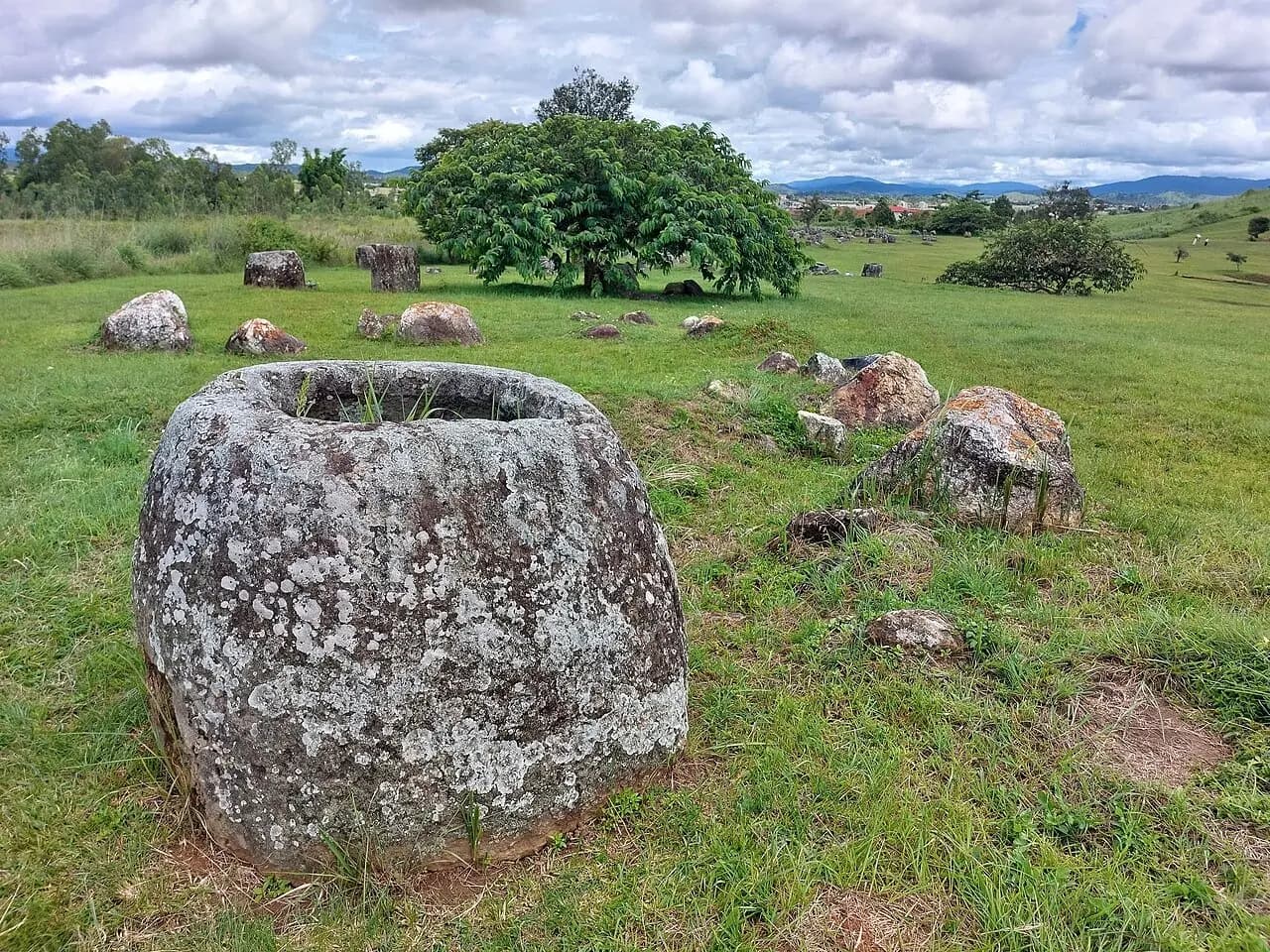
Some of the stone jars on the Xieng Khouang plateau in Laos stand taller than a person. They are hollowed out of stone and left standing on hills and ridges.
Louise Shewan and colleagues describe jars up to three meters high that sit alone or in clusters of more than 400. UNESCO counts 1,325 jars inside the 15 protected parts of the site. It says more than 2,100 give the Plain of Jars its name.
The province was bombed in the Second Indochina War. MAG, the demining organization, says "more than two million tons of cluster bombs were dropped on Laos" between 1964 and 1973. Shewan and colleagues call one of the jar quarries "heavily contaminated with UXO and not accessible for excavation."
The traditional view
UNESCO inscribed the site in 2019. Its description reads "tubular-shaped megalithic stone jars used for funerary practices in the Iron Age." It dates the sites "between 500 BCE and 500 CE (and possibly up to as late as 800 CE)."
UNESCO adds that the jars are the most prominent evidence of a civilization "about which little is known." It also says the distribution of the sites is "thought to be associated with overland routes." Its integrity statement says "some attributes have been damaged in the past by bombing and other effects of war, and by cattle grazing."
The French archaeologist Madeleine Colani surveyed the jars in the 1930s. Shewan and colleagues write that she placed the sites in the Southeast Asian Iron Age, about 500 BC to 500 AD, from the objects found with them. She recovered fragmented skeletal remains, glass and carnelian beads, ceramic vessels and iron and bronze tools.
Colani also described a limestone cave at Site 1 as a crematorium. The nomination file that Laos submitted to UNESCO says "more recent consideration of the crematorium hypothesis has questioned this use."
Recent excavations have found burials around the jars. Dougald O'Reilly and colleagues report "a range of mortuary practices, high rates of infant and child mortality, and new evidence dating these interments to the ninth to thirteenth centuries AD."
The plateau is lived on today. The nomination file notes that contemporary Hmong graves lie among the jars at Site 52.
Nicholas Skopal and colleagues wrote in 2026 that "current scholarship maintains that the jars served a mortuary purpose." They add that this may be "either as symbolic monuments or as containers for the deceased."
What the Wider Question Looks Like
In Earthly Enigmas I write that "history books treat the ancient world as a series of isolated experiments." In Chapter 3 I argue that the standard narrative substantially underweights the megalithic tradition of India.
The jars of Laos have relatives. A 2022 survey says stone jars are "a unique archaeological phenomenon in Assam, India, with similar features also present in the Lao People's Democratic Republic and Indonesia."
Where They Don't Meet
The published record is careful and the authors say openly what they do not know. Three questions stand out.
When were the jars set in place?
UNESCO gives 500 BCE to 500 CE for the sites. Shewan and colleagues write that "it has not been possible to estimate when the jars were first placed on the landscape" until now. They used optically stimulated luminescence on sediment beneath jars. That method estimates when buried sediment was last exposed to light.
At Site 2 the sediment beneath two jars gave a range of 1240 BC to 660 BC. The authors conclude the jars were positioned "potentially as early as the late second millennium BC."
The bone around the jars at Site 1 is much younger. Shewan and colleagues date mortuary activity there to the ninth through thirteenth centuries AD. They write that "the placement of the megaliths preceded the mortuary activity around the jars, indicating re-use of the sites."
A charcoal sample from beneath one jar at Site 1 gave 1168 to 1264 calAD. The authors point out that two secondary burials lay near the sample, so the date may belong to the burials and not to the jar.
Other readings of the dates exist. A report in Archaeology magazine in 2005 says the Japanese archaeologist Eiji Nitta found an urn with human bones beneath a jar at Site 1. The magazine says the urn looked to him like tenth-century Khmer pottery, so the jar above it could be no older. I have not read Nitta's report.
Tate Devantier-Thomas wrote a master's thesis at James Cook University on how the jars were carved. He writes that "current dating remains uncertain, with a broad potential range from 3500 BCE through to 1300 CE." He writes that Colani proposed iron tools from the tool marks on the jars, which supported an Iron Age date. His carving experiments led him to state that "iron tools were not necessary for the carving of sandstone jars."
Skopal and colleagues add that "the chronology of the megalithic tradition itself remains poorly defined." What would date a jar itself, and not the ground around it?
What were the jars for?
UNESCO says the jars were used for funerary practices. Shewan and colleagues write that "the original purpose of the megalithic jars, however, remains a mystery." They add that the mortuary purpose "remains to be confirmed through retrieval and dating of human remains found in situ preserved inside a jar."
Skopal and colleagues report on that kind of find. They excavated a large jar at Site 75 over three field seasons. Inside it they found the disarticulated remains of at least 37 individuals, with iron tools, earthenware, a copper-based bell and glass beads.
The same paper states that "definitive evidence is elusive and key questions regarding their purpose, age and makers remain unresolved." The remains from Site 75 date to about 890 to 1160 cal AD, so they speak to that period.
Earlier ideas were different. Skopal and colleagues note that an early hypothesis proposed the jars were storage containers for food or water. A local story reported by Archaeology magazine says the jars held rice whiskey for a victory feast. I have only seen that story in the magazine.
Skopal and colleagues also report fragments of largely burnt bone and teeth inside several jars at Sites 1, 3 and 67. The magazine says Colani found burned bones while Nitta and Thongsa Sayavongkhamdy found unburned ones. It quotes the geoarchaeologist Julie Van Den Bergh asking whether the two finds stem from different periods. How many jars held the dead, and how many only marked the place where someone lay?
Who were the makers, and where did they live?
UNESCO says little is known about the civilization. The nomination file says "the identification of occupation sites for the people who created and used the jar sites remains a mystery."
The objects that survive point outward. Skopal and colleagues report glass beads from Site 75 that suggest the community "participated in an extensive and far-reaching trade network" linking Southeast Asia to the Middle East and South Asia. They suggest jars were possibly placed at nodal points on overland routes.
UNESCO places the plain at "an historical crossroads" between two cultural systems of Iron Age Southeast Asia. It names them as the Mun-Mekong system and the Red River and Gulf of Tonkin system.
So the sites show contact and the settlements are missing. Where are the villages of the people who carved and carried the jars?
The questions I can't put down
Some questions need more room than one article gives them. Two of them keep pulling me back.
How do you move a jar that may weigh more than 30 tonnes? Shewan and colleagues write that the transport "is unknown" and that dragging on rollers or a sledge "remains speculative." The quarry at Site 21 lies 8 km from Site 1 across undulating terrain. The Plain of Jars Archaeological Project database says jars on the slopes below the quarry may have been abandoned on the way "for unknown reasons." I ask a similar question about the islets of Nan Madol in Chapter 3, and the Nan Madol article sets out that case. You can read a free sample of the book to see how I handle it.
Are the jars of Laos, Assam and Indonesia one tradition or several? The Laos nomination file says there are "suggestions of a similar cultural tradition and cultural transmission, although it is assumed related to different civilisations." The question is whether they share a source or arose separately. I follow a question of that kind across continents in Earthly Enigmas. The articles section has more subjects in the same format.
Sources
- UNESCO World Heritage Centre: Megalithic Jar Sites in Xiengkhuang, Plain of Jars (1587)
- Lao PDR nomination file, Megalithic Jars Sites in Xiengkhuang, Volume 1 (UNESCO document 166326)
- Shewan et al., Dating the megalithic culture of Laos, PLOS ONE 16(3), 2021
- O'Reilly et al., Excavating among the megaliths: recent research at the Plain of Jars site 1 in Laos, Antiquity, 2019 (abstract)
- Skopal et al., The death jar: a new mortuary tradition at the Plain of Jars, Lao PDR, Antiquity 100(412), 2026
- Devantier-Thomas, Shaping the Stone: Experimental Approaches to the Plain of Jars Megaliths, Lao PDR, James Cook University master's thesis, 2021
- Karen Coates, Plain of Jars, Archaeology magazine, July 2005
- Plain of Jars Archaeological Project: site database
- Archaeological survey of the Assam stone jar sites, Asian Archaeology, 2022 (abstract)
- MAG (Mines Advisory Group): Laos