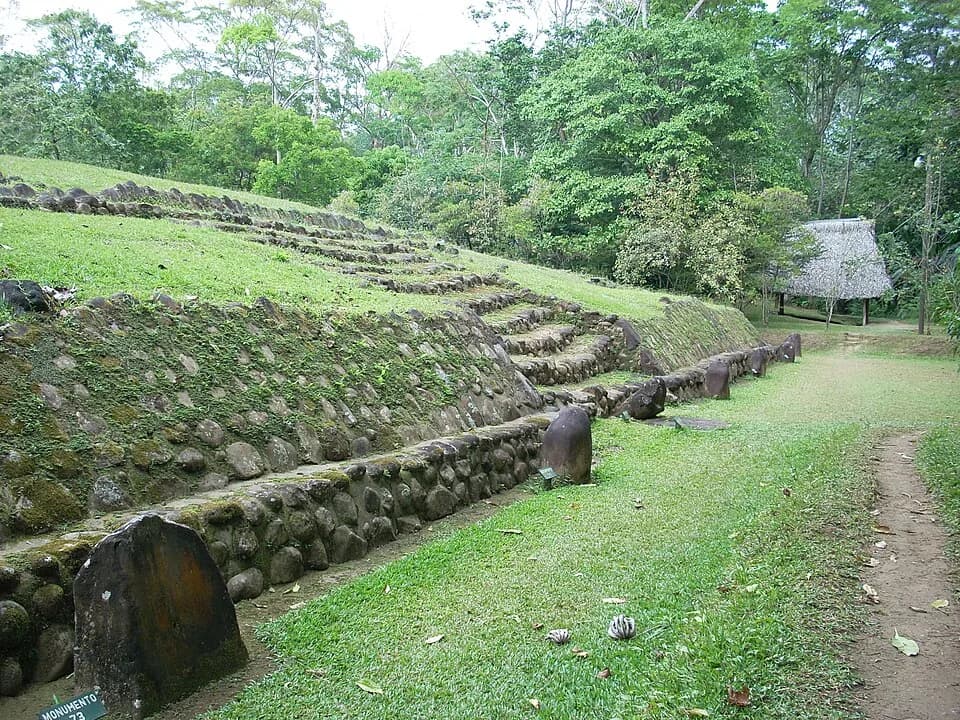
Tak'alik Ab'aj is a K'iche' phrase for standing stone. The Guatemalan culture ministry says the site received the name because its original name is not known and because stelae were still standing there.
Some of the carved stones there appear not to stand where their carvers first set them. In 2008 excavators found two carved fragments built into the wall of a small platform. They show different subjects in different styles and they fit together. Two more pieces of the same sculpture had turned up in other buildings in earlier years.
Joined, the four pieces make a column 2.30 meters tall that is still incomplete. The excavators call it El Cargador del Ancestro, the Ancestor Bearer.
The traditional view
UNESCO says the site's "1,700-year history spans the years from 800 BCE to 900 CE." It says the first half of that period "saw the transition from the Olmec civilization to the emergence of the Early Mayan culture." The city lay on a long-distance trade route that connected the Isthmus of Tehuantepec in present-day Mexico with present-day El Salvador.
UNESCO inscribed the park in 2023. Its advisory body ICOMOS counted 252 sculptures in the nominated area. It writes that they were made in "six different styles" and names them Olmec, Maya, Potbelly, Zoomorph, Coastal and Local. It adds that the styles "might represent different cultural traditions, some developing in parallel during the same cultural epoch."
ICOMOS gives the sequence in steps. Olmec dominance ran from 800 to 350 BCE and a transitional period followed from 350 to 100 BCE. Early Mayan culture then emerged at the beginning of the Late Preclassic (100 BCE to 50 CE). ICOMOS says it "reached its mature expression with the second generation (50 to 150 CE), marked by the development of the Mayan Long Count astronomical calendar." It also writes that "the beginnings of Maya writing are evident on the sculpted monuments" in the form of "brief glyphic texts and Long Count dates."
ICOMOS writes that "it appears that Olmec monuments from the Middle Preclassic period were extracted from their original placements." They were "reinstated on new structures in the Late Preclassic period." It calls the west facade of Structure 12 an example of "what may be an 'open-air museum'." UNESCO lists this "re-use and re-combination of sculptures from different styles and earlier eras" among its reasons for inscription.
J. A. Graham, R. F. Heizer and E. M. Shook reported a preliminary exploration in February 1976. ICOMOS dates formal investigations to 1976 and says a national project begun in 1987 now has about one hundred participants. Graham and his coauthors credit the earlier spelling Abaj Takalik to S. W. Miles, who translated "piedra parada" into Quiche.
ICOMOS notes that the nominated area is 14.88 hectares and "represents less than three percent of the entire 650-ha archaeological site." It quotes the investigators in calling that area "the ceremonial heart of Tak'alik Ab'aj."
The park is also a place of living practice. UNESCO says Indigenous groups of twenty-two Mayan language affiliations "still consider the site a sacred place and visit it to perform rituals." ICOMOS names K'iche', Mam, Kaqchikel and Tz'utujil as the main groups and reports an average of 250 ceremonies a year with more than 1,760 people. It "recognises the importance the nominated property holds for different Indigenous communities."
ICOMOS also wrote that the continuity and direct association between the ancient features and current practice "have not yet been sufficiently documented." It made that point when it assessed criterion (vi). The ministry calls the site "un centro de una cultura ancestral viva," a center of a living ancestral culture.
A Past Built Into the Walls
The excavators describe an apparent practice of gathering the past in front of the buildings. Christa Schieber de Lavarreda and Miguel Orrego Corzo write that in the Ruth phase builders set old Olmec-style monuments in front of building facades. They also built fragments of sculpture into the stonework.
Their 2022 paper says this suggests summing up and alluding to their history, or rather invoking the ancestors. The wording is "resumir y aludir a su historia, o más bien invocar a los ancestros" and the English is my translation.
In 2010 the same authors asked why the Olmec and the Maya appear together at the site. They answer that there is a bridge ("hay un puente") between the two worlds. They describe the bridge as the old idea of calling on the ancestors to build "lo nuevo sobre lo viejo," the new on the old (my translation). They see continuity in the layers and no break.
Marion Popenoe de Hatch has studied the site's pottery for three decades according to the 2019 chronology paper. She reads the evidence differently. Her 2006 paper observes that "ethnicity shows itself in ceramics while ideology expresses itself in art and iconography." It argues "that what is Olmec and what is Maya have different roots but that they originally shared a common ideology."
She adds that the original population used Ocos pottery "which continually evolved over time." Sculptured art "changed from the Olmec style of the Middle Preclassic to the Maya style of the Late Preclassic." She doubts the language of the site was Mam or Proto-Mam.
She writes that the elite and scribes probably understood Cholan Maya. She adds that it may still be too early to speculate about the ethnic group that occupied the site (my translation).
These statements concern different things. One is a reading of ancient texts and pottery. The other is a record of present practice at a place that Indigenous communities hold sacred.
The book touches nearby ground in four places. In Chapter 5 I write that history books treat the ancient world as a series of isolated experiments and I name Maya pyramids among the examples. In Chapter 7 I write that the Maya calendar tracks Venus "to within seconds of arc." The book gives no source for that figure and I have not checked it here.
In Chapter 11 I write that the builders of Göbekli Tepe were trying to make sure we did not have to start from zero again. In Chapter 18 I write that the revised Maya population estimates are now mainstream. None of these passages mentions Tak'alik Ab'aj. The Göbekli Tepe article covers the burial argument.
Two other Maya articles sit beside this one. The Pakal mask article follows a face that was put back together more than once. The Uxmal article follows a pyramid built over earlier temples.
Three Questions the Walls Leave Open
The sources lean on dates and on stones that have been moved. Three questions stand out.
How do you date a stone that has been moved?
Graham, Heizer and Shook raised the problem in their 1978 report. They note that sculptures of several kinds have been re-used and re-positioned as late as the Late Classic. They write that "the dating of placement may be of very little aid in assessing the age of carving."
About the Olmec-style pieces at Tak'alik Ab'aj they write that "many of the Olmec sculptures we located are probably re-set monuments." They add that they have no confidence in the chronology of Olmec sculpture in Mexico. They therefore "see no virtue in attempting to date the Abaj Takalik Olmec pieces on this basis."
The excavators later proposed that the Olmec-style monuments were carved at the site in the Middle Preclassic. For the column they reason from the walls. Monuments 215 and 217 were trimmed to sit flush in the wall of Structure 7A. The authors date that wall and a royal burial in the same building to around AD 100, with a radiocarbon range of 60 BC to AD 90.
The authors write that a sculpture already destroyed and reused by then "no pueda ser más tardía y que deba ser más temprana." That means it cannot be later and must be earlier (my translation). Their 2022 paper on Stela 87 states the logic directly. The last placement gives a "chronological ceiling" and the time of first use must have come before it (my translation).
The 2019 chronology paper adds a caution about method. Its authors acknowledge that "radiocarbon dates may not always translate into the dates of use or construction."
A ceiling is easy to set. If the last wall only gives a ceiling, what gives the floor?
What happens to the story when the dates move?
In 2010 the excavators gave the first Maya-style phase at the site, called Rocío, as 400 to 200 BC. They placed Altar 48, which they call the Monument to the Maya Birth, around 300 BC.
In 2019 the same project published a revised sequence. Takeshi Inomata had asked in 2013 whether the team would share its radiocarbon dates. The team reviewed 52 dates and 28 of them were new. Inomata processed them with a Bayesian model. The Rocío phase now runs from 100 BC to AD 50 and the Ruth phase from AD 50 to 150.
The paper is titled "Cronología nueva con estratigrafía vieja," which means new chronology with old stratigraphy (my translation). Its abstract says the team was sure stratigraphy was its strong point and "did not realize that this strength would lead to an earthquake." The team classed 22 of the 52 samples, or 42 percent, as unreliable. It calls the new sequence "sujeta a pruebas," which means subject to testing.
By 2022 the project placed Monument 11, Altar 48 and Stela 87 in the Rocío phase of 100 BC to AD 50. These belong to what it calls the first generation of early Maya sculpture and writing at the site.
Inomata and Henderson draw wider conclusions in a 2016 article. I have read only the abstract. It names the Gulf Coast, Chiapas and the Southern Maya Region. Centres there "experienced political disruption or reorganisation at the end of the Middle Preclassic period around 350 BC."
The Tak'alik team and Inomata have not agreed on what the revision means. The team writes that its period "no tiene carácter de hiato," which means it was not a gap. Popenoe de Hatch had proposed a shift at 400 BC in the constellations observed, from the Big Dipper to Draco. She linked it to the change from Olmec to Maya. The 2019 paper says the transition phase now sits on the other side of that dividing line.
The ICOMOS sequence quoted above matches the newer figures. What else in the Olmec-to-Maya account moves when its dates move?
How much weight can a worn date carry?
The carved Long Count dates are the fixed points. UNESCO names the calendrical system and hieroglyphic writing among the early traditions the site shows.
Graham and his coauthors describe Stela 5 with two columns of glyphs. The first column reads 8.4.5.17.11, which is AD 126. The second reads 8.2 or 3.2.10.5, which is AD 103 or 83. They add that the glyph panel is "unfortunately none too well preserved."
On Stela 2 they judged the cycle number to be 7 although it is damaged. Most of the katun number had flaked away. They listed three possible spans and the latest of them was 38 to 18 BC. They wrote that the choice might best be left "to be resolved when fuller data are available." They called a reading of 8 for the cycle "a remote possibility."
The 2019 paper uses Stela 5 at AD 126 as an absolute anchor for its radiocarbon model. It reports a proposal made since 2012 that takes the Stela 2 bak'tun as 8 and the first two positions as 8.6. That gives a reconstructed date of about AD 159 or 161. I have not read the 2012 proposal.
The same worn text has been read as falling between 235 and 18 BC and as about AD 160. The 2019 paper places both stelae late in the sequence of stelae at the site.
Graham's team also wrote in 1978 that the Maya-style monuments show "a fully developed Maya style lacking any clear relationship to known earlier sculptural styles." They wrote that the origin of Maya hieroglyphic writing "should remain open." The excavators' later papers propose a first generation of early Maya texts that came before the stelae. They name Monument 11, Altar 12 and Altar 48.
How much weight can a worn date carry?
The questions I can't put down
Some questions need more room than one article gives them. Two of them keep pulling me back.
What were the three rows of stones pointing at? On the platform called Structure 7 stand three rows of monuments. Marion Popenoe de Hatch measured them with a theodolite. She matched the west row to the center point of Ursa Major at its eastern limit between 700 and 500 BC. She matched the center row to the star Eta Draconis between 400 BC and AD 400. She called the platform "lo que parece ser un observatorio astronómico," what appears to be an astronomical observatory (my translation).
The 2019 dating moved the phases around her dividing line of 400 BC and I have not read her later paper on the east row. In Chapter 5 I write about "celestial events" and "long-cycle awareness" shared by sites in seven countries. I follow that question through Earthly Enigmas.
Why keep the old stones? The excavators describe the "cancelación" of the first Olmec platforms and the destruction of Olmec sculpture late in the Middle Preclassic. They then describe old and new stones gathered in front of later buildings. ICOMOS reports the State Party's case that the reuse shows "the intention to evoke the past and create a historic discourse, particularly in times of crisis."
Both are readings of what the excavation recorded, which is walls, fragments and layers. In Chapter 11 I write that Stonehenge and Carnac "represent something different, the attempt to rebuild." I follow the question of why builders keep the past at other sites through Earthly Enigmas. You can read a free sample of the book before you decide. The articles section has more subjects in the same format.
Sources
- UNESCO World Heritage Centre, National Archaeological Park Tak'alik Ab'aj (1663)
- ICOMOS, Advisory Body Evaluation, Tak'alik Ab'aj (No 1663, approved 9 March 2022)
- Guatemalan Ministry of Culture and Sports, Tak'alik Ab'aj
- Graham, Heizer and Shook, Abaj Takalik 1976: Exploratory Investigations (Contributions of the University of California Archaeological Research Facility 36, 1978)
- Schieber de Lavarreda and Orrego Corzo, La escultura "El Cargador del Ancestro" y su contexto (XXIII Simposio, 2010)
- Schieber de Lavarreda and colleagues, Cronología nueva con estratigrafía vieja en Tak'alik Ab'aj (XXXII Simposio, 2019)
- Schieber de Lavarreda and colleagues, La Estela 87 vista desde la ventana de Tak'alik Ab'aj (34 Simposio, 2022)
- Popenoe de Hatch, Evidencia de un observatorio astronómico en Tak'alik Ab'aj (XV Simposio, 2002)
- Popenoe de Hatch, Lo Olmeca y lo Maya en Tak'alik Ab'aj (XIX Simposio, 2006)
- Inomata and Henderson, Time tested: re-thinking chronology and sculptural traditions in Preclassic southern Mesoamerica (Antiquity 90, 2016, abstract only)