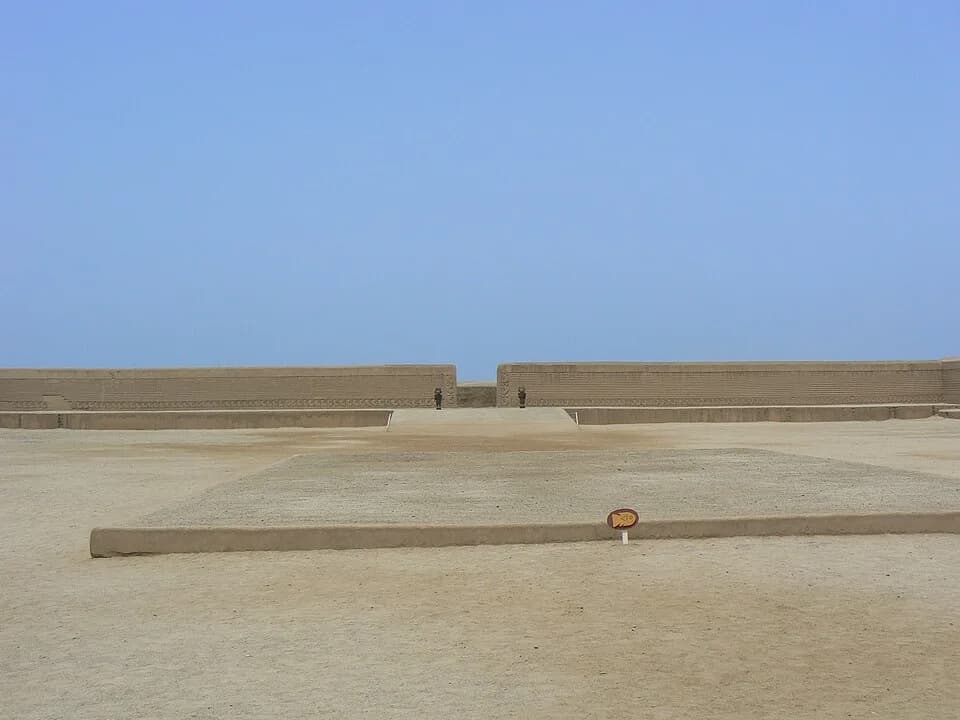
Nik An is the one walled compound at Chan Chan that visitors can walk into. Its tall mud walls carry rows of fish, birds and nets.
In 1986 the heritage advisers at ICOMOS wrote about the same palace under its older name, Tschudi. They called that type of work "highly criticized pastiche" and asked whether it might spread to satisfy mass tourism.
The traditional view
UNESCO's record says the Chimu Kingdom "reached its apogee in the 15th century, not long before falling to the Incas." Its capital Chan Chan "was the largest earthen architecture city in pre-Columbian America."
The monumental zone covers around six square kilometers. UNESCO says it holds nine large rectangular complexes called "citadels" or "palaces." The earthen walls "were often decorated with friezes representing abstract motifs, and anthropomorphical and zoomorphical subjects."
Peru's tourism board, PromPeru, counts ten citadels in the central area. It says the Nik An palace, "previously known as Tschudi," has "undergone the most restoration work and is the only building open to visitors."
Archaeologist Alfredo Narváez took part in the 1983 and 1984 excavations at the palace. In a 1989 paper he dates the Chimú culture from 850 to 1470 A.D. He describes the palaces as having three parts.
The north part has a great plaza and U-shaped rooms called audiencias, which he reads as administrative. At Tschudi the burial platform sits in the south part.
What the Mud Remembers
In Chapter 3 of Earthly Enigmas I write about Inca stone sites in the Andes and I ask whether the Inca inherited an older tradition. ICOMOS puts the Inca conquest of the Chimú kingdom at about 1470.
The Palace Nobody Can Pin Down
Three questions about the compound remain open in the published record.
How much of the wall did the Chimú make?
The ICOMOS evaluation says the palace received "massive restoration" from 1964 to 1969. UNESCO's statement of authenticity covers the whole site. It says the original earthen architecture "is undergoing conservation interventions using earthen materials and still truthfully represents the construction methods and the spirit of the Chimú people."
Peru's conservators say they are still searching for what works. In the CyArk tour Arturo Paredes Núñez says irreversible materials including plastics were tried and proved costly to undo. He heads the research and conservation unit at the site agency. The transcript is a machine translation, so I give the sense and not the wording.
A Ministry of Culture news item describes a planned covers project for the audiences sector of Nik An to unify the design and materials of the current covers. A 2026 UNESCO decision takes note of emergency conservation and maintenance work at Nik An.
The Chimú changed the walls too. Narváez found that the west and south walls of one corridor were first decorated with rhomboids. Those were sealed over to make a surface for horizontal waves with marine birds along the base.
I have not found a public record that marks each relief as original, rebuilt or repaired. I have not searched the Peruvian archives.
How much of the wall you photograph did the Chimú make, and which Chimú design is it?
When was Nik An built?
Narváez reports that earlier studies placed the Tschudi compound in both the early and the late phases of the city. The first sequences rested on surface architecture. He quotes Kent Day, "Despite the lack of stratigraphic relations, ciudadelas can be ordered in sequence on the basis of architectural variation."
Geoffrey Conrad ran radiocarbon dates. Narváez writes that they came from canes inside the walls, "in other words, the dates came from surface contexts." He says the results "differed from the sequence which Conrad had established."
Narváez concludes that "the placement of Tschudi Palace in the latest part of the Chan Chan sequence is correct." He rests that on pottery, on tall adobes lying over earlier square-ended adobes, and on Inca-period pottery found with pits cut for building material. He adds that Alan Kolata, whose adobe sequence he supports, discounts pottery as a dating tool.
He also reports that Cornejo, who excavated in the audiencias, argued for five reoccupations and found no evidence of use in Inca times.
The dates for the culture itself vary. Narváez gives 850 to 1470 A.D. UNESCO's statement gives the ninth to the fifteenth centuries. ICOMOS wrote in 1986 that the Chimú civilization replaced the Mochica culture around 1200.
When was Nik An built?
Who was it built for?
UNESCO counts nine compounds called citadels or palaces. ICOMOS put a question mark after its own labels and wrote "(royal districts? aristocratic districts?)."
Michael Moseley wrote in Science that "each monarch built his own seat of government during life and this became a monument to his name after death." He added that the size of the city does not reflect a large resident population because "building was done by nonresident work forces."
A summary of Geoffrey Conrad's chapter by anthropologists at HRAF says ten compounds match the ten kings listed in traditional histories. It reads them as products of split inheritance. The new king took the political power while other heirs received the wealth and used part of it to venerate the dead ruler.
Narváez suggests that the central part of Tschudi "was probably the residence of the Chimú lord." He also reports that later people reused the compound, into Colonial times. I have not found a source that names the ruler of this compound.
Was Nik An a royal home, a royal tomb or an administrative center, and did the answer change over time?
The questions I can't put down
Some questions need more room than one article gives them. Two of them keep pulling me back.
What was here before the palace? Narváez reports that the earliest floors under Tschudi belong to the Early Chimú period. He also reports Moche pottery in the fill. He notes that Iriarte reported a "tiahuanacoid" burial in the deepest levels of one area, which he calls "evidently occupied some centuries before the construction of Tschudi Palace." In the book I ask the same kind of question about Inca sites. I follow it through Earthly Enigmas.
What did the rain do before the Spanish came? Narváez found a layer of rain-laid sediment over floors that carried Inca-period pottery. He writes that the rain "practically disfigured or deformed" the friezes. ICOMOS adds that the wooden beams that supported the terraces disappeared in the 17th century, so the walls are no longer sheltered. In the book I give the Nazca plateau under 20 minutes of rain a year. The Nazca article looks at that desert. You can read a free sample of the book before you decide. The articles section has more subjects in the same format.
Sources
- ICOMOS evaluation of Chan Chan, World Heritage List no. 366 (1986)
- UNESCO World Heritage Centre: Chan Chan Archaeological Zone
- UNESCO Decision 48 COM 7A.35: Chan Chan Archaeological Zone
- Narváez, Chan Chan: Chronology and Stratigraphic Contents, Andean Past 2 (1989)
- Moseley, Chan Chan: Andean Alternative of the Preindustrial City, Science 187 (1975), abstract
- Conrad, The Burial Platforms of Chan Chan, in Chan Chan: Andean Desert City (summary by HRAF)
- CyArk Tapestry: Chan Chan, Tschudi Palace (transcripts and about page)
- Peru Ministry of Culture: preservation work at Chan Chan
- PromPeru: Discover the impressive Chan Chan ruins