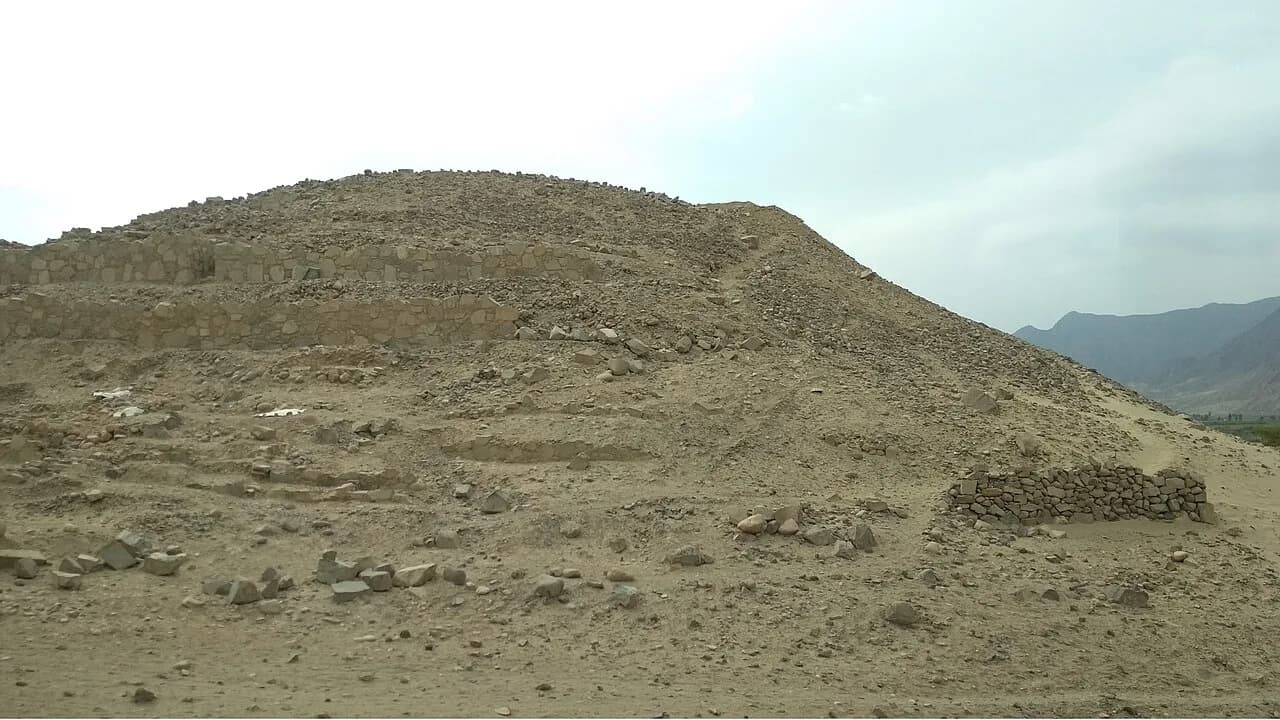
On a dry desert terrace above the Supe River in Peru stand six large pyramids. The people who built them had no pottery.
I keep coming back to how little we know about the people who ran the place.
The traditional view
UNESCO lists the Sacred City of Caral-Supe as a 626-hectare site that dates to the Late Archaic Period of the Central Andes. It calls Caral the oldest center of civilization in the Americas.
UNESCO says Caral is one of 18 urban settlements in the area. It describes six large pyramidal structures, platform mounds and sunken circular courts. It reports that radiocarbon analysis places the site between 3000 and 1800 BC.
Ruth Shady Solís, Jonathan Haas and Winifred Creamer published the first dates in Science in 2001. The abstract gives a range from 2627 to 1977 calibrated years BC for monumental architecture, urban settlement and irrigation agriculture at Caral.
Haas, Creamer and Alvaro Ruiz followed in Nature in 2004. They report 95 new radiocarbon dates from 13 large early sites in the Fortaleza and Pativilca valleys. The sites share large-scale monumental architecture, extensive residential architecture and a lack of ceramics.
UNESCO adds that a quipu found on the site testifies to the complexity of Caral society. A quipu is the knotted cord that Andean peoples used to record information.
The American Pyramids
In Earthly Enigmas I place Caral among the pyramids of the Americas. I date it to about 2600 BCE and I cite Ruth Shady Solís in Science. I describe a city on the Pacific coast of Peru with monumental architecture and no pottery, and I note that it was radiocarbon dated.
I call it the oldest known city in the Americas by that date. I set it beside Cholula and Cahokia and I ask whether the American pyramids came from independent invention, shared knowledge or something else.
What Has Not Been Settled
Both views lean on questions the evidence cannot yet answer. Three of them stand out.
How old is the oldest city in the Americas?
The Science paper gives 2627 to 1977 calibrated years BC for Caral. The Nature paper gives 3000 to 1800 calibrated calendar years BC for the wider cultural complex. UNESCO gives 3000 to 1800 BC for the site and calls the Supe Valley the earliest known manifestation of civilization in the Americas.
The Wikipedia article on the Caral-Supe civilization says the first city is generally dated to about 3500 BCE at Huaricanga in the Fortaleza area. It says this rests on Haas's dates. I have not checked that in the original.
Popular Archaeology reports that a team led by Peter Fuchs found a circular sunken plaza at Sechin Bajo in the Casma Valley. It says radiocarbon dating put the plaza between 3500 and 3000 BCE. I have not checked that in the original either.
My date of about 2600 BCE matches the start of the Science range. How old is the oldest city in the Americas?
Who ran Caral, and what kind of society was it?
UNESCO calls Caral a fully developed socio-political state. It reads a powerful religious ideology in the pyramids and the elite residences.
Haas and Creamer wrote in Current Anthropology that more than 30 large Late Archaic sites have been identified in the Norte Chico. They say differing theories have been offered to explain how complex polities emerged there. They propose a regional sphere of interaction with a dominant political nexus and with fishing communities taking part along the coast.
The BBC reports Shady's finding that about 3,000 people lived in Caral. It also says Caral had no defensive walls and that researchers have found no evidence of any weapons.
The sources describe a state, a regional sphere and a peaceful city. Who ran Caral, and what kind of society was it?
What brought Caral to an end?
UNESCO says Caral is remarkably intact largely because of its early abandonment and late discovery. The text I read does not give a reason for the abandonment.
The Guardian reports that Shady's team concluded a severe drought about 4,200 years ago forced the population to leave. It says the drought may have been part of a putative mega-drought known as 4.2ka. Some archaeologists believe that drought forced people out of cities in Mesopotamia and the Indus Valley.
Popular Archaeology reports that Sandweiss and colleagues found evidence of an earthquake about 1820 BC that destroyed much of Caral and Aspero. I have not checked that in the original.
The dates are worth setting side by side. A drought 4,200 years ago falls around 2200 BC. UNESCO gives the occupation as running to 1800 BC. The Guardian dates the new settlements at Vichama and Peñico to between 1800 and 1500 BC.
What brought Caral to an end?
The questions I can't put down
Some questions need more room than one article gives them. Two of them keep pulling me back.
Where did the pyramid idea come from? UNESCO says the platform mounds and sunken circular courts of Caral influenced nearby settlements and then a large part of the Peruvian coast. In the book I ask whether pyramids in the Americas reflect independent invention, shared knowledge or something else. I follow that question through Earthly Enigmas. The Nazca lines lie farther south on the same coast.
What message did they leave? Shady says the friezes in the settlements people moved to after Caral were left so that people would not forget a climate crisis. In the book I follow the idea of knowledge carried forward through ancient sites. You can read a free sample before you decide. The articles section has more subjects in the same format.
Sources
- UNESCO World Heritage Centre: Sacred City of Caral-Supe
- Shady Solis, Haas and Creamer, Science 292 (2001), abstract
- Haas, Creamer and Ruiz, Nature 432 (2004), abstract
- Haas and Creamer, Current Anthropology 47 (2006), abstract
- The Guardian: Archaeologists discover how oldest American civilisation survived a climate catastrophe (2025)
- BBC Travel: The newly discovered desert city that's rewriting the history of the Americas (2025)
- Popular Archaeology: The New World's First Monumental Civilization
- Popular Archaeology: Caral, America's Oldest City
- Wikipedia: Caral-Supe civilization (secondary, for the Huaricanga date only)