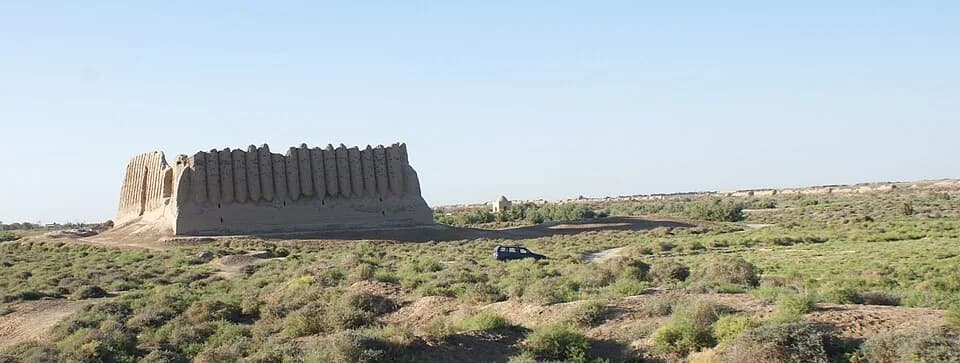
The walls of Erk Kala at Merv still stand about 30 meters high, according to UNESCO. Around them lie the walls of other cities built at other times.
UNESCO describes the historic center as a series of adjacent walled cities. They sit in an oasis in the Turkmenistan desert that a river fed for thousands of years.
The traditional view
UNESCO calls Ancient Merv the oldest and best-preserved of the oasis cities along the Silk Route in Central Asia. It says the remains span 4,000 years of human history.
The UCL Ancient Merv Project works with the Turkmenistan Ministry of Culture and the Ancient Merv State Park. It says Merv was founded around the 6th century BCE and became perhaps the third largest city in the world in the 10th century CE.
UNESCO says Merv became a capital of the Arabic Caliphate at the beginning of the 9th century. It became a capital of the Great Seljuks Empire in the 11th and 12th centuries.
The historic center holds Erk Kala, Gyaur Kala and the medieval Sultan Kala. Gyaur Kala holds a Buddhist stupa and monastery. Sultan Kala holds the Mausoleum of Sultan Sanjar, built in the 12th century.
UNESCO describes the sites as built at different times along the changing course of the Murgab river. New sites went up after old ones were abandoned and never occupied again. UNESCO calls them "memory keepers."
In 1221 the Mongols took the city. The Persian historian Juvaini wrote an account of it, and I quote him below.
What the Evidence Does Not Settle
In Earthly Enigmas I write that history books treat the ancient world as a series of isolated experiments.
The sources do describe contact. UNESCO says the oasis held an exceptional variety of cultures in continual interaction. Eurasianet reports that burials at Bronze Age Gonur, in the same oasis, held goods that indicate trade with cultures as far off as Egypt and the Indus Valley.
The City Nobody Can Count
The accounts of Merv lean on questions the evidence has not yet closed. Three of them stand out.
How many people lived in Merv, and how many died?
Juvaini writes that a sayyid named Izz-ad-Din Nassaba spent thirteen days and nights counting the slain inside the town. Juvaini says they counted only the bodies plain to see and arrived at "more than one million three hundred thousand." I read the Boyle translation in a scan of the book, so the wording may carry scan errors.
Ibn al-Athir gives a different figure. The Guardian quotes him as saying the dead were counted at around 700,000 corpses. Its author, Kanishk Tharoor, says Ibn al-Athir based his account on reports from refugees. I have not read Ibn al-Athir myself.
Tharoor writes that the death toll was almost certainly exaggerated. He also writes that some estimates make Merv the biggest city in the world around 1200, with more than half a million people. UCL gives its place in the 10th century as perhaps the third largest.
I found no population estimate built from the ruins. UCL lists the nature of Mongol Merv, meaning continuity, reuse and change, as a research objective that is still open.
How many people did Merv hold, and what do the ruins say about the number?
Which Merv is the old one?
UNESCO says Merv has supported urban centers since the 3rd millennium BC. It lists Bronze Age centers dated 2500 to 1200 BC inside the park, including Gonur.
The UCL project says Merv was founded around the 6th century BCE. Eurasianet reports that Viktor Sarianidi's team noticed ruins north of Merv, established in the 6th century BC, getting older the deeper they went into the Karakum. They followed the trail to Gonur, which Eurasianet dates to the late 3rd millennium BC.
Both statements come from mainstream institutions. One seems to count the oasis and the other seems to count the city. None of the pages I read says which count the name Merv should carry.
Is Merv one place with a very long history, or a series of cities that share a name?
What decided where the next city stood?
UNESCO says the sites follow the changing course of the Murgab river as it shifted from the east to the west. Eurasianet writes that civilization followed the river as it meandered south and west, abandoning Gonur and later Merv.
Tharoor adds another layer. He writes that under Muslim rule urban activity shifted west across the Razik canal from Gyaur Kala. He says many Gyaur Kala structures were probably used as material for the new city. He also writes that the Mongols destroyed the dam on the Murghab. I have not checked that last claim.
UCL says the timing is still under study. Its research objectives include the scale and date of occupation in the area later covered by Sultan Kala, and late occupation in Gyaur Kala.
What decided where the next Merv went, the river, the rulers or something else?
The questions I can't put down
Some questions need more room than one article gives them. Two of them keep pulling me back.
What were the white rooms for? Sarianidi, who excavated Gonur and other Bronze Age sites in Margiana, writes that vessels in their "white rooms" held remains of ephedra, cannabis and poppy. He reads them as places where a soma-haoma drink was made. He also writes that some scientists doubt what the vessels held, and he mentions negative test results from a laboratory in Helsinki. The editor of his paper, Jan Houben, says it was so far not possible to confirm his identifications in all details. In Chapter 5 I make the case for a global network that links ancient cultures. I follow that question through Earthly Enigmas.
What did the libraries hold? Tharoor reports that the geographer Yaqut al-Hamawi counted at least 10 significant libraries in Merv, one with 12,000 volumes, and left as the Mongols advanced. In Chapter 10 I follow what was lost, including a site buried on purpose, and the Göbekli Tepe article looks at that one. You can read a free sample before you decide. The articles section has more subjects in the same format.
Sources
- UNESCO World Heritage Centre: State Historical and Cultural Park "Ancient Merv"
- UCL Ancient Merv Project and its Our Research page
- Juvaini, The History of the World-Conqueror, vol. I, translated by J. A. Boyle (Internet Archive scan)
- Kanishk Tharoor, Lost cities #5: how the magnificent city of Merv was razed (The Guardian, 2016) (secondary; source for the Ibn al-Athir and Yaqut quotations)
- Eurasianet: Turkmenistan, Making a Bid for Cradle-of-Civilization Status (2007) (journalism)
- Viktor Sarianidi, Margiana and Soma-Haoma (EJVS 9-1c, 2003) (with editor's note by Jan Houben)