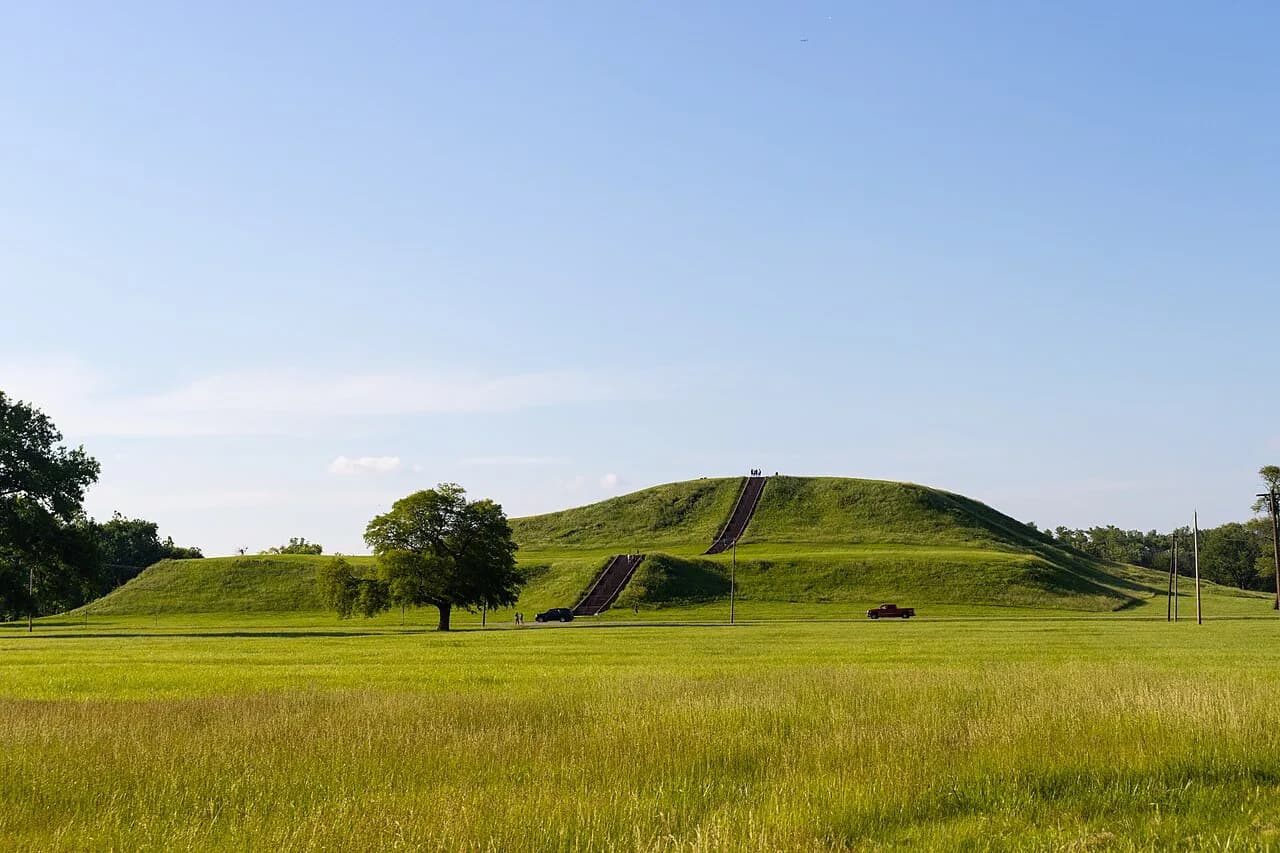
A hill of packed earth rises about 30 meters beside the Mississippi River in Illinois. Every basket of it was carried by hand.
Around it once stood a city of perhaps 10,000 to 20,000 people. Today most visitors find a quiet park and a grassy slope.
The traditional view
UNESCO lists Cahokia Mounds State Historic Site as the largest pre-Columbian settlement north of Mexico. It describes a Mississippian center occupied from about 800 to 1350 that held 10,000 to 20,000 people at its peak between 1050 and 1150. The city covered more than 1,600 hectares and included some 120 mounds.
Monks Mound stood at the center. UNESCO calls it the largest prehistoric earthen structure in the New World. It was built in fourteen stages, rises in four terraces and reaches a height of 30 meters.
The Cahokia Mounds State Historic Site measures it at 291 meters north to south and 236 meters east to west, using the 130 meter contour as the base. It adds that only excavation can show the true base. The site also says that Cahokia was larger than London in AD 1250.
The mound took its name from Trappist monks who gardened on its first terrace. They never lived on it.
UNESCO reads the layout as evidence of a powerful political and economic hierarchy that organized labor, farming and trade. It also notes an astronomical observatory the archaeologists call Woodhenge, a circle of wooden posts.
The American Pyramids
In Earthly Enigmas I describe Cahokia in the chapter on impossible structures. I write that between about 1000 and 1200 CE a city rose on the Mississippi floodplain. At its peak it held an estimated 10,000 to 20,000 people, more than London at the same period.
I give Monks Mound as a platform mound built in fourteen stages from about 22 million cubic feet of hand-carried earth. I give its base as about 291 by 236 meters and its height as 30 meters. I say the base is larger than the base of the Great Pyramid of Giza.
I stress how it was built. The builders had no metal tools, no wheeled transport and no draft animals. They carried baskets of earth.
I write that Cahokia was abandoned around 1350 CE and that the reason is not established. The Mississippian culture left no written record. The mound remains, and I note that most Americans have never heard of it.
I put Cahokia beside Teotihuacan, Cholula and Caral. I describe multiple civilizations across thousands of years and thousands of kilometers arriving independently at the same monumental form. I say they oriented it to astronomical phenomena and built it at scales that pushed the limits of the available technology. Several were abandoned under circumstances that remain unexplained.
I put the choice plainly. The pattern could reflect independent invention, shared knowledge or something else. I say the physical evidence alone cannot answer that question.
I also say there are serious scholars who believe the conventional models are adequate. I call that a legitimate position that should be heard.
What Has Not Been Explained
Both views lean on questions that the evidence has not settled. Three of them stand out.
How fast was it built?
The Archaeological Conservancy summarizes two published answers. Research in the 1960s determined that the mound was built in fourteen stages and may have taken as long as 250 years.
A later study sampled soil from a slope that had collapsed in 2005. Its authors found that the borrow pits would not have lain undisturbed for long. Dr. Timothy Schilling is quoted as saying "Construction must have been relatively continuous without long interruptions." He is also quoted as saying "In my opinion, 20 years is a good number."
The same summary says the team cautions that its data give no absolute ages. It adds that blocks of sod went into part of the mound, along with the basket loads of earth. I have not read the original paper in the Midcontinental Journal of Archaeology.
Was it twenty years or 250?
Where did the people come from?
Slater, Hedman and Emerson describe the years before 1050 as a time of low population densities and dispersed communities. By 1050, they write, social life, political organization and religious beliefs were radically transformed. They note that the abrupt emergence of Cahokia has been called "The Big Bang."
Their paper adds that the estimated population cannot be accounted for by birth rates alone and requires an influx of new people. Strontium isotope tests on tooth enamel found that one third of the people analyzed were non-local, with multiple places of origin.
The same authors write that how these interactions affected Cahokia's growth "is not known." In the book I write that a city rose on the floodplain. I say nothing there about where its people came from.
Who were they, and why did they gather here so quickly?
Why did they leave?
A 2015 paper in the Proceedings of the National Academy of Sciences says the causes of Cahokia's decline and abandonment "remain unclear." It lists drought, overuse of resources, intergroup conflict and political upheaval as proposed causes.
The authors add flooding. Lake sediment cores point to a large flood around AD 1200, the first in more than 500 years. They write that by AD 1350 the political system centered on Cahokia had completely dissolved.
The lead author, Samuel Munoz, says "We are not arguing against the role of drought in Cahokia's decline." The University of Wisconsin-Madison account of the study also notes that archaeologists have found little direct evidence of flooding at Cahokia itself.
A wall also circled the center of the city. The Cahokia Mounds site says the two-mile stockade went up around AD 1100 and was rebuilt three times over 200 years. It says some portions were built in a hurry.
Slater and colleagues describe the site as virtually abandoned by the early 14th century. The Wisconsin account says it was deserted by 1400. In the book I give 1350 and say the reason is not established.
What finally emptied the city?
The questions I can't put down
Some questions need more room than one article gives them. Two of them keep pulling me back.
What was Woodhenge for? The Cahokia Mounds site says the archaeologists found as many as five circles of posts, built over about 200 years. Three posts mark the solstices and the equinoxes. The post for the equinox sunrise lines up with the front of Monks Mound. The site also says that ideas of stars, the moon and eclipses have not been proven convincingly. In the book I describe the American pyramids as oriented to astronomical phenomena. I follow the question through Earthly Enigmas.
Did the pyramid builders of the Americas share knowledge or invent it alone? The Cahokia Mounds site says the grave goods in Mound 72 show links to areas as far away as Oklahoma, Tennessee and Wisconsin. Teotihuacan and Caral lie far beyond that range. In the book I leave the question open and say the physical evidence insists on asking it. You can read a free sample before you decide. The Teotihuacan article and the Caral article take up the same pattern. The articles section has more subjects in the same format.
Sources
- UNESCO World Heritage Centre: Cahokia Mounds State Historic Site
- Cahokia Mounds State Historic Site: Mound 38, Monks Mound
- Cahokia Mounds State Historic Site: Explore (stockade, Woodhenge)
- Cahokia Mounds State Historic Site: Mound 72
- The Archaeological Conservancy: Cahokia's Monks Mound May Have Been Built in Only 20 Years (summary of a study in the Midcontinental Journal of Archaeology)
- Slater, Hedman and Emerson, Journal of Archaeological Science (2014): Immigrants at the Mississippian polity of Cahokia (abstract and introduction read)
- Munoz and others, PNAS (2015): Cahokia's emergence and decline coincided with shifts of flood frequency on the Mississippi River (abstract and excerpts read)
- University of Wisconsin-Madison: As the river rises