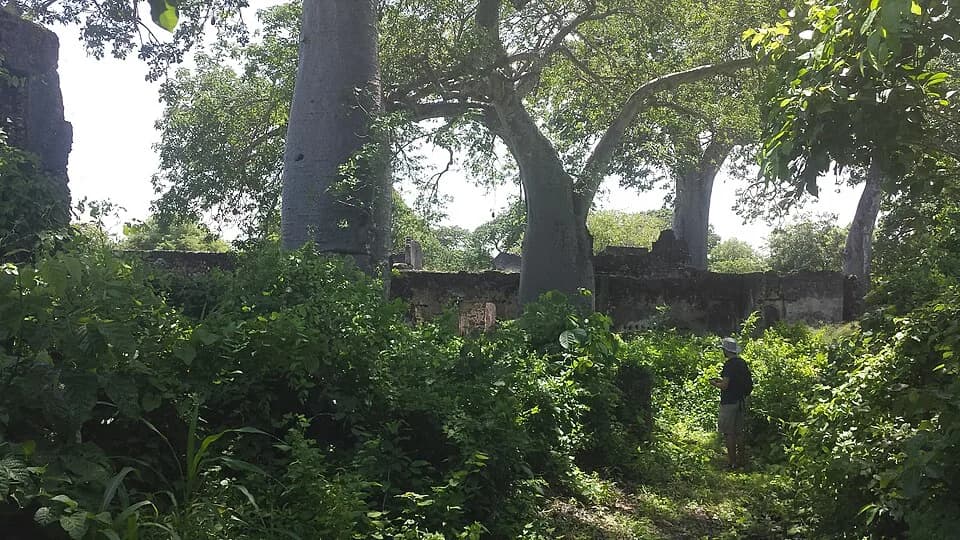
Songo Mnara lies on a small island in the Kilwa archipelago off southern Tanzania. A town wall once enclosed dozens of coral stone houses and a cemetery at the center.
The archaeologists count six mosques in a town of about seven hectares. One of them stood on a tidal islet and gave the place its name.
Horton, Fleisher and Wynne-Jones write that no inscriptions have been found at the mosques or anywhere else on the site.
The traditional view
UNESCO lists Songo Mnara together with Kilwa Kisiwani. It says the ruins at the northern end of the island consist of "the remains of five mosques, a palace complex, and some thirty-three domestic dwellings."
UNESCO says the prosperity of both towns "was based on control of Indian Ocean trade with Arabia, India and China." It adds that "In the 16th century, the Portuguese established a fort on Kilwa Kisiwani and the decline of the two islands began."
The University of York project page describes a site "dominated by the well-preserved remains of more than 40 large domestic room-blocks, five mosques, and numerous tombs." It calls the "relatively short, 150-year occupation" an advantage, because it lets the team study household and public spaces from one period.
Mark Horton, Jeffrey Fleisher and Stephanie Wynne-Jones give their own count in a 2017 paper. They write that the town holds six mosques, around 48 houses and a population of 500 to 1,000 people. They place the occupation "beginning in the late 14th and ending in the early 16th century."
The same paper describes a central open area with as many as 1,000 burials. Many are marked by masonry tombs or by head and foot stones. On one grave the excavators found over 5,000 quartz pebbles, which they read as memorial acts left one by one.
Fleisher and Sulas, in a 2015 paper, write that the settlement was "Built rapidly in the late 14th or early 15th century" and "occupied for approximately 150 years." They say it was once thought to be a retreat for elites from Kilwa, and that recent research suggests it was "a fully functioning town."
Rødland and colleagues add in a 2020 paper that the wattle and daub houses "contained comparable quantities of imported goods, coins and general material wealth to the stone houses."
Archaeology magazine quotes Fleisher calling the Swahili case "a textbook example of a colonial archaeology." That older reading treated the coast's stone towns as foreign colonies. The Kilwa article covers that debate.
UNESCO warns that the property is "subject to invasion by vegetation and inundation by the sea."
A Town Laid Out in Advance
In Earthly Enigmas I write that history books treat the ancient world as a series of isolated experiments. I place the Indus Valley planned cities inside that argument in Chapter 5.
Songo Mnara was also planned. Archaeology magazine says the town "was built quickly, with an urban plan," unlike Kilwa, "an older town that grew organically." Horton and colleagues write that the plan created a series of open spaces, with the cemetery at the center.
What the Ground Cannot Say
The accepted account is detailed, and its authors say plainly where it runs out. Three questions stand out.
Why was a new town built beside Kilwa?
Archaeology magazine writes that "It is not known why people from Kilwa Kisiwani established Songo Mnara in the fourteenth century." Horton and colleagues call the town's relationship with the Kilwa polity "somewhat of a mystery."
They offer one suggestion and mark it as a possibility. Perhaps it was built "by a community of merchants that deliberately left Kilwa during a period of documented internal disputes in the late 14th century."
Written records do not settle it. Horton and colleagues report that Portuguese writers described Kilwa well but Songo Mnara in no detail. They cite a single 17th-century reference, relayed by personal communication, to a secret meeting held at the palace.
Oral history leaves the question open too. The project collected traditions about specific buildings and tombs. The paper says more general understandings of the site's history are "inextricably tangled with the Kilwa historical narrative."
Why did people build a second town eleven kilometers from Kilwa, and who decided to?
What emptied the town?
Horton and colleagues note the Portuguese arrival in 1500 and the stone fort at Kilwa in 1505. They write that these "may have precipitated the decline of the stonetowns in the archipelago and the abandonment of Songo Mnara." They add that "there is no historical evidence to suggest that the Portuguese reached Songo Mnara."
They point to a burned mosque. The Town Wall Mosque ended in a large fire and its stone was reused in the town wall, most likely in the early 16th century. They write that the burning "may date to the sacking of Kilwa in 1505." They present this as a possibility.
Englong and colleagues offer a different line in a 2024 paper. Their sediment cores show "evidence suggesting human abandonment of the island from around 1500 CE." They link it to rising seas and "potentially prolonged drought conditions spanning from 1570 to 1700 CE." I have read only the abstract.
Architectural evidence, cited to Garlake, suggested that the houses were reoccupied and rebuilt in the 17th or 18th century. Horton and colleagues write that archaeological support for this "has been elusive." They say the town was fully abandoned and overgrown when Lieutenant Prior visited in 1811.
What emptied Songo Mnara, and how fast did it happen?
Why six mosques?
Horton and colleagues call six mosques "an unusual quantity for a town of only 7 hectares and a population of 500-1000 people." UNESCO and the York page say five. I have not found which building the count of five leaves out.
The authors give several readings, each attributed to them. They read the Necropolis and Mnara mosques as beacons that told visitors arriving by sea the town was Islamic. The Mnara Mosque held only about 16 worshippers. The authors call it "curious to build such a major undertaking" for so few.
They also note that the Northeast Mosque stands beside one of the largest houses. Private sponsorship of it could be "a source of local power and authority." They suggest the Town Wall Mosque may have served women, with a small room for the imam and a larger room behind it.
Archaeology magazine adds two other possibilities. The same unusual layout "may also represent a madrassa," and Horton suspects the number of mosques and graveyards "could indicate that it even became a pilgrimage site." The magazine calls the interpretation preliminary.
The tower that gives the town its name adds a further puzzle. Early visitors and scholars called it a pagoda, a watchtower and a tower kiosk. Burton, in 1859, identified it as a mosque. Horton and colleagues note a rubble mound near the Necropolis Mosque that could be a collapsed minaret. They find it "tempting" to link that mound to a tower reported fallen in 1784.
Why did a town of this size build six mosques, and what was each one for?
The questions I can't put down
Some questions need more room than one article gives them. Two of them keep pulling me back.
Why do the mosques point in different directions? Horton and colleagues list qibla bearings that range from 340 to 20 degrees. They write that the Northeast Mosque was "20 degrees off." They note that the Mnara Mosque was rebuilt on a new bearing of 0 degrees, and that the true direction of Mecca from the site is 0.56 degrees. They suggest the mosques were set out by "folk astronomical methods." In Chapter 5 of the book I write that the scholarly debate focuses on whether alignments were intentional or coincidental. I follow that question through Earthly Enigmas.
What was buried under the floors? Archaeology magazine reports foundation deposits in some houses, "such as coin caches and strings of carnelian beads." Horton and colleagues describe valuables buried in pits and, in the Central Mosque, a mihrab that looks "deliberately taken down" when the mosque was abandoned. The book follows a different buried question, the burial of Göbekli Tepe, and I draw no comparison. The Göbekli Tepe article looks at that site. You can read a free sample of the book before you decide. The articles section has more subjects in the same format, including the neighboring Swahili town of Gedi and the stone city of Great Zimbabwe.
Sources
- UNESCO World Heritage Centre: Ruins of Kilwa Kisiwani and Ruins of Songo Mnara
- University of York, Department of Archaeology: Songo Mnara project page
- Horton, Fleisher and Wynne-Jones, The Mosques of Songo Mnara in their Urban Landscape (Journal of Islamic Archaeology, 2017) (read from the accepted manuscript)
- Fleisher and Sulas, Deciphering public spaces in urban contexts (Journal of Archaeological Science, 2015) (read from a repository copy)
- Rødland, Wynne-Jones, Wood and Fleisher, No such thing as invisible people (Azania, 2020) (open access)
- Englong and colleagues, Unveiling 4500 years of environmental dynamics and human activity at Songo Mnara, Tanzania (Quaternary Science Advances, 2024) (abstract only)
- Archaeology magazine, Stone Towns of the Swahili Coast (January/February 2014) (secondary journalism)