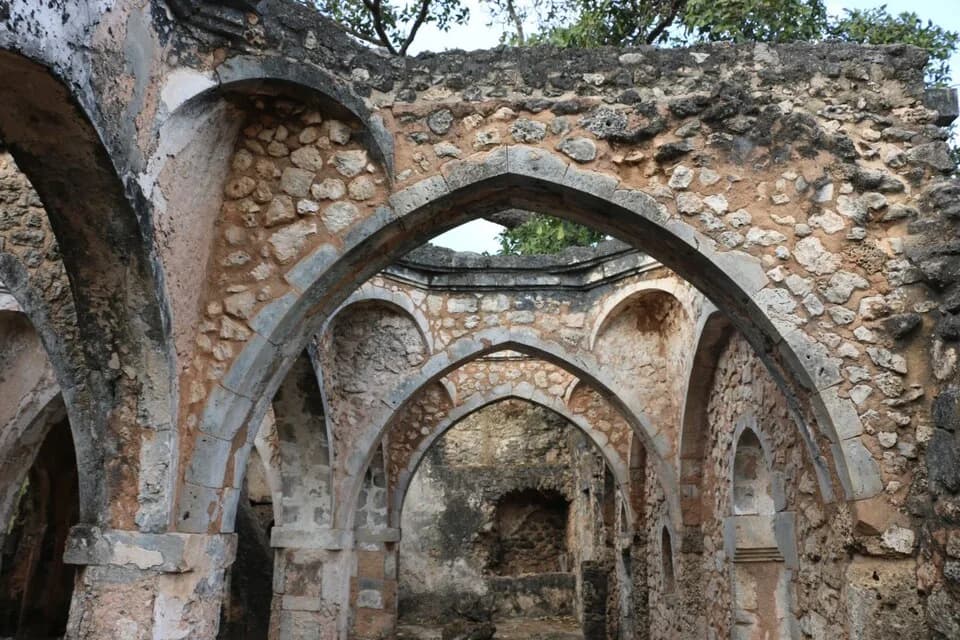
The Great Mosque of Kilwa stands on Kilwa Kisiwani, a small island off the coast of Tanzania. Its roof is a run of domes and vaults built from coral stone and lime mortar.
UNESCO calls it the oldest standing mosque on the East African coast. Excavators have found traces of an earlier building under its floor.
The traditional view
UNESCO lists the Ruins of Kilwa Kisiwani and Songo Mnara together. It says Kilwa Kisiwani "was occupied from the 9th to the 19th century." It describes the Great Mosque as "constructed in the 11th century and considerably enlarged in the 13th century, and roofed entirely with domes and vaults, some decorated with embedded Chinese porcelain."
UNESCO adds that the mosque has "sixteen domed and vaulted bays" and a "unique plan." It says the island's merchants traded gold and ivory from the interior for silver, perfumes, Persian faience and Chinese porcelain.
Neville Chittick excavated at Kilwa until 1965. Horton and colleagues say his work produced a chronology by which urban development on the Swahili coast "has been measured ever since." They add that it "rested primarily on imported ceramics."
Wynne-Jones and Fleisher write that Chittick's excavations at the Great Mosque "served to detail several phases of construction and destruction." They list "an early prayer hall of the 11th century and a large domed extension during the 14th century."
Chittick wrote in the 1977 Cambridge History of Africa that the extension more than doubled the mosque's area. He gave its size in the 14th century as about forty by twenty meters. He said it was about a third of that before the enlargement.
In 2016 Horton, Olsen, Fleisher and Wynne-Jones dug a trench beside one of Chittick's. They report twenty-one radiocarbon dates. They write that the sequence places "the first coral buildings and coins at the end of the tenth century."
The mosque is also a place of prayer today. Mercy Mbogelah, one of the guides interviewed for the CyArk virtual tour, says community members still use it. Revocatus Weja Bugumba says repairs between 2002 and 2004 added carving to the domes and thickened the arches against seeping water.
What the Stones Leave Open
In Earthly Enigmas I write that history books treat the ancient world as a series of isolated experiments.
UNESCO says that from the 13th to the 16th century "much of the trade in the Indian Ocean thus passed through their hands," meaning the merchants of Kilwa. Kilwa sat inside a documented network.
Where the Accounts Part
The accepted account has gaps of its own. Three of them stand out.
When was each part built?
UNESCO puts the first mosque in the 11th century and the enlargement in the 13th. It dates the great dome to the 13th century and says it was the largest in East Africa until the 19th. UNESCO dates the palace of Husuni Kubwa to between about 1310 and 1333.
Chittick wrote that the early fourteenth century brought "a new architectural style" with vaults and domes. He gave "a large extension to the Great Mosque (more than doubling its area)" as the example. Wynne-Jones and Fleisher also place the domed extension in the 14th century. I have not found where UNESCO's 13th century date comes from.
Other readings give other dates. The teaching site Art and Architecture of the Middle Ages gives "1130-70 and 1310-33." CyArk's tour text says the original mosque was built in the 9th to 11th century. It says the extension came in the 13th to 14th.
Horton and colleagues move the beginning earlier. They write that the lime kilns Chittick linked to building the mosque "can now be seen to pre-date that structure." They add that "the earliest mosque structure at the site seems also to have been built in the late tenth century and to have been demolished at this moment, burnt to the ground, its stone burnt for lime."
Their trench lay beside Chittick's trench ZLL, which sits 27 meters south of the mosque. They link it to the mosque through two coins of Ali bin al-Hasan that Chittick found in the packing of the first floor. They ask in print how to interpret the destruction. They offer a local reading and a wider one tied to upheaval around the Indian Ocean.
When was the first prayer hall built, and what burned it?
What did Ibn Battuta see?
UNESCO writes that Ibn Battuta stopped at Kilwa in 1331 and 1332 and described it as one of the most beautiful cities of the world. In H. A. R. Gibb's English translation the line reads differently. It says "The city of Kulwa is one of the finest and most substantially built towns; all the buildings are of wood."
Chittick reads that as a memory of a town of wood and thatch. He writes that most of Kilwa was still built of mud and wattle in the early fourteenth century. Gibb calls a proposed alternative reading of the Arabic "more than dubious."
Ibn Battuta names the mosque only in passing. He says the sultan came out of it after Friday prayer and went back into it to change his robes. He describes no dome.
The Kilwa Chronicle tells a later story. A website that reproduces Freeman-Grenville's translation gives the Arabic History as saying "During the reign of al-Hasan ibn Sulaiman the Friday Mosque collapsed." It says "the people prayed under shelters and tents" until a later sultan. I have not checked that wording against Freeman-Grenville's book.
Horton and colleagues sum up Chittick the same way. The mosque was "in ruins" from the middle of the fourteenth century and was rebuilt around 1400. Wynne-Jones and Fleisher add that "it is possible that Ibn Battuta did not actually travel to East Africa." They cite Fauvelle-Aymar and Hirsch. I have not read that paper.
What did Ibn Battuta see when he prayed here, if he did?
Who first prayed here?
Horton and colleagues report an Ibadi community at Kilwa in the early twelfth and early thirteenth centuries. They cite a poem of about 1200 about a mission "to reconvert Kilwa to Ibadism." They also quote Ibn al-Mujawir, who wrote around 1232 that Kilwa "reverted from the Shafiiyya to the Kharijiyya."
Ibn Battuta calls the people of Kilwa "Shafi'ites in rite." Horton and colleagues note "considerable dispute between different religious factions that we might expect to be reflected" in the Chronicle and in the archaeology.
Wynne-Jones and Fleisher summarize Horton's argument about mosque design. Ibadi mosques had "shallow mihrabs," and an example stands at Sanje ya Kati near Kilwa. A more elaborate mihrab style might point to Shi'a communities. By the 14th century most coastal communities were Sunni and Shafi'i. I have not checked what kind of mihrab the Great Mosque's first hall had.
The older account differs. Horton and colleagues write that Chittick's interpretations "were guided by his belief that the Swahili people and settlements were the result of colonisation by Persian and Arab settlers." They write that the Shirazi story is figurative and that "it is unlikely that these rulers actually travelled from Shiraz."
Which community built the first prayer hall, and who prayed in the extension?
The questions I can't put down
Some questions need more room than one article gives them. Two of them keep pulling me back.
Where did the gold come from? UNESCO says the island traded "gold and ivory from the hinterland." Horton and colleagues report Chittick's view that Kilwa held a "virtual monopoly of the gold trade" with southern Africa. Ibn Battuta says a merchant told him that gold dust reached Sufala from a place called Yufi. Gibb's footnote calls that "probably due to some misunderstanding on Ibn Battuta's part." In the book I follow a different question about gold and stone ruins in southern Africa in Chapter 7. The Great Zimbabwe article looks at a stone city inland. I follow my question through Earthly Enigmas.
How were the ablution stones moved? Masoudi Issa Abeid, another voice on the CyArk tour, describes the ablution area. He says it has "stones there that can weigh up to five tons, even four tons." He adds that "those stones are found in mainland areas." He says the coral on the coast is soft and can be cut with a saw. I have not checked those weights or where the stones came from. In the book I write that the moving of the Carnac stones has no fully confirmed account. You can read a free sample before you decide. The articles section has more subjects in the same format, including the neighboring Swahili town of Gedi.
Sources
- UNESCO World Heritage Centre: Ruins of Kilwa Kisiwani and Ruins of Songo Mnara
- Tanzania Wildlife Management Authority: Ruins of Kilwa and Songo Mnara
- Horton, Olsen, Fleisher and Wynne-Jones, The Chronology of Kilwa Kisiwani, AD 800-1500 (African Archaeological Review, 2022) (read from the accepted manuscript)
- Wynne-Jones and Fleisher, The Eastern African Coast (Oxford Handbook of Islamic Archaeology, 2021)
- H. A. R. Gibb (trans.), The Travels of Ibn Battuta, vol. II (Hakluyt Society, 1962)
- H. N. Chittick, The East Coast, Madagascar and the Indian Ocean, in The Cambridge History of Africa, vol. 3 (1977) (read from a third-party text copy)
- CyArk: The Great Mosque of Kilwa Kisiwani, tour transcripts (an English rendering of Kiswahili narration)
- Art and Architecture of the Middle Ages: Great Mosque of Kilwa (secondary, dates only)
- pieterderideaux.jimdofree.com: Kilwa Chronicle (secondary compilation of the Chronicle wording)
- Wikipedia: Great Mosque of Kilwa (used only to locate sources)