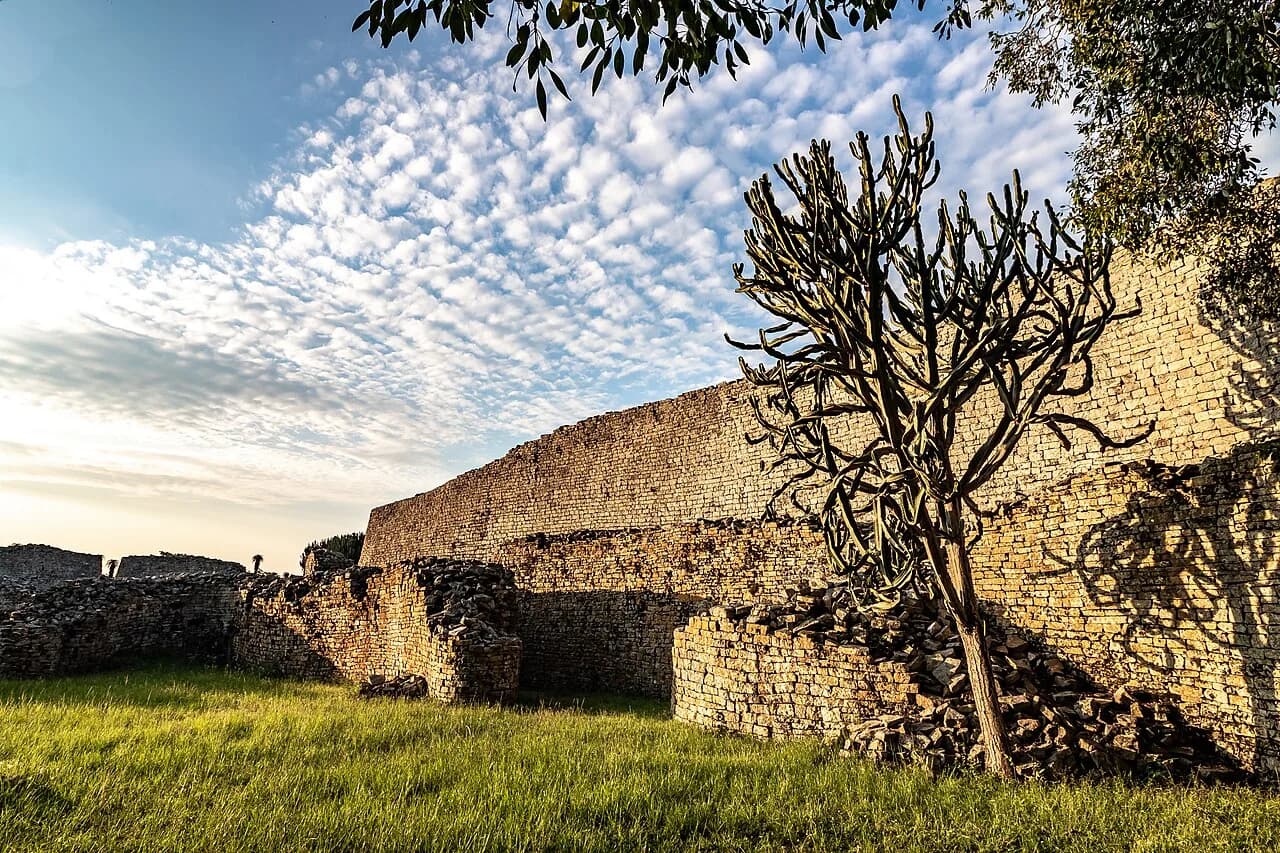
The outer wall of the Great Enclosure at Great Zimbabwe runs about 250 meters around an oval. The National Museums and Monuments of Zimbabwe says it was built without any binding material.
Inside the wall stands a conical tower about 10 meters high. Writers have offered explanations that range from a symbolic grain bin to a phallic symbol.
The traditional view
UNESCO describes the ruins as a unique testimony to the Bantu civilization of the Shona between the 11th and 15th centuries. It says the property was built between 1100 and 1450 and extends over almost 800 hectares in three groups. They are the Hill Ruins, the Great Enclosure and the Valley Ruins.
The National Museums and Monuments of Zimbabwe calls it Southern Africa's largest pre-colonial settlement. It says the city flourished between 1290 and 1450 and is the largest of more than 300 Zimbabwe-type sites. The Shona word Zimbabwe means a house of stone.
UNESCO says that in the 14th century the city was the principal city of a major state extending over the gold-rich plateaus and that its population exceeded 10,000. Excavations found glass beads and porcelain from China and Persia and gold and Arab coins from Kilwa. UNESCO reads these as evidence of long-standing trade with the outer world.
The same entry notes the legends that long attached the ruins to the Queen of Sheba. Shadreck Chirikure writes for the British Academy that the explorer Karl Mauch set in motion a view. In that view the city was too advanced for Africans to have built it.
Randall-MacIver and then Gertrude Caton-Thompson led excavations that Chirikure says concluded the city was locally built. A Guardian feature says that remains the consensus today. UNESCO calls the edifice unquestionably of Bantu origin and says the site is still used by contemporary communities for spiritual reasons.
Gold and the Stone Ruins
In Earthly Enigmas I write about gold in Chapter 7. I describe stone ruins across about 1,500 square kilometers near Mpumalanga in South Africa, documented by Michael Tellinger. I write that they have no official age assignment, and I read them as fitting Anunnaki mining.
Tellinger names it on his own website. He writes that a stone circle he calls Adam's Calendar is aligned to the north with Great Zimbabwe and the Great Pyramid of Giza. He puts them along the 31 degrees East longitude. He also writes that a Sumerian text mentions sites that can be equated with Great Zimbabwe. I have not checked either claim.
Archaeologists read the Mpumalanga ruins differently. Peter Delius, Tim Maggs and Alex Schoeman describe them as the stone-walled settlements of the Bokoni. In a published extract they write that excavations have yielded clearly African material culture such as ceramics and the remains of dakha houses. They also report the link Tellinger and Johan Heine draw with Great Zimbabwe and say it rests on a shared longitudinal line. I have seen only that extract.
Where the Accounts Part Ways
The accepted account has a settled core and a wide margin. Three questions sit in the margin.
What were the walls for, and who stood inside them?
UNESCO calls the Hill generally considered a royal city. It says the west enclosure is thought to have housed successive chiefs and that the east enclosure, where steatite posts topped with birds were found, is considered ritual.
The Antiquity editor's summary of Chirikure and Pikirayi says they challenge the structuralist reading in which parts of the site went to kings, priests, wives or circumcision rituals. They present the enclosures as the work of successive rulers, each founding a new residence and power center.
Thomas Huffman's abstract argues that a Mapungubwe dynasty introduced class structures at Great Zimbabwe. It says the new elite used the Zimbabwe birdstones to establish their legitimacy.
David Beach wrote in Current Anthropology that Huffman's reconstruction relies on dubious oral traditions and pictures a city essentially static in its use of space for two centuries. He offers a Shona dynastic model and says it is one of several possible models.
Chirikure and colleagues conclude that the categories of elite and commoner were situational and transient. The Guardian lists readings of the walls that include defense, a show of authority and privacy for royal families. It reports an estimate of 18,000 people at the peak and only 200 to 300 elite inside the buildings. I have not checked those figures.
What were the walls for, and who stood inside them?
When did it begin, and when and why did it end?
UNESCO gives 1100 to 1450 and says the capital was abandoned about 1450 because the hinterland could no longer feed an overpopulated city and because of deforestation. The museums authority gives 1290 to 1450.
The Bayesian chronology by Chirikure, Pollard, Manyanga and Bandama says the stone walls probably began at the end of the twelfth or beginning of the thirteenth century. It says occupation continued to at least the sixteenth and probably into the seventeenth century.
Innocent Pikirayi's abstract on the demise of the city says the decline is poorly known because of limited archaeological data and vague historical sources. It says environmental data show Great Zimbabwe declined when climatic conditions were favorable.
The Guardian says the most common explanation for the abandonment is a shortage of food, pastures and resources, but that the precise cause remains unclear.
When did it begin, and when and why did it end?
What did the missing layers hold?
The Antiquity editor's summary of Chirikure and Pikirayi quotes Peter Garlake on the early investigators. He calls them the men who removed all the most important finds from the ruins and stripped them of so much of their deposits.
The Bayesian chronology abstract says early excavators destroyed key categories of evidence. Vieri and colleagues write that finished gold objects and the infrastructure for processing gold were often destroyed without record.
The Guardian reports that Richard Nicklin Hall became curator in 1902. It says layers of deposit up to four meters deep were lost while he searched for signs of non-African builders. I have not checked that in Hall's own text or in an archaeological source.
The dates, sequences and uses described above were reconstructed from a limited set of radiocarbon dates, imported goods and the stratigraphy that survived.
What did the missing layers hold?
The questions I can't put down
Some questions need more room than one article gives them. Two of them keep pulling me back.
Who mined the gold, and where did it go? UNESCO describes a state over gold-rich plateaus. Vieri and colleagues recovered fragments of more than a hundred gold-processing vessels and argue that local agency in gold was far greater than generally assumed. They also report that most finished gold objects were sold by prospectors linked to the Ancient Ruins Company and by private fortune seekers. The Guardian says more than 4,000 gold mines were found around the site and gives an estimate of 600 tonnes. I have not checked those figures. In the book I follow the question of gold through the Sumerian record in Chapter 7. You can find it in Earthly Enigmas.
How far can oral tradition carry the reading of a wall? Beach doubts the oral traditions in one reconstruction. Chirikure and colleagues build their reading on Shona philosophy, practice and ethnography. In Chapter 11 I write that oral tradition is routinely underestimated by modern scholarship. You can read a free sample before you decide. The articles section has more subjects in the same format.
Sources
- UNESCO World Heritage Centre: Great Zimbabwe National Monument
- National Museums and Monuments of Zimbabwe: Southern Region, Masvingo
- Chirikure, Reclaiming Great Zimbabwe's past to learn lessons for the future (British Academy, 2020)
- Chirikure, Pollard, Manyanga and Bandama, A Bayesian chronology for Great Zimbabwe (Antiquity 87, 2013) (abstract only)
- Chirikure and Pikirayi, Inside and outside the dry stone walls (Antiquity 82, 2008) (editor's summary only)
- Huffman, Mapungubwe and Great Zimbabwe (Journal of Anthropological Archaeology 28, 2009) (abstract only)
- Beach, Cognitive archaeology and imaginary history at Great Zimbabwe (Current Anthropology 39, 1998) (abstract only)
- Chirikure and colleagues, Elites and commoners at Great Zimbabwe (Antiquity 92, 2018) (abstract only)
- Pikirayi, The demise of Great Zimbabwe, AD 1420-1550: an environmental re-appraisal (2006) (abstract only)
- Vieri, Chirikure, Lane and Martinon-Torres, Gold in Great Zimbabwe (Archaeological and Anthropological Sciences 15, 2023)
- Delius, Maggs and Schoeman, extract from Forgotten World (Heritage Portal) (search excerpt only)
- Michael Tellinger, Adam's Calendar
- The Guardian, Lost cities #9: racism and ruins, the plundering of Great Zimbabwe (2016) (secondary journalism)