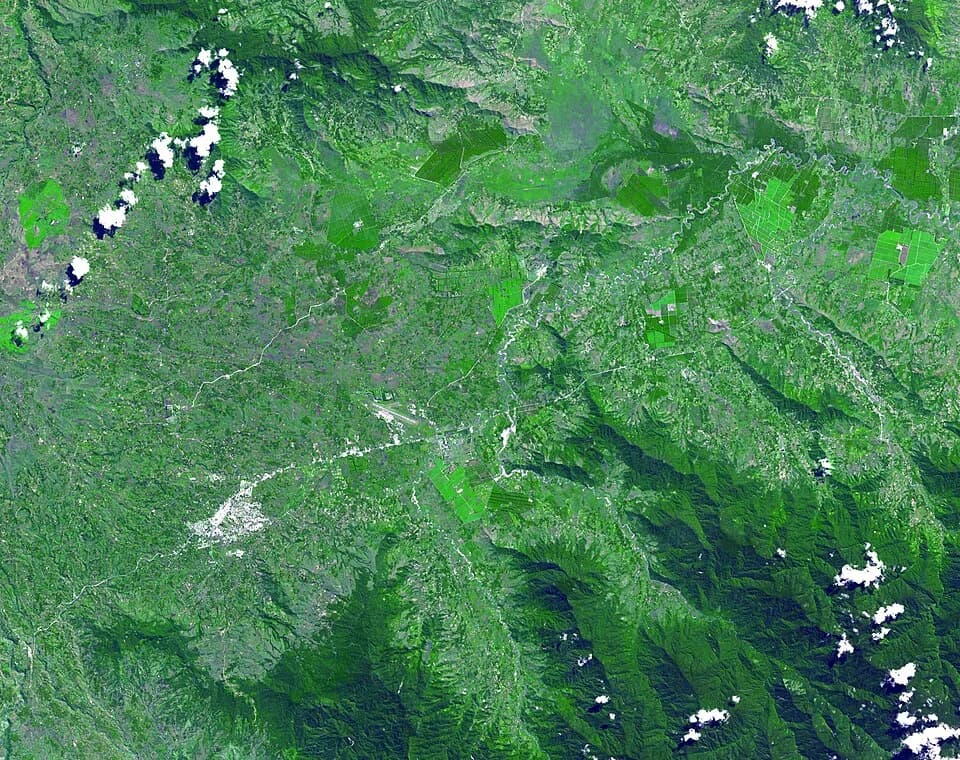
Kuk has no ruins. UNESCO describes 116 hectares of swamp in the western highlands of New Guinea, about 1,500 meters above sea level.
The oldest traces are pits, runnels and stake holes cut into black clay and sealed under grey clay. They are about 10,000 years old. The people who excavated them agree that the plot was used for plants. They do not agree on whether it was a farm.
The traditional view
UNESCO added the Kuk Early Agricultural Site to the World Heritage List in 2008. Its description says excavation shows wetland reclamation worked almost continuously for 7,000 and possibly 10,000 years. It dates the leap from plant exploitation to agriculture to around 6,500 years ago. It calls Kuk one of the few places where the evidence suggests independent agricultural development.
Jack Golson was responsible for the archaeology in the main fieldwork of 1972 to 1977, according to the ANU Press volume on the site. Tim Denham returned in 1998 and 1999. He reported the results with colleagues in Science in 2003.
They divided the remains into phases. Plant use and some cultivation on the wetland margin date to 10,220 to 9910 calibrated years before the present. Mound cultivation began by 6950 to 6440 and ditched cultivation by 4350 to 3980. They concluded that agriculture arose independently in New Guinea by at least 6950 to 6440.
They also wrote that New Guinea was a primary center of agricultural development before any known Southeast Asian influence. The Kuk volume says the early dates suggested an antiquity comparable to the Fertile Crescent. It adds that the conventional wisdom had been that New Guinea received its agriculture from Southeast Asia.
Starch from taro was found on the worked edges of three stone tools. The volume reports that a stone pestle from the base of the Phase 1 channel was used to prepare a yam.
The volume names the Kawelka as the traditional owners of the land. It says the site management plan has the government recognize them as such and grant them use rights.
Beginnings
In Earthly Enigmas I take positions on the questions the swamp raises, so I set them out here.
In Chapter 2 I describe the conventional model as farming first, then surplus, then social organization, then monuments. I write that Göbekli Tepe is a temple complex that came before agriculture.
In Chapter 5 I write that history books treat the ancient world as a series of isolated experiments. I name independent invention as the mainstream alternative. I say it has credentialed defenders and a limit. I read the shared geometry across continents as a sign of inheritance.
What Nobody Has Settled
Both views lean on questions the evidence cannot yet answer. Three of them stand out.
Was the oldest plot a farm?
The editors of the Kuk volume call chapter 11 "The Case for 10,000-Year-Old Agriculture at Kuk." In that chapter they write that the authors differ about the interpretation of the Phase 1 evidence.
Philip Hughes and Jack Golson read the channel beside the plot as dug by people to drain the wetland margin for cultivation. Denham reads the channel as natural and the plot as some form of plant exploitation. All three agree that the evidence shows prehistoric plant exploitation.
A 2004 paper by Denham concluded that the evidence was insufficient to claim the channel was artificial. It added that this did not negate a long-term trajectory toward agriculture in the highlands from the early Holocene.
The 2003 paper by Denham and colleagues says more substantial evidence for deliberate planting "is not unequivocally demonstrable until the mid-Holocene." In 2026 Denham writes in Frontiers in Environmental Archaeology that the significance of the surface "is debated." He sets out three readings. People may have cleared a resource-rich patch in the forest, tended a shifting cultivation plot or practiced "an alternative type of plant exploitation." He calls the evidence ambiguous and says it plausibly represents early shifting cultivation.
The dates differ in quality. Six radiocarbon dates from the channel fills combine to 10,200 to 9,910 years before the present. Dates from the plot's own features are, in Denham's word, "more variable."
What would show that a plot 10,000 years old was planted as well as cleared?
What happened in the 3,000 years nobody dug up?
UNESCO describes wetland reclamation "worked almost continuously for 7,000, and possibly for 10,000 years." Its Outstanding Universal Value text calls the land use "remarkably persistent but episodic."
The Kuk volume says there is no archaeological evidence for continued use of the wetland margin for the 3,000 years after Phase 1. It says clearly intensive cultivation appears only with the mounds 7,000 to 6,500 years ago. UNESCO notes that excavations have touched only a minor proportion of the core area.
The same chapter says the palaeoecological signals show forest disturbance by fire continuing through those years.
What were people doing with the swamp between the first plot and the first mounds?
Where did the first plants come from?
Denham and colleagues call taro a lowland crop. They say its use at Kuk in the early Holocene is suggestive of deliberate movement of the plant into the highlands. In 2026 Denham writes that key food plants were translocated and vegetatively propagated from another location and planted in a prepared plot.
UNESCO calls the shift to agriculture at Kuk independent. Denham and colleagues cite genetic work that places the domestication of a wild banana in New Guinea, with a later spread to Southeast Asia. They also write that the idea of early independent agriculture in New Guinea "has been questioned," and they cite M. Spriggs and B. Smith. I have not read either.
The Kuk volume mentions a 1992 report of taro starch grains about 28,000 years old on stone tools from the northern Solomons. I have not checked that.
None of the Kuk sources I read says where the carried plants grew before they reached the swamp.
Where did they carry them from?
The questions I can't put down
Some questions need more room than one article gives them. Two of them keep pulling me back.
Did farming lead to a civilization here? Denham and colleagues write that early independent agriculture is often linked to large-scale population movements, social stratification and the rise of civilization. They say none of those is typical of New Guinean societies today or in the past. In the book I describe the usual sequence as farming, then surplus, then monuments. I follow it through Göbekli Tepe, where the monuments come first. I follow that question through Earthly Enigmas.
How long can a story hold a real event? About a hundred versions of a Time of Darkness story have been collected across Papua New Guinea. Russell Blong ties it to an ashfall from an eruption probably in the 1660s. He writes that the accounts prove essentially accurate oral traditions can be handed down over at least 300 years. He also says the stories underestimate the time that has passed. In Chapter 9 I follow Aboriginal stories that match drowned coastlines and argue that oral memory lasts much longer. The Kuk test spans about 300 years. The flood stories article follows the longer spans. You can read a free sample before you decide. The articles section has more subjects in the same format.
Sources
- UNESCO World Heritage Centre: Kuk Early Agricultural Site
- Denham et al., Origins of Agriculture at Kuk Swamp in the Highlands of New Guinea, Science 301 (2003) (full text read at this copy)
- Golson, Denham, Hughes, Swadling and Muke (eds), Ten Thousand Years of Cultivation at Kuk Swamp in the Highlands of Papua New Guinea (ANU Press, 2017), chapter 1
- Same volume, chapter 8: Tibito Tephra, Taim Tudak and the Impact of Thin Tephra Falls (Blong)
- Same volume, chapter 11: Phase 1, The Case for 10,000-Year-Old Agriculture at Kuk (Denham, Golson and Hughes)
- Denham, Clarifying ambiguity: a reassessment of the multi-disciplinary evidence for a 10,000 year-old palaeosurface at Kuk Swamp, Frontiers in Environmental Archaeology (2026)
- Denham, Early agriculture in the highlands of New Guinea: an assessment of Phase 1 at Kuk Swamp, Records of the Australian Museum Supplement 29 (2004) (abstract only)