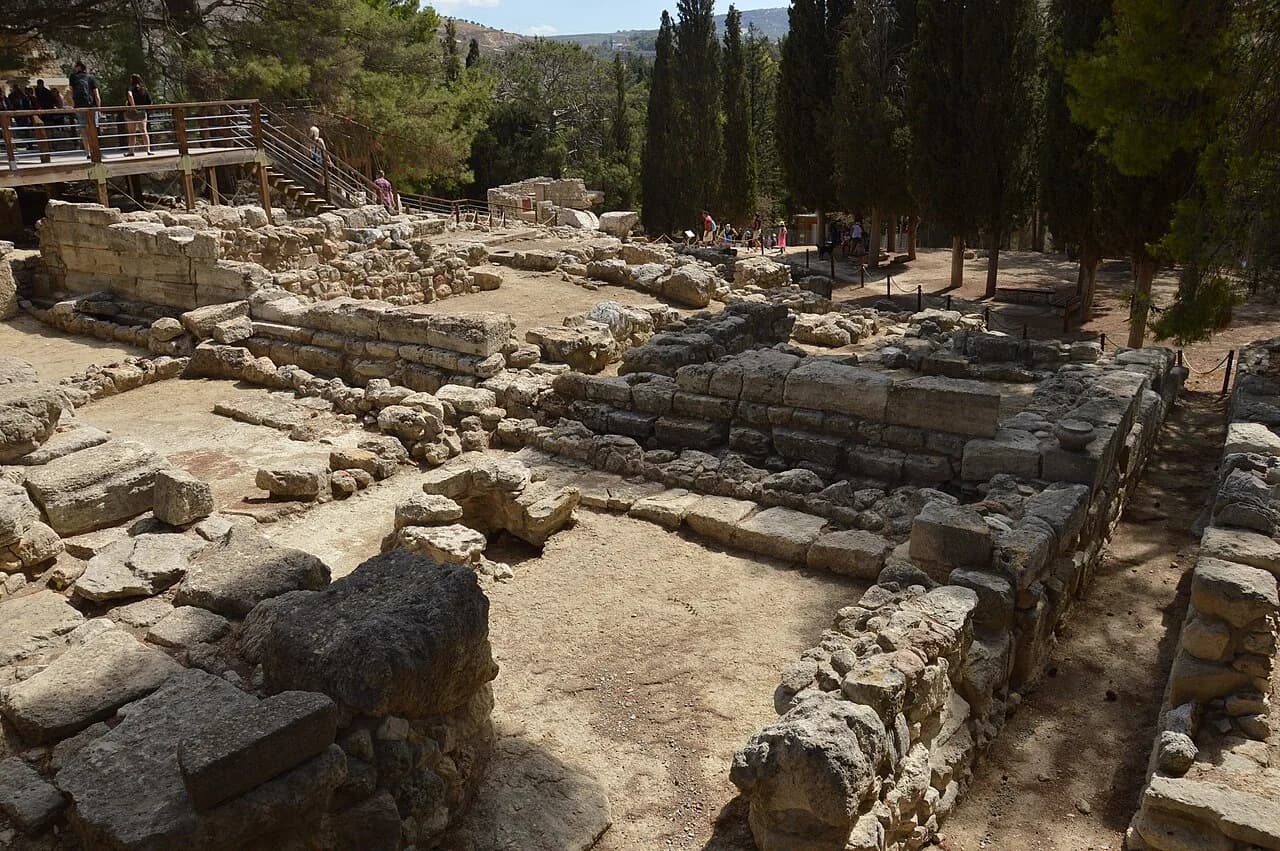
Almost a million people a year walk through the Palace of Minos at Knossos. The Ashmolean Museum calls it the second most popular archaeological site in Greece.
Excavators found the imprints of wooden columns at the Grand Staircase. The architect replaced them in concrete.
The traditional view
UNESCO's Minoan Palatial Centres listing names Knossos among six sites on Crete that date from 1900 to 1100 BCE. It describes them as administrative, economic and religious hubs. It points to "labyrinthine planning, courtyards, storage systems, and sophisticated hydraulic installations."
Arthur Evans began digging at Knossos in 1900 and kept working there until 1931. The Ashmolean's curator Andrew Shapland says the Bronze Age palace was in use from around 1900 to 1350 BCE.
Britannica says the first palace went up at the start of the Middle Minoan period, between 2000 and 1580 BCE. It reports that an earthquake about 1720 BCE leveled most of Knossos and that the palace was rebuilt. The remains on the excavated site today belong to that rebuilt palace.
Evans and his architects then rebuilt parts of it again. Shapland describes a simple stone and timber shelter in 1901, steel joists and vaulted brick ceilings from 1904, and reinforced concrete from the 1920s. Evans called the work reconstitution.
The Greek State now owns and runs the site. The Ashmolean says there is no suggestion that the Evans restorations should be removed.
What We Are Looking At
The evidence still raises a question of the kind the book asks. How much of the famous palace can a visitor read as Bronze Age evidence, and how much is an interpretation built to explain it?
What Nobody Has Settled
Both views lean on questions the evidence cannot yet answer. Three of them stand out.
How much of the palace is Bronze Age?
UNESCO is open about the problem. It says Knossos faces challenges "due to the extensive reconstructions carried out in the early 20th century." It adds that all reconstructions are well documented and that methods for clearly distinguishing authentic remains from later ones will be further developed.
Shapland writes that it can be difficult for archaeologists and visitors alike to disentangle the twentieth century reconstitutions from the Bronze Age building. The Ashmolean built a 3D model that compares present wall heights with Evans's archive to strip the later additions away. Shapland says that work is ongoing.
He also says later archaeologists have criticized reconstructions such as the north entrance bastion with its charging bull. There is little evidence for them. He adds that there is evidence for life-size bull frescoes on the palace walls, so the overall effect evokes the Bronze Age even if the details are problematic.
The best known case is the Prince of the Lilies. Ute Günkel-Maschek writes in the Annual of the British School at Athens that Evans and the Gilliérons built it from a group of painted stucco fragments. She calls it one of the most famous icons of its period "but also its most controversial."
She reports that Evans first described remains of no less than three figures. The fragments were later aligned in one direction and united into the Priest-King Relief. Doubts began because only sphinxes and female figures were known to wear that kind of crown.
Jean Coulomb argued from 1979 that the torso fragment belonged to a right-facing boxer. Günkel-Maschek argues that a comparison with other necklaces "conclusively confirms the leftward orientation" of the figure. Evans himself wrote that it might show "Minos himself in one of his mortal incarnations."
Which parts of the palace came out of the ground, and which parts were supplied?
When did the last palace stop working, and what stopped it?
The sources do not agree on the dates. UNESCO gives 1900 to 1100 BCE for the group of Cretan sites. The Ashmolean gives about 1900 to 1350 BCE in one article and 2000 to 1350 BCE in another. Britannica says what Evans called the Last Palace was destroyed by a fire of uncertain origin some time after about 1400 BCE.
Britannica adds that the Late Minoan phase is regarded as having coincided with the eruption of Thera, which "may have caused the destruction of Knossos." A 2023 paper in Scientific Reports says the eruption was initially speculated to have led to the fall of Minoan civilization on Crete. The same paper says radiocarbon places the eruption around 1600 BCE. It says archaeological arguments tied to the start of the New Kingdom in Egypt put it after about 1540 BCE. Its own result favors the mid sixteenth century.
A mid sixteenth century eruption and a palace used until about 1350 BCE sit roughly two centuries apart.
The clay tablets add a second dispute. John Bennet of the University of Sheffield writes on the British School at Athens site about a bitter dispute over the Knossos tablets. Leonard Palmer argued they were so similar to the Pylos tablets that they must share the Pylos date of about 1200 BCE. John Boardman and others vigorously opposed him. Bennet says the argument reached the letter pages of national newspapers and produced two books in one volume in 1963.
Bennet adds that a 1968 find of an inscribed stirrup jar in a Late Minoan IIIB context at the Unexplored Mansion gave Palmer's side more to work with. I have not checked where the dating argument stands today.
When did the last palace stop working, and what stopped it?
Who lived on the hill before the palace?
Katerina Douka and colleagues open a 2017 paper in Antiquity by saying that the origins of Knossos "remain enigmatic." They report that Evans found a series of Neolithic deposits about ten meters deep beneath the Bronze Age remains. Their radiocarbon modeling points to a small Aceramic colonization, followed by a later reoccupation. They write that the results firmly place an early farming community there in the first half of the seventh millennium BC.
They attribute the founding to a movement of farmers and herders onto the island. They say the lack of comparable wild plants and animals on Crete corroborates that view. They also name a possible Mesolithic presence at other sites on Crete and say it may likewise have come through maritime connections. I have not read the sources they cite for that.
Britannica agrees that the first inhabitants probably came from Anatolia in the seventh millennium BCE. A 2017 paper in Nature says the origins of the Minoan and Mycenaean cultures "have puzzled archaeologists for more than a century." Its authors report that the Minoans they sampled had at least three quarters of their ancestry from the first Neolithic farmers of western Anatolia and the Aegean. One figure caption in the paper names Minoans from Lasithi and Moni Odigitria. I have not checked whether any of the individuals came from Knossos itself.
By these dates people lived on the hill for roughly five thousand years before the first palace.
Who first crossed the sea to this hill, and what became of them?
The questions I can't put down
Some questions need more room than one article gives them. Two of them keep pulling me back.
Where did the Labyrinth come from? The Ashmolean says Homer mentions Knossos and a dancing floor that Daedalus built for Ariadne, but he does not mention a labyrinth. Herodotus describes a labyrinth in Egypt. Evans wrote in his diary in 1894 that he saw no reason against thinking the mysterious complication of passages was the Labyrinth. He later suggested that the double axe sign, which the Ashmolean says had the ancient name labrys, made labyrinth mean House of the Double Axes. I ask questions of this kind throughout Earthly Enigmas.
Can anyone read Linear A? Britannica says the Minoans replaced a hieroglyphic script with Linear A and that it has not yet been fully deciphered. UNESCO calls Cretan Hieroglyphic and Linear A the two earliest writing systems in Europe. Britannica says the Linear B used at Knossos after Mycenaean control is generally deemed the prototype of Greek. The Enkomi tablet and the Indus seal raise the same question about other scripts. You can read a free sample of the book before you decide. The articles section has more subjects in the same format.
Sources
- UNESCO World Heritage Centre: Minoan Palatial Centres
- Ashmolean Museum, Andrew Shapland: Rebuilding the Palace of Minos at Knossos
- Ashmolean Museum, Andrew Shapland: Myths of the Labyrinth
- Günkel-Maschek, The Lilies of the Prince, Annual of the British School at Athens 119 (2024)
- Bennet, Archaeology, philology and science (British School at Athens, 2024)
- Douka and others, Dating Knossos and the arrival of the earliest Neolithic in the southern Aegean, Antiquity 91 (2017)
- Lazaridis and others, Genetic origins of the Minoans and Mycenaeans, Nature 548 (2017)
- Olive shrub buried on Therasia supports a mid-16th century BCE date for the Thera eruption, Scientific Reports (2023)
- Britannica: Knossos
- Britannica: Minoan civilization