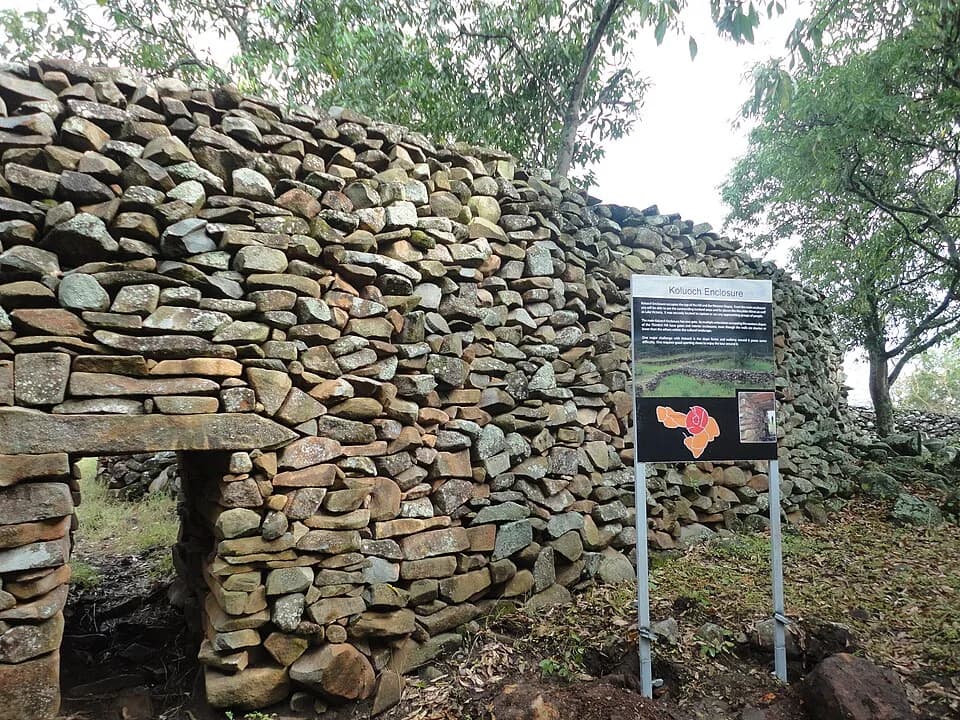
UNESCO describes the walls at Thimlich Ohinga as dry stone, built with no mortar and no cement. An outer face and an inner face are held together by a middle layer of smaller stones.
The charcoal dates published so far run from about 1650 to 1900. UNESCO says the settlement was probably built in the 16th century.
The traditional view
UNESCO places Thimlich Ohinga 46 kilometers northwest of Migori Town in the Lake Victoria region of Kenya. The World Heritage Committee inscribed it in 2018. UNESCO calls it a dry-stone walled settlement and the largest and best preserved of the enclosures built by pastoral communities of the Lake Victoria basin.
The property has four larger enclosures. The main one is called Kochieng. The others are Kakuku, Koketch and Koluoch. In the local language each enclosure is an Ohinga, and the plural is Ohingni.
UNESCO gives the walls a height of 1.5 to 4.5 meters and an average thickness of one meter. It says the stones were "placed in an interlocking system that enhanced overall stability without use of any mortar or cement."
The National Museums of Kenya says the name means a "frightening dense forest" in Dholuo. The ICOMOS evaluation says Thimlich comes from a Luo word for a scary jungle.
UNESCO says the Ohinga "seems to have served as a fort for communities and livestock, but also defined social entities and relationships linked to lineage." ICOMOS adds house pits, cattle kraals and an iron working area just outside the northern wall of the main enclosure.
The museums record written work at the site from the 1960s and say National Museums researchers began working there in 1980. The monument was gazetted in 1981. Kenya's own nomination dossier reports an earlier survey by Lofgren and later surveys by Onjala that found at least 521 enclosures south of the Winam Gulf. Thimlich Ohinga is the best preserved of them.
The place is still part of living memory. UNESCO says legal protection is strengthened by "traditional rules and taboos maintained by community elders." The same dossier says the site was viewed as sacred by the local community until the 1980s and was used as a place of sacrifice in times of calamity.
What the Evidence Does Not Settle
The sources disagree with each other more than they disagree with any outside theory. Heights run from 1.0 to 4.5 meters depending on the page. The age is given as 16th century, about 500 years, about 400 years and 1650 to 1900, sometimes on the same website.
In Earthly Enigmas I write that oral tradition is routinely underestimated by modern scholarship, and in Chapter 11 I call it a technology. Here the oral accounts of the builders conflict with each other, and the written sources lean on them for dates.
Where They Don't Meet
When was it built?
UNESCO says the settlement was "probably built in the 16th century CE." The museums page for the site says it was "built in the 16th century CE." The page on the site's history says the archaeological record "goes beyond 500 years ago."
The ICOMOS evaluation gives a different reasoning. It says both Bantu and Nilotic groups seem to have adopted similar strategies of dry-stone settlement. From that it concludes that the period of construction and occupation "is likely to be between 1590 and 1680, when such groups are known to have settled in the eastern Lake Victoria region."
It then says "These dates also correspond with charcoal samples from excavations at Thimlich Ohinga, which gives dates ranging from 1650 to 1900 CE."
Fredrick Odede and his coauthors in Kenya Past and Present report the two determinations behind that range. They give them as "110±80 and 200±80" radiocarbon years before present, calibrated to "about 1650 to 1900 AD." They credit Wandibba (1986). I have not read his original note.
Kenya's dossier says the occupation "goes back to about 400 years." It also refers to a recent study by the team that it calls unpublished. The same dossier says samples were collected for radiocarbon dating in 2017. I have not seen those results.
Lofgren, in the dossier's summary of her 1967 survey, thought the enclosures "unlikely to be more than a few hundred years old."
The charcoal range runs two centuries past the end of the building window that ICOMOS proposes. Which date belongs to the building of the first wall, and which belongs to the people who lived behind it?
Who built it?
The museums page gives the oldest reading. It says the present inhabitants of the area arrived "probably some three centuries ago." It says "it seems most likely that Bantus who initially occupied this region prior to the arrival of Luos first built the stone structures."
ICOMOS notes that the site "has often been considered a historic Luo site." It adds that "historical research and oral tradition attest to a diversity of occupants." Under oral tradition it names the Bantu groups Wagire and Kamageta as the earliest inhabitants and several Nilotic groups who came later.
The finds point in more than one direction. ICOMOS says the ceramics are mainly cord rouletted and that this motif "is principally Nilotic while iron working is associated with the Bantu groups." It reads the site as an early interaction between two main groups.
The dossier quotes Lofgren on the pottery. She called the roulette decorated sherds "indistinguishable from the ceramic wares of the present Luo and Bantu inhabitants." She also recorded that her informants named the Basuba as builders at some sites and the Luo at most of the others.
Odede and his coauthors take up the same technique while studying the earthwork enclosures of Bondo, north of the Winam Gulf. They write that rouletting is unlikely to have been practiced by any common ancestral Bantu group, which suggests Bantu groups copied the technique from Nilotes. They add that this is the opposite of what Wandibba proposed in 1977. They also write that conflicting oral traditions "make it impossible to determine the builders of the earthworks based on oral history alone." That sentence concerns the earthworks of Bondo and says nothing directly about Thimlich Ohinga.
Kenya's dossier puts the caution plainly. The fluidity of identity in the region cautions "against making overly simple inferences from material traces regarding either the ethnic or linguistic identities of the founders of Thimlich Ohinga." It also says it is "well attested that the site was inhabited during its final stages of occupation by self-identifying Luo communities."
Who laid the first stones, and what kind of evidence could say so?
How much of the wall is original?
ICOMOS is direct about this. It writes that "what used to be ruins are now fully restored, and that documentation of the restorations is not available." It adds that new walls demarcate the boundary between the site and the forest, and that this work "is not easily distinguishable from the stone structures."
ICOMOS says its previous evaluation considered that "some of the restoration work could possibly have been executed overzealously." The State Party answered that the works were done after 1981 with qualified supervision and documentation by the National Museums of Kenya. It says they used traditional masonry techniques taught to younger apprentices. ICOMOS concluded that authenticity "has been demonstrated."
UNESCO's own statement repeats the concern. It says the ruins "have now been largely restored" and that the new work "is not always easily distinguishable from the historic stone structures."
Kenya's dossier lists the restoration campaigns. The first major partial restoration of the walls took place from 2001 to 2003. More followed in 2007 and 2008 and again in 2011 and 2012.
The ICOMOS description also notes that the outer wall of Kochieng "has undergone modification during the site's occupation." It says the joint where an extension was added to the north-eastern section can still be identified.
If the restoration records are incomplete, which courses of stone can be read as the work of the original builders?
The questions I can't put down
Some questions need more room than one article gives them. Two of them keep pulling me back.
What was the enclosure for, and who ran it? UNESCO says it served as a fort and also defined social units. ICOMOS says it "likely had its own governance connected to broader regional power structures." Kenya's dossier calls the stone enclosures of Nyanza "numerous but devoid of social stratification." On Great Zimbabwe it says there is less evidence for a direct historical or cultural link between the two regions, and it says the same of the claims "often made by journalists" of a direct link with Thimlich Ohinga. The Great Zimbabwe article and the Loropéni article look at two other walled places on the same terms. The articles section has more subjects in the same format.
How does a building tradition travel through the generations? ICOMOS reports Kenya's case that the walls stayed sound through a maintenance tradition passed on by apprenticeship, and it finds that case appropriate. Kenya's dossier says the walls were believed to be a link with ancestral spirits and that this made people avoid damaging them. Kenya's dossier also calls the three-phase technique one "not known to exist anywhere else in eastern Africa." In Chapter 11 of the book I follow the question of what oral tradition can carry across time. You can find it in Earthly Enigmas or read a free sample before you decide.
Sources
- UNESCO World Heritage Centre: Thimlich Ohinga Archaeological Site
- ICOMOS Evaluation, Thimlich Ohinga Archaeological Site (No 1450rev), March 2018
- National Museums of Kenya: Thimlich Ohinga
- National Museums of Kenya: Thimlich Ohinga, site and monuments
- Kenya, Thimlich Ohinga Archaeological Site, additional information for the nomination dossier (2018)
- Odede, Magaga and Cokumu, Gunda-Buche: The historical earth bank enclosures of western Kenya, Kenya Past and Present 38 (2009)
- Wandibba, Thimlich Ohingni, Azania 21 (1986) (citation only, not read)
- Wikipedia (Thimlich Ohinga) was used only to find the Odede and Wandibba references.