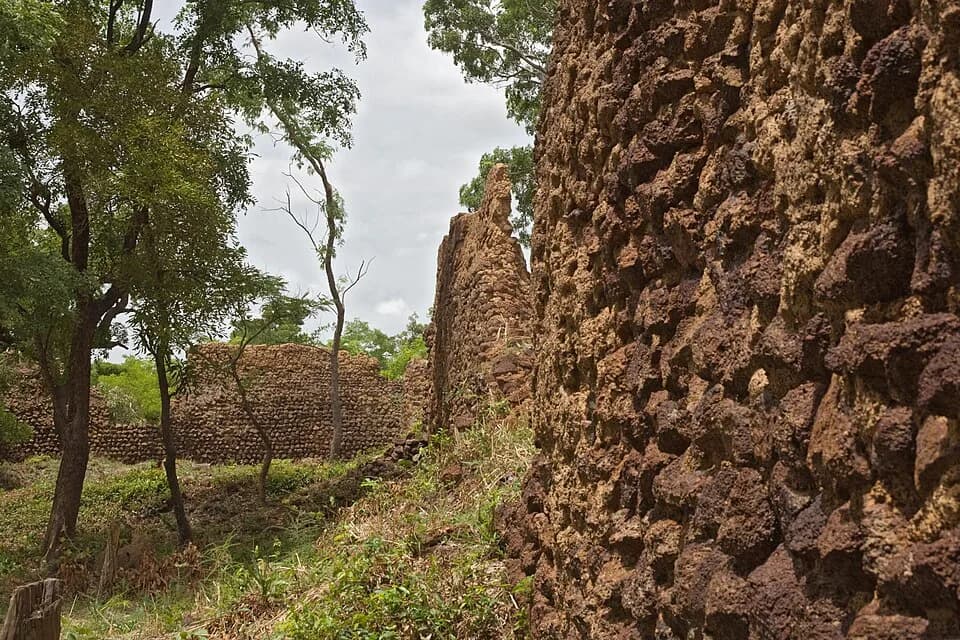
The walls at Loropéni rise up to six meters. The researchers working there report no visible way in.
Lassina Simporé of the University of Ouagadougou says nobody yet knows who built the place, when, or why.
The traditional view
Loropéni stands in southwestern Burkina Faso near the borders with Côte d'Ivoire, Ghana and Togo. UNESCO describes a property of 11,130 square meters with "imposing, tall, laterite stone perimeter walls, up to six metres in height." The World Heritage Committee inscribed it in 2009 as the first site in the country to be listed.
UNESCO calls Loropéni the best preserved of ten similar fortresses in the Lobi area. It is part of "a larger group of around a hundred stone-built enclosures." UNESCO reads them as a network "that flourished at the same time as the trans-Saharan gold trade."
The Committee's decision cites radiocarbon dates from recent excavations. They suggest the enclosure "dates back at least to the 11th century AD and flourished between the 14th and 17th centuries." The brief description says the settlement was occupied by the Lohron or Koulango peoples, "who controlled the extraction and transformation of gold in the region." It says the site was finally deserted in the early 19th century.
A joint program of French, Burkinabe and Ivorian researchers has excavated and surveyed the ruins. CNRS says it launched in 2015 and that the site was discovered in 1902.
UNESCO is open about the limits. Its statement says the function of the place "still remains in part speculative." The brief description adds "Much mystery surrounds this site large parts of which have yet to be excavated."
What the Evidence Does Not Settle
The researchers describe the same gaps. Simporé told CNRS, "As of today, we don't know who constructed the ruins of Loropeni, why they were made, nor when they were built." Each of those three open questions has its own published evidence.
Where They Don't Meet
Who built it?
UNESCO's summary names the Lohron or Koulango peoples as the occupants who controlled the gold. The archaeologists describe a gap. In the CNRS video anthropologist Quentin Mégret says he asked local people about the builders. "We were hoping to get a clearer idea of who the builders were by talking to the people here." He adds "That didn't end up being the case at all."
Rodrigue Guillon says in the same video that this kind of construction "required a strong workforce and centralized power to corral the workers." He also says that without knowing anything about the people who built the wall "we can't know their intentions."
Hervé Farma-Hantissié reports one of the local stories. "Some say that those who built these structures were giants, five or six meters tall." He says that relics surrounded by "lots of mythology" show the local population has taken them up.
Farma's 2022 doctoral summary warns about how the question has been handled. In my translation he writes that the structures "have often been attributed to peoples supposed to have the technical, intellectual or organizational capacities to build them." He ties this to their use of stone and their monumental scale, which he calls rare in this part of West Africa.
Who raised these walls, and what kind of evidence could name them?
How old is it?
UNESCO's summary says the ruins "have recently been shown to be at least 1,000 years old." The Outstanding Universal Value text says the enclosure dates to at least the 11th century and flourished from the 14th to the 17th.
The CNRS video reports that a first charcoal date points to occupation in the 15th century. A 2019 paper by Fabrice Monna and colleagues calls the ruins "probably dating from the fifteenth century."
In 2018 La Croix quoted Guillon. In my translation he said charcoal analysis gives a dating range "from the middle of the 14th century to the middle of the 17th century." He said his team had seen at least two phases of occupation.
Farma's summary reports earlier research on the large enclosures that found continuous occupation from the middle of the 11th century to the 18th. His own excavations of smaller stone structures nearby give the 14th to the 18th.
These statements come from different publications and different years. The sources I read do not say whether the earliest date marks the building of the wall or the first people to live behind it. I have not seen the radiocarbon tables.
When was the wall built, and when did people first live inside it?
What was it for?
UNESCO says the fortified settlements are linked to the tradition of gold mining. It calls Loropéni "an exceptional testimony to the settlement response generated by the gold trade."
The CNRS video offers two hypotheses for the apparent wealth, an activity tied to the gold trade or to the slave trade. Guillon says the first question is whether the wall was defensive or a display of power. He says there is no real answer yet.
Digging has added a complication. Guillon told La Croix in 2018, in my translation, "What we find is tied to daily and village life. Archaeologically speaking, for the moment, we cannot say the fortress is linked to a particular trade."
Farma's summary adds a third point. He writes that the exchange networks known from historical sources "bypassed" the area the stone enclosures occupy. He says more research is needed to understand how the structures fit into the region.
What was this enclosure for?
The questions I can't put down
Two more questions keep pulling me back.
How much of Loropéni has anyone opened? Guillon told La Croix in 2018 that his team had explored only 2 percent of the enclosure. Farma's survey of about 14 square kilometers around the ruins recorded 161 archaeological sites, 142 of them stone enclosures or structures. He writes that the small ones have been little investigated. In Earthly Enigmas I point out that only 8 of the 18 kilometers of tunnels at the Great Pyramid of Cholula have been excavated.
How did anyone get in, and where did the water come from? In the CNRS video Fabrice Monna says there is no visible point of entry and calls it "an unanswered problem." Siméon Kouassi says few wells have been found nearby and fewer inside the walls. The excavation turned up an abundance of ceramics that look like water storage vessels. Kouassi says the people "must have had to carry water a long way." You can read a free sample of the book before you decide. The articles section also covers other stone-built places in Africa, such as Great Zimbabwe.
Sources
- UNESCO World Heritage Centre: Ruins of Loropéni (list entry 1225)
- UNESCO World Heritage Committee, Decision 33 COM 8B.12 (2009)
- CNRS Images, The Mysterious Ruins of Loropeni (English transcript of the video, translation by Jay Swanson)
- CNRS Le Journal, La cité oubliée de Loropéni (French original)
- La Croix, Au Burkina Faso, le mystère des ruines de Loropéni (2018, in French; translations are mine)
- Hantissié Hervé Farma, doctoral thesis summary, Afrique : Archéologie & Arts 18 (2022, in French; translations are mine)
- Monna et al., Contextualization of Archaeological Information Using Augmented Photospheres (Sustainability, 2019) (first five pages read)