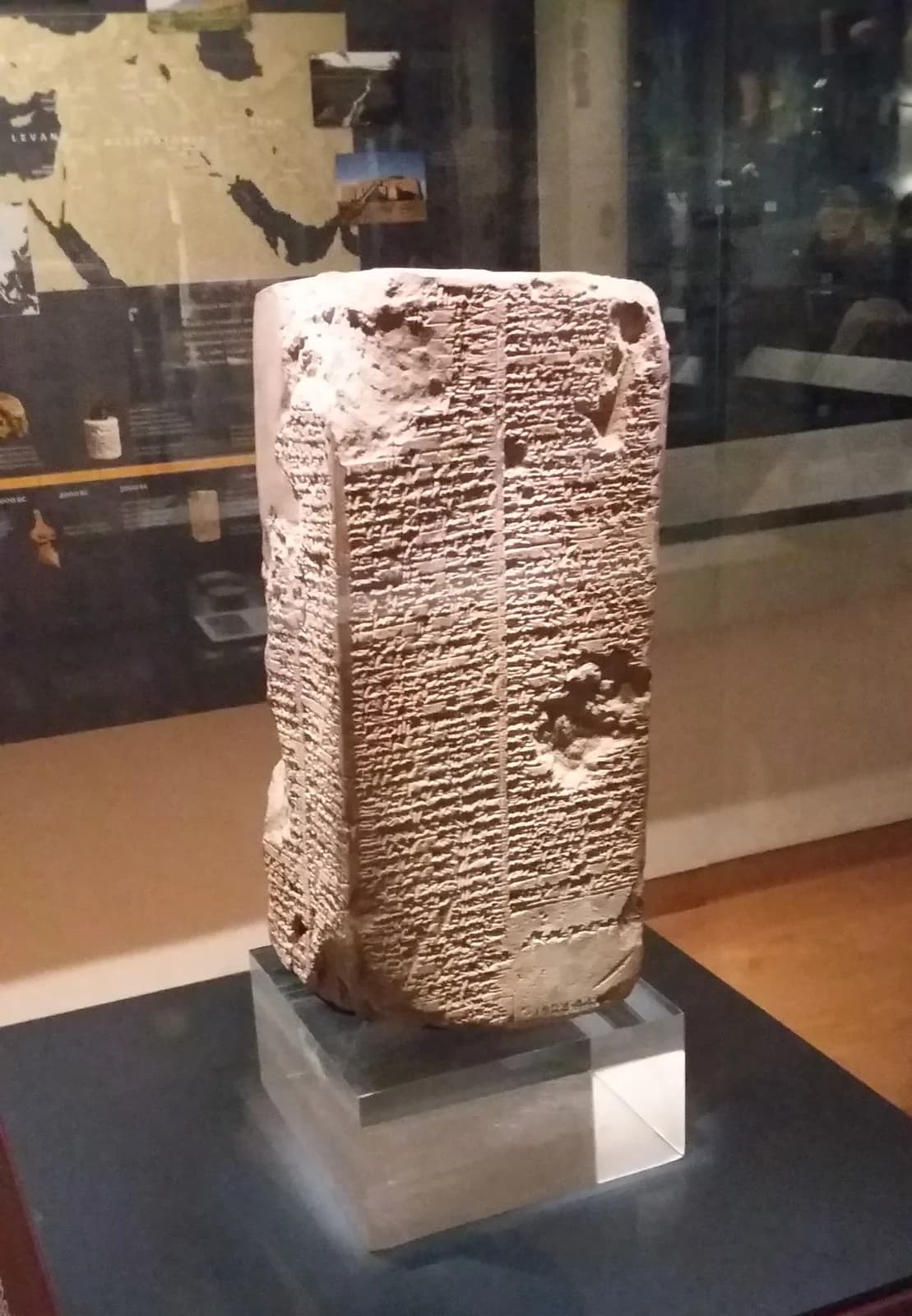
A clay prism about 20 by 9 centimeters sits in a museum in Oxford. Its first line says the kingship came down from heaven. The first eight kings on it reign for a combined 241,200 years.
The list then says the flood swept over and carries on with more kings. People still argue about what it records.
The traditional view
The most complete copy of the Sumerian King List is a clay prism in the Ashmolean Museum. The museum dates it to about 1800 BC and says it probably comes from Larsa. Each of its four sides carries two columns of cuneiform. The museum says several versions survive and this one is the most extensive and the most complete.
The Electronic Text Corpus of Sumerian Literature at Oxford gives a translation. It opens with "After the kingship descended from heaven, the kingship was in Eridug." Eight kings in five cities then rule 241,200 years. The translation continues "Then the flood swept over."
Kingship then descends again and settles in Kish. Reigns of hundreds of years continue. The translation gives Etana 1500 years in one copy and 635 in another. Gilgamesh appears as a lord of Kulaba who ruled 126 years. His flood story has its own article, Flood Stories.
Later entries read like ordinary reigns. Sargon of Agade is given 56 years, with two copies giving 55 and 54.
The Ashmolean says the list is not history as we would understand it. It calls it a combination of myth, legend and historical information. The museum adds that the list seems to have been composed to imply that the rule of Mesopotamia could be held by one city at a time. It says the rulers of Isin used it to present themselves as the rightful successors of earlier kingdoms. The museum captions the prism with the words "Ancient political spin."
Thorkild Jacobsen published the standard edition in 1939. He concluded that the author drew on local date lists from a number of Babylonian cities. He calls the huge early reigns obviously unhistorical. He also calls the material behind the list a historical source of high value.
Civilization Doesn't Work This Way
In Earthly Enigmas I read the Sumerian tablets as possible historical records and not only as myth. I write that the King List opens with kingship descending from heaven at Eridu. I read that opening as transmission from above rather than an invention.
I say Sumer has no developmental trail. I date its emergence to about 4500 BCE and describe it arriving with writing, base-60 mathematics, law and irrigation already in place. I call it a starting line. I write that scholars have catalogued 39 distinct cultural firsts that appear together in the Sumerian record without a traceable ancestry.
I see the same pattern in Egypt. I write that Egypt's oldest texts describe the gods as physical inhabitants of Egypt in a prior age. The priesthood said its knowledge came from Zep Tepi, the First Time. I say the Turin King List begins with the Neteru and the Shemsu Hor.
I also write that the mainstream position is that these entries are mythological. I say whether the priests' claim was mythological or historical is the question the book has been building toward. I think the historical interpretation deserves more weight than it has been given.
Across cultures I write that each one remembers a prior age of visitors who taught and left. The details vary and the core structure does not.
What the List Leaves Unexplained
Both readings lean on questions the evidence has not settled. Three of them stand out.
Where does the legend stop?
The prism gives the eight kings before the flood a combined 241,200 years. Alulim alone rules 28,800. Jacobsen keeps the names and the order and rejects only the exaggerated figures. He writes that "there is obviously no reason to reject more than the exaggerated figures themselves."
He describes the turn this way. "At a certain point the reigns then change and become quite normal, keeping within what seems humanly possible." The copies do not agree even on the figures after that point. Etana is given 1500 years in one manuscript and 635 in another.
The Ashmolean calls the whole text a combination of myth, legend and historical information. In the book I read the opening as transmission from above.
Where does the legend stop, and who drew that line?
How old is the opening?
Jacobsen studied the manuscripts one by one. Four of them contain evidence that they began with the first dynasty of Kish, which comes after the flood. Three others seem to have had a section on the rulers before the flood.
He could not decide between two explanations. A copyist may have found that section damaged and left it out. A copyist may instead have added it from another source. He writes that "Neither of the two main possibilities here mentioned seems a priori more probable than the other."
He adds that the section on the first rulers has "an individuality of its own." A separate tablet, W-B 62, gives a list of kings before the flood very much as the prism does. The reigns differ considerably in length. He also discusses a Sumerian epic with a flood account that uses the line "the crown of kingship was lowered from heaven." He says "a very close connection exists between this epic and the antediluvian tradition."
In the book I read the opening line as transmission from above. How old is that line, and what did the first scribe to write it down have in front of him?
Why one line of kings?
Jacobsen says the author arranged the dynasties one after another because of "an erroneous theory of a single kingship." He calls that arrangement "of negligible value." He still builds a chronology from the list. The last chapter of his book is titled Resulting Chronology.
The two accounts also differ on who the list served. The Ashmolean points to the rulers of Isin. Jacobsen says the original was composed under Utu-hegal, and that most surviving manuscripts were written in the later part of the Isin dynasty.
In the book I describe Sumer as a starting line with no trail behind it. The list is one of the texts that places its early rulers in order. What can a list shaped by one idea tell us about the order of events?
The questions I can't put down
Some questions need more room than one article gives them. Two of them keep pulling me back.
What was the scribe copying? The Museo Egizio in Turin holds a papyrus it calls "the only true list of kings apart from Manetho." Peter Lundström of the Pharaoh.se site says it lists gods, demigods and spirits before its human kings. He dates it to the reign of Ramesses II and says it cannot be determined whether it copies an even older list. His transcription of one damaged line gives 13,420 years plus a lost number for the spirits and the Followers of Horus. I have not checked that against the papyrus. In the book I say whether the priests' claim about the First Time was mythological or historical is the question I have been building toward. I follow it through Earthly Enigmas.
Why do two lists share a shape? Jacobsen notes that other peoples of antiquity also held very exaggerated ideas of how long humans lived in the earliest times they knew. He quotes the historian Eduard Meyer, who sees the same shrinking of lifespans in the Egyptian account. In the book I write that each culture remembers a prior age of visitors who taught and left. You can read a free sample before you decide. The articles section has more subjects in the same format.
Sources
- Ashmolean Museum: Sumerian King List
- Electronic Text Corpus of Sumerian Literature: The Sumerian king list, translation
- Jacobsen, The Sumerian King List, Assyriological Studies 11 (Oriental Institute, 1939)
- Museo Egizio: History, Content and Restoration of the so-called Turin King List
- Pharaoh.se: Turin King List, contents
- Pharaoh.se: Turin King List, column 3