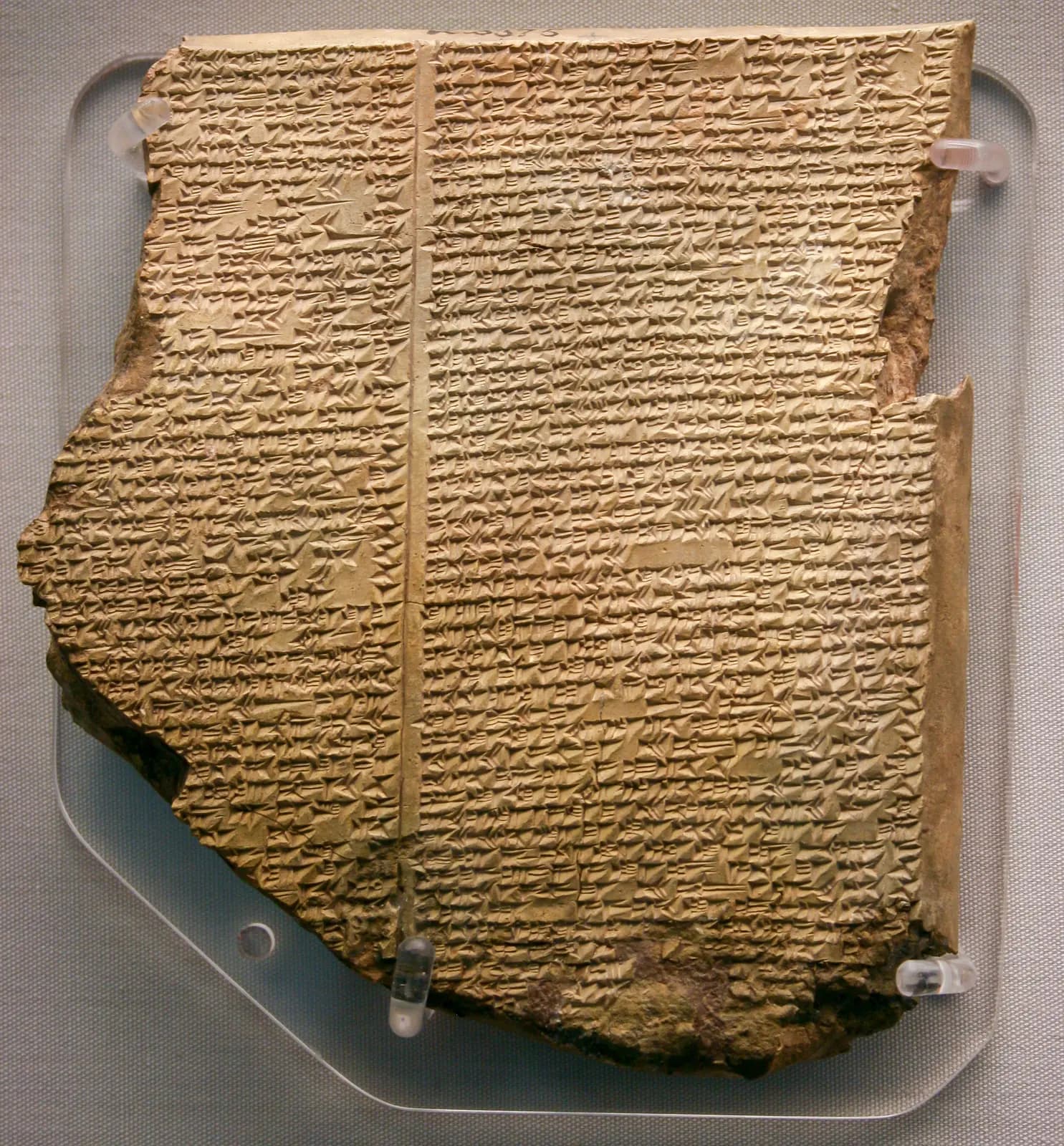
In the early 1870s the translator George Smith read a clay tablet from the palace of an Assyrian king. It told of a flood, a warning, a boat and a bird sent out to find land. The story sounded very familiar.
Stories like it turn up in many places. People still argue about what they remember.
The traditional view
The tablet is part of Tablet XI of the Epic of Gilgamesh. It is a seventh century BC copy found at Nineveh in the palace of Ashurbanipal. The British Museum catalogues another fragment of Tablet XI, the story of the Flood, from the Library of Ashurbanipal.
George Heath-Whyte of Tyndale House writes that older versions exist. Two tablets about a thousand years older than the tablets Smith read tell the story of a hero called Atra-hasis. A Sumerian composition of similar date holds a flood story, and another version was known at Ugarit. He calls the popular view that Genesis simply rewrote Gilgamesh too simplistic.
Samuel Noah Kramer of the Penn Museum writes in Expedition that southern Mesopotamia is a region where torrential floods are endemic. He agrees with Max Mallowan that the story was inspired by "an actual catastrophic but by no means universal disaster" around 3000 B.C.
David MacDonald reads the same excavations differently in Creation/Evolution Journal. Woolley's flood deposit at Ur dates to about 3500 BCE, and floods at Kish and Shuruppak fall around 3000 to 2900 BCE. MacDonald finds no compelling grounds to tie the story to any of them. He suggests that endemic flooding may have been enough to generate the story.
The Flood Stories Everyone Remembers
In Earthly Enigmas I count 217 flood traditions worldwide. I write that they come from cultures that never met and tell the same tale. The shared elements are a warning to survivors, a boat or refuge, a worldwide flood and a civilization restarting from a small group.
I describe two academic camps. One insists on the literal truth of the Bible account. The other dismisses flood stories as symbolic narratives, natural metaphors or the human fear of water. I think both camps overlook the same point. The ubiquity and similarity of the stories indicate a shared memory of a real event.
I read Gilgamesh as a compressed historical account. It gives a council decision, a warning from Ea, a cube-shaped boat, a landing on Mount Nisir and birds sent out in order. Local floods explain local myths. I say a story of mountains submerged and almost all humanity destroyed needs a larger event, and I explain the shared structure by a global flood.
I cite Nunn and Reid, who found 21 Aboriginal Australian stories that match drowned coastline features. I take their work as proof that oral memory can last 7,000 to over 10,000 years. A Sumerian memory of a 12,800-year-old flood is then the expected outcome. I tie the flood to the impact and to a sea-level rise of about 120 meters.
I read the warning in these stories as foreknowledge. I allow that it could be a narrative convention, and I say it could also be a dim memory of what actually happened. Perhaps astronomers in a sophisticated pre-impact civilization tracked incoming fragments. I say the survivors designed the survival.
I describe flood stories as the kind of story serious academics do not take seriously. I call them the expected survival profile of a civilization that lost its physical infrastructure but retained its human carriers.
Which Flood Do They Remember?
Both readings leave questions open. Three of them stand out.
How big was the flood?
Kramer and MacDonald disagree about whether any Mesopotamian flood sits behind the story. MacDonald notes that Eridu, just seven miles from Ur, shows no sign of the Ur flood. He also notes that the silt at Kish averages under ten inches and the Shuruppak deposit is about fifteen inches. The Ur deposit is up to eleven feet thick.
In the book I say local floods explain local myths and I count 217 traditions that share a structure. Counting is its own question. An online compilation of flood stories hosted by TalkOrigins says it included stories in most borderline cases. One of them is a Hopi story of a flood that was avoided and never occurred. The compiler is not named on the page I read.
How big was the flood the stories remember?
How long can a story last?
MacDonald writes that even the most traumatic events tend to fade from memory after a few generations without writing or a highly developed oral procedure. He applies that to a flood around 3500 BCE in Sumer.
Nunn and Reid reach a very different figure from 21 coastal locations in Australia. Their abstract says the stories appear to have endured since about 7,250 to 13,070 calibrated years before the present. It calls this an extraordinary longevity of oral traditions. I have read only the abstract.
In the book I take their work as proof that oral memory can last 7,000 to over 10,000 years. I conclude that a Sumerian memory of a 12,800-year-old flood is the expected outcome.
The oldest written Mesopotamian versions are much younger. Kramer dates the Sumerian flood myth to about 2000 B.C. or earlier, and the Flood Tablet is a seventh century BC copy.
How long can a story last?
When did the water rise?
Lambeck and colleagues reconstructed sea level from about 1,000 observations. They report that the main phase of deglaciation ran from about 16,500 to about 8,200 years ago. The fastest rise came about 14,500 to 14,000 years ago and the rate slowed during the Younger Dryas.
In the book I put a sea-level rise of about 120 meters after the 12,800-year impact. Other candidate events sit at other dates. The Woods Hole Oceanographic Institution describes a 1997 proposal by Ryan and Pitman for a catastrophic Black Sea flood about 9,400 years ago. It also describes a 2009 study that found the water rose only 5 to 10 meters. I have read only an excerpt of that page.
The Mesopotamian deposits date to about 3500 to 2900 BCE.
When did the water rise, and did it rise once?
The questions I can't put down
Some questions need more room than one article gives them. Two of them keep pulling me back.
Why does someone always know in advance? Heath-Whyte writes that the ancient Near East was "awash with stories" of a man who survived a divinely ordained flood thanks to the warning of a god. In the book I weigh two readings of the warning. One is a narrative convention. The other is a dim memory of what actually happened. I follow the question through Earthly Enigmas.
Do the flood layers and the carbon dates describe the same Tiwanaku? Marsh and colleagues model 102 radiocarbon dates and put the start of Pumapunku construction at about AD 580. In the book I cite Helmut Tributsch, who reads flood deposits at Tiwanaku as showing that some structures predate catastrophic inundations. The Tributsch paper was not checked for this article. You can read a free sample before you decide. The Puma Punku article covers the site itself, and the articles section has more subjects in the same format.
Sources
- Tyndale House: Artefact in focus, The Flood Tablet
- British Museum: Gilgamesh tablet 11, the story of the Flood
- Penn Museum, Expedition: Reflections on the Mesopotamian Flood (Kramer)
- NCSE, Creation/Evolution Journal: The Flood, Mesopotamian Archaeological Evidence (MacDonald)
- Nunn and Reid: Aboriginal Memories of Inundation of the Australian Coast Dating from More than 7000 Years Ago (abstract)
- Lambeck and others: Sea level and global ice volumes from the Last Glacial Maximum to the Holocene (PNAS)
- Woods Hole Oceanographic Institution: Noah's Not-so-big Flood
- TalkOrigins: Flood Stories from Around the World
- Marsh and others: The center cannot hold, a Bayesian chronology for the collapse of Tiwanaku (PLOS ONE)