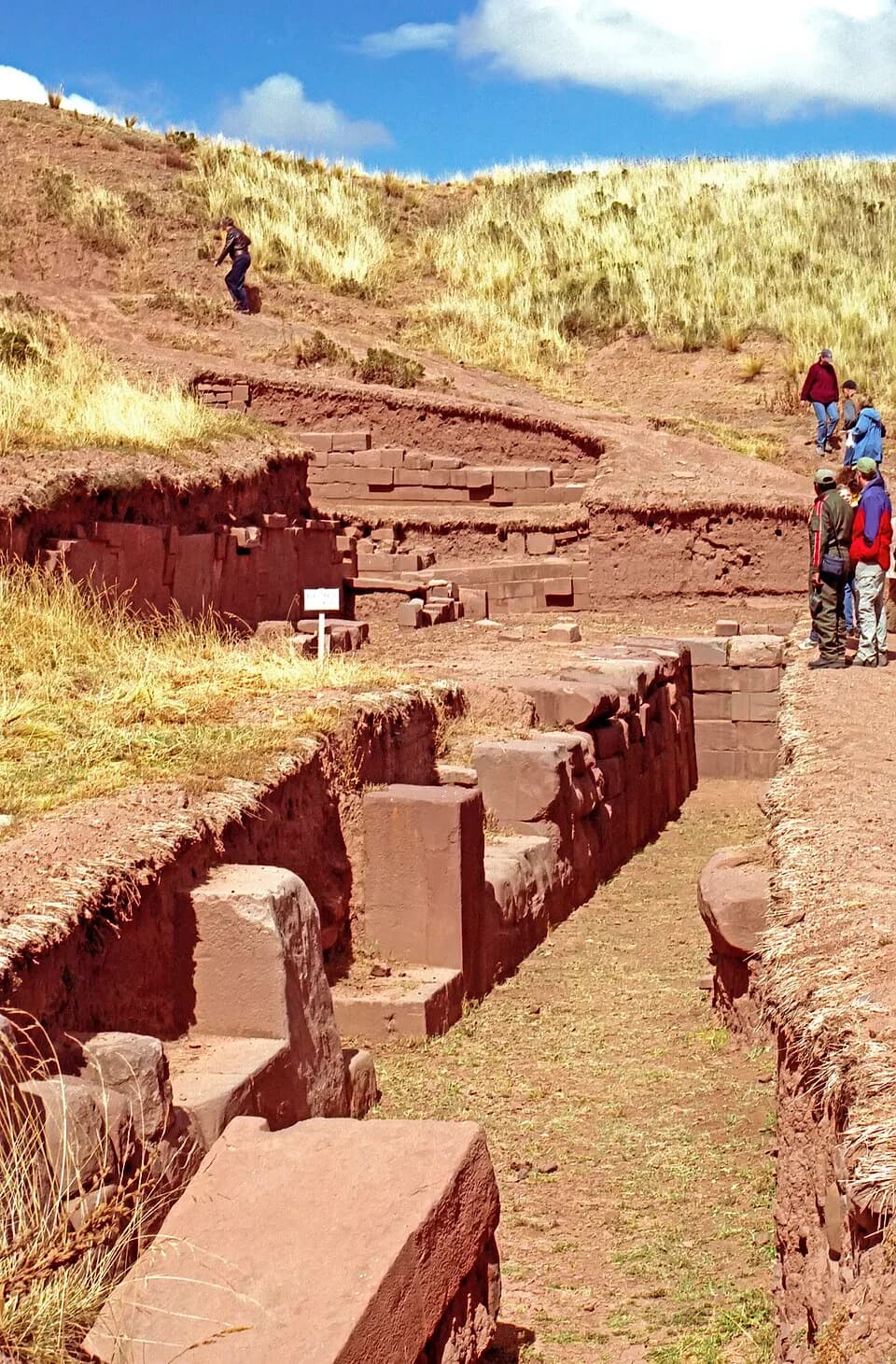
A platform about 120 meters on a side stands high on the Bolivian altiplano. Pillars about five meters tall frame its outer wall.
Posnansky and Vranich both read those pillars as a way of watching the sun. They put the building of the platform thousands of years apart.
The traditional view
UNESCO says Tiwanaku began as a small settlement and flourished into a planned city between 400 and 900 AD. It describes the Kalasasaya as a large rectangular open temple that is believed to have been used as an observatory.
Alexei Vranich describes how the platform lines up with the sun. Its main entrance is on the east side, two meters north of center, and aligns with the point where the sun first appears at the equinox. Pillars at the southeast and northeast corners mark where the solstice sunrises first appear over the eastern mountains.
Eleven upright andesite stones on the west side mark the setting sun at the solstices, the equinoxes and other divisions of the solar year. Vranich calls the whole arrangement "a unique and sophisticated system of horizon-related astronomy."
The date comes from radiocarbon. Vranich reports that the dates for the platform are problematic, and that the range runs from about AD 300 to 500 once the extreme dates are set aside. He credits that range to John Janusek, who reviewed the radiocarbon dates for the whole site. Janusek notes difficulties with how the interior fill was excavated, dated and reported.
A 2023 study by Erik Marsh and colleagues modeled 102 radiocarbon dates from Tiwanaku. They put the founding of the site at about AD 180 and the end of monument building at about AD 720.
Posnansky's much older dating is not accepted in the academic literature. Marsh writes in a 2019 paper on Posnansky that his theories were based on little concrete information. He adds that Posnansky's ideas were strongly influenced by the trends of his day, including racist anthropology.
The Puma Punku article covers the stonework itself. This article stays with the dates and the sun.
The Dating Game
In Earthly Enigmas I give the conventional dating for Tiwanaku as about 500 to 1000 CE. I set the work of Arthur Posnansky beside it. Posnansky concluded from the astronomical alignments of the site that its original construction predates Tiwanaku by thousands of years. I note that his method has been disputed.
I also write that his conclusions were set aside and never definitively refuted. I cite Helmut Tributsch, who reads flood deposits at Tiwanaku as showing that some structures predate catastrophic inundations. The Flood Stories article takes up the flood layers.
In the same chapter I argue that official dates for monuments often come from who is presumed to have built them. I call that circular logic. I also say that both columns of my dating table operate within considerable uncertainty.
What the Dates Leave Open
Both views lean on questions the evidence cannot yet answer. Three of them stand out.
How old is the Kalasasaya?
Posnansky published his working. I read it on a website that hosts a translation of his 1945 book, and I have not checked it against the printed edition. He measured the angle between the two solstice directions that the temple marks. On the average of his readings and those of a German astronomical mission it was 49 degrees 22 minutes 42 seconds.
For 1930 he calculated 49 degrees 59 minutes 6 seconds, after allowing for the horizon and for refraction. The difference was 36 minutes 24 seconds. From it he derived an obliquity of the ecliptic of 23 degrees 8 minutes 48 seconds when the temple was built. He wrote that this figure is "on the point of 15,000 years B.C."
Radiocarbon gives a very different range. Janusek places the platform between AD 300 and 500, and Vranich calls the underlying dates problematic.
A conference abstract by David Fink and colleagues in 2025 tried a third method, cosmogenic beryllium-10, on the tops of three Kalasasaya pillars. They find that the signal in the pillar tops "is dominated by inheritance." Blocks at a quarry, they say, were cut as recently as 1,500 to 3,000 years ago. They also write that "The date of construction of Tiwanaku is unknown." I have read only the abstract.
Posnansky's number comes from the angle of the walls. Janusek's comes from material in the interior fill. Fink's comes from when stone left the bedrock. Do these three methods date the same event, and which one dates the building of the platform?
How exact is the angle?
Posnansky measured the platform itself. He found that its corners are not exact right angles. The east and west walls deviate from the meridian by 1 degree 1 minute 30 seconds and 1 degree 6 minutes 30 seconds. The north and south walls deviate by 40 and 42 minutes. The angle he turned into a date was 36 minutes 24 seconds.
Rolf Müller, the German astronomer who worked with him, believed the small deviations were intentional. Müller published his own study of the temple in 1931 and I have not read it. Posnansky believed the temple was exactly oriented in its time. He pointed to the clay of an ancient lake bed, which moves when water gets into it.
In a conference abstract, Epis and colleagues say Posnansky "failed to realize that the high propagation of errors led to incorrect results" when he dated the site. They propose dating the site from the alignment of the Kalasasaya with stars of Orion. Their abstract gives no date, and I have not read the full paper.
Vranich adds that the reconstruction of the Eastern Gateway has been justifiably criticized by architects and conservators. He says the width of the opening matches the remains as uncovered in 1903 and published by Posnansky.
How exact was the platform when it was built, and how exact is it now?
What stood here before the planned city?
Vranich writes that the semi-subterranean court is the earliest surviving structure at Tiwanaku and stayed in use for nearly a millennium. Deep excavations nearby have found glimpses of other early buildings. Later construction has buried or obscured most of the early period.
He adds that the ritual core was rebuilt again and again, and that the work included razing older structures to provide ashlars for new buildings. He also writes that chronological control over the construction sequence is in need of more absolute dates.
Marsh and colleagues find reuse late in the sequence. After about AD 630 the masonry at the Pumapunku and the Akapana uses reused stone. They write that continual reuse makes it challenging to track building traditions precisely.
The founding date has moved a good deal between studies. Vranich says Carlos Ponce Sanginés proposed a sequence beginning from 1600 BC as a set of modest hamlets. Fink and colleagues write that the earliest settlement is believed to be at least about 3,000 years old. Marsh and colleagues put the founding at about AD 180.
Marsh says in his 2019 paper that both Posnansky's chronology and the Ponce Sanginés chronology run millennia older than current research suggests.
What stood here before the planned city, and how would we tell it from the stone that was reused?
The questions I can't put down
Some questions need more room than one article gives them. Two of them keep pulling me back.
Was Posnansky refuted or set aside? In the book I write that his conclusions were set aside and never definitively refuted. Marsh writes that his chronology was discarded with the site's first radiocarbon dates after his death. He also quotes the archaeologist Wendell Bennett, who said the evidence and conclusions were not presented in a manner acceptable to scientific archaeology. I follow the question through Earthly Enigmas.
Who built it, and how many people lived there? UNESCO calls Tiwanaku a planned city and the capital of a powerful pre-Hispanic empire. Vranich says archaeologists now use terms such as festival city for a place that held very large temporary crowds, and that research remains dynamic and fluid. In the book I credit the Tiwanaku culture and set Posnansky's much older claim beside it. You can read a free sample before you decide. The articles section has more subjects in the same format.
Sources
- UNESCO World Heritage Centre: Tiwanaku, Spiritual and Political Centre of the Tiwanaku Culture
- Vranich, Monumental Perceptions of the Tiwanaku Landscape, chapter 5 of Political Landscapes of Capital Cities (University Press of Colorado)
- Marsh and others: The center cannot hold, a Bayesian chronology for the collapse of Tiwanaku (PLOS ONE, 2023)
- Marsh: Arthur Posnansky, the Czar of Tiwanaku Archaeology (Bulletin of the History of Archaeology, 2019)
- Posnansky, Tihuanacu: The Cradle of American Man, translated text as hosted on atlantisbolivia.org (a web copy, not checked against the printed book)
- Fink, Levchenko and Fujioka: Cosmogenic exposure dating the Pre-Columbian archaeological structures at Tiwanaku, Bolivia (EGU General Assembly 2025, conference abstract)
- Epis, Costa, Motta and Ayub: Tiwanaku (Bolivia), An Archaeoastronomical Study On The Role Of The Stars In The Dating Of The Site (SIAAC conference abstract)