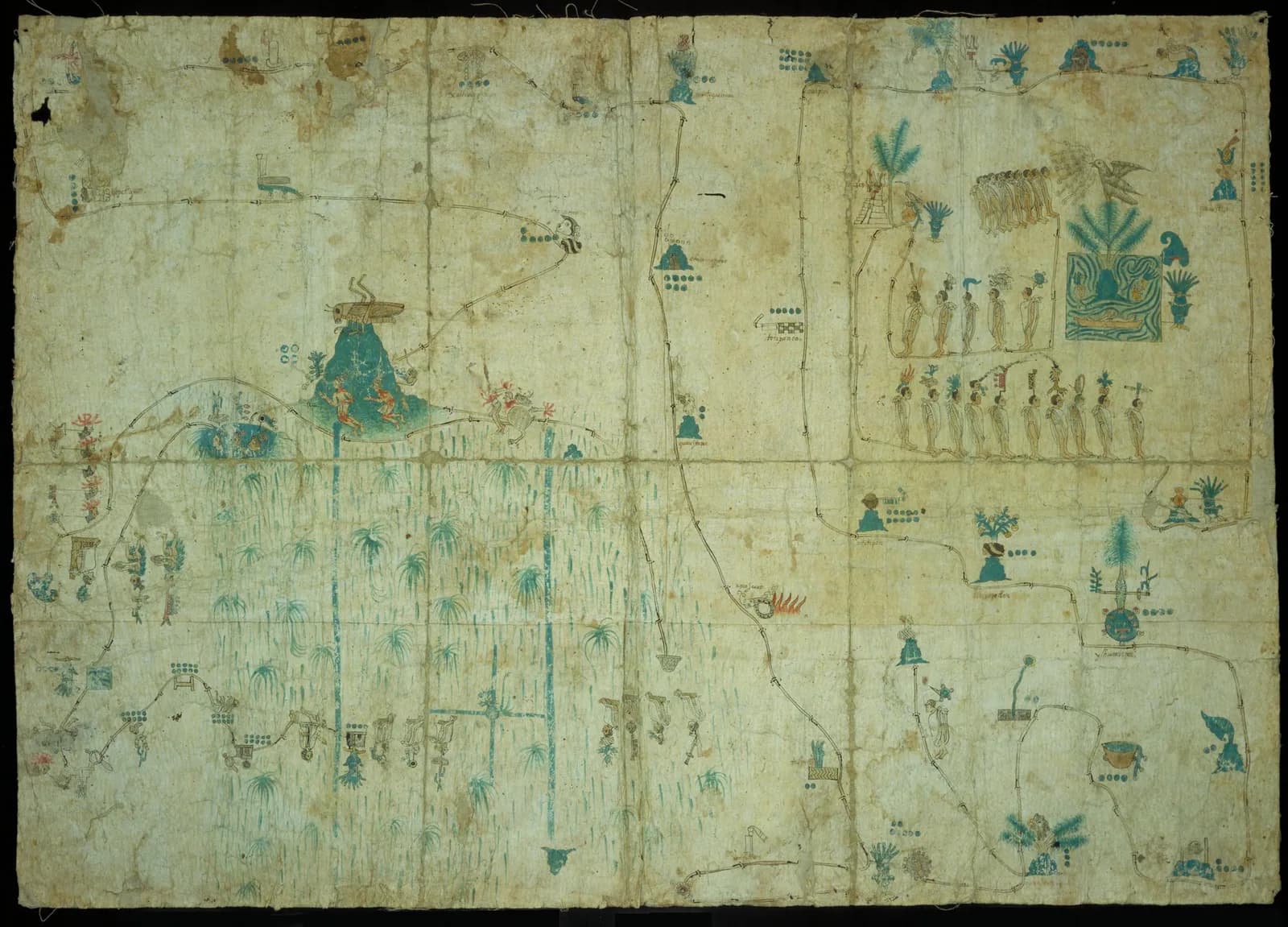
A trail of footprints winds across a single sheet of amate paper that measures 54.5 by 77.5 centimeters. Small circles beside the place signs count the years the travelers stayed.
The Library of Congress says the community that produced the sheet has not been identified with certainty.
The traditional view
The Library of Congress record calls the sheet "a cartographic history of the migration of the Aztec from Aztlán to Tenochtitlan." It says "A trail of footprints connects these locations." The original is held by Mexico's National Institute of Anthropology and History (INAH). The record adds that the sheet "is thought to date from the 16th century."
INAH's own repository entry is in Spanish, so all quotations from Spanish sources in this article are my translations. It describes a route marked by two thin black lines with human footprints on it. It counts 15 figures, each with a name sign, and "around 40" place signs.
After a battle at Chapultepec one group of lords separates to found Tlatelolco. Another group goes to Culhuacan and then to Tenochtitlan, which appears small inside a blue cross beside a stream.
María Castañeda de la Paz studied the sheet at length. In a 2001 article she calls it a pictographic manuscript of the Valley of Mexico "from the beginning of the sixteenth century." She says it tells the migration from Aztlán to the founding of Tenochtitlan with "special emphasis on the stay at Chapultepec."
She also objects to the name. In her words the name Sigüenza "has nothing to do with the cultural context it belonged to." She prefers Pintura de la Peregrinación Culhua-Mexica.
The sheet is named for Carlos de Sigüenza y Góngora, who lived from 1645 to 1700. The Library of Congress calls him a scholar and government official who was an early student of Aztec history.
The Italian traveler Giovanni Francesco Gemelli Careri copied the sheet in the 1690s. The Mapas Project says his copy was the first publication of the map, in A Voyage Round the World in 1704. His title called it a copy of "an antient picture kept by D. Carlos Siguenza."
The chain of owners is long. Castañeda writes that the sheet belonged first to Juan de Alva Ixtlilxóchitl, who left it to Sigüenza. Papers from his library went to the Jesuit college, and the collector Lorenzo Boturini acquired part of them. Boturini's collection later ended up abandoned in the basements of the viceregal palace, and she writes that the sheet was probably obtained there. She adds that Alexander von Humboldt did not find it when he visited in 1803.
INAH says the sheet stood outside the collection at the end of the nineteenth century until it was returned to the national museum in 1904.
What a Painted Memory Can Carry
In Earthly Enigmas I ask how far a memory can travel.
In Chapter 9, under the heading The Flood Stories Everyone Remembers, I write that "Oral tradition doesn't last ten thousand years by accident." In Chapter 16 I give the Mesoamerican codices that survive as fewer than 20 out of an estimated 400.
This sheet is one painted account of where a people came from. The sources below disagree about who made it, when and what it shows.
What the Sheet Leaves Open
Both views lean on questions the sources have not settled. Three of them stand out.
Who painted it, and from what?
The Library of Congress says scholars believe the community that made it "most likely was Chapultepec." INAH's repository lists the period as Prehispanic. The INAH-linked Biblioteca Digital Mexicana entry gives the sixteenth century in one field and 1600 to 1699 in another.
Castañeda argues for an older source behind the sheet. She calls it a Mexica-Tenochca pictographic manuscript that "refers back to the period of Axayácatl." She adds that "perhaps the original, now lost, was made at that time."
Her reasons are on the route. It crosses the Huasteca and the Tepanec lands west of the lake, and both were conquered under Axayácatl. She also notes that the founding of Tlatelolco is drawn as an "insignificant appendix."
Sebastián van Doesburg reviewed her 2006 book in the journal Anuario de Estudios Americanos. He agrees her reading points the right way. He also notes that Aatl dies at the battle of Chapultepec yet appears later among the founders of Tenochtitlan. In his words these are signs that the sheet "is in reality a composition based on a diversity of earlier sources."
A news report from 2007 quotes a UNAM researcher as saying the map was begun in 1530. I have not checked that figure.
Who painted the sheet we have, and what older picture or pictures did that person work from?
How long did the journey take?
Castañeda says the sheet counts time two ways. Small circles give the years of a stay, and bindings mark the end of a 52-year cycle. She writes that "there is a numerical mismatch between the two counting systems."
Federico Navarrete puts the sheet in a wider field in his 2011 book. He writes that one Mexica source, copied by Chimalpahin, lists 92 stops. The sources on the migration name more than twenty on average.
Navarrete notes that the sources agree closely on where the Mexica tied their years. He suggests that "it is possible that the Mexica histories made an adjustment of the dates after the fact." He also writes that the Mexica settled in their final territory "long before the founding of Mexico-Tenochtitlan," and that their stories fold that long residence into the migration. He says these ideological elaborations "should be viewed with skepticism."
Gemelli's 1704 note gives yet another count. The English text says the fifteen heads of families "had wandred an Hundred and four Years" before reaching a place on the way. It says some Spanish authors put the departure in 820 with 80 years on the road, and that this "does not agree with the Picture." Castañeda says the notes Gemelli added were probably dictated by Sigüenza.
Which count does the sheet itself keep, and how long was the road?
What does the circle of star-eyes show?
One place sign stands apart. INAH's Biblioteca Digital Mexicana entry says that among the many known place names one has "mythical, not geographic, existence." That place is Ilhuicatepec, which takes the spot of Coatepec in similar pictures.
The same entry reads the sign as "the destruction, by water, of the Third Age or Third Sun, the collapse of the sky from an excess of rains." It describes a blue circle dotted with eyes that stand for stars. A hill rises in the middle, and from it grows a great tree pierced by an arrow.
Castañeda reads the sign the same way. She writes that the sources "are explicit" that the Third Age ended in rains so torrential that the sky fell onto the earth. In her reading the green of the ground is "the color with which water is represented in the manuscript."
Van Doesburg disagrees on the evidence. He writes "I do not see sufficient evidence that the circle represents a 'watery surface'." He adds that "it is common in several documents to represent the night sky by a circle with starry eyes." Once the water, the fire drill and the maize are set aside, he writes, "little remains to connect the place sign" with the flood stories. He still accepts the tree as a world axis.
The two Mexican descriptions even differ on color. The entry calls the circle blue and Castañeda calls it green. I have not examined the original.
Gemelli's text opens with a flood of its own. He writes that "The antient Histories of Mexico" tell of "all Men and Beasts" perishing and "only one Man and Woman" saved. The scan I read is OCR text with the old long s normalized, so I have not checked every word against the page image. Castañeda reads two heads floating in the water at Aztlán as ancestors named Coxcox and a Toltec woman. I have not compared the two readings.
What does the circle of star-eyes show?
The questions I can't put down
Some questions need more room than one article gives them. Two of them keep pulling me back.
What did the painter leave out? Van Doesburg notes that the carriers of the sacred bundles do not appear on the sheet. He writes that their absence "seems to reveal an attempt to keep quiet the religious aspects of the tradition." He adds that the cult of the sacred bundles was "strongly persecuted" by friars and Spanish administrators. Castañeda sees the hand of European influence in the bird that speaks at Aztlán, which she says takes the form of a dove. In Chapter 16 of Earthly Enigmas I name Diego de Landa, who burned Maya books in 1562. I follow the question of what institutions kept and destroyed through the book.
Where was the homeland called Aztlán? Castañeda writes that no glyph has been found that clearly names it. Navarrete writes that for the Mexica "we do not really know where they came from." Following Christian Duverger, Castañeda argues that Aztlán projects the lake of Mexico back into the past. The 2007 news report says Alfredo Chavero and others do not agree. In Chapter 11 I write that oral tradition is a technology. The Oztoticpac Lands Map article looks at a Nahua sheet drawn for a court. The Nuremberg Plan of Tenochtitlan article looks at the first printed picture of the city where this journey ends. You can read a free sample of the book before you decide. The articles section has more subjects in the same format.
Sources
- Library of Congress, The Sigüenza Map (World Digital Library record 2021668420)
- INAH Repositorio Institucional, Mapa de Sigüenza
- Biblioteca Digital Mexicana, El Mapa de Sigüenza (INAH)
- María Castañeda de la Paz, La Pintura de la Peregrinación Culhua-Mexica (Mapa de Sigüenza), Relaciones 86 (2001)
- Sebastián van Doesburg, review of Castañeda, Pintura de la Peregrinación de los Culhuaque-Mexitin, Anuario de Estudios Americanos 65:2 (2008)
- Federico Navarrete Linares, Los orígenes de los pueblos indígenas del valle de México, chapter El camino migratorio de los mexicas (UNAM, 2011)
- Gemelli Careri, A Voyage Round the World, vol. 4 (London, 1704), Internet Archive scan (OCR text)
- The Mapas Project, Sigüenza, Mapa de (Gemelli)
- Azteca21 / Notimex news report, July 4, 2007 (secondary)
- Wikipedia was not used. I have not read Castañeda's 2006 book, Boone's Stories in Red and Black or Duverger. I know them only through Castañeda's article, van Doesburg's review and Navarrete.