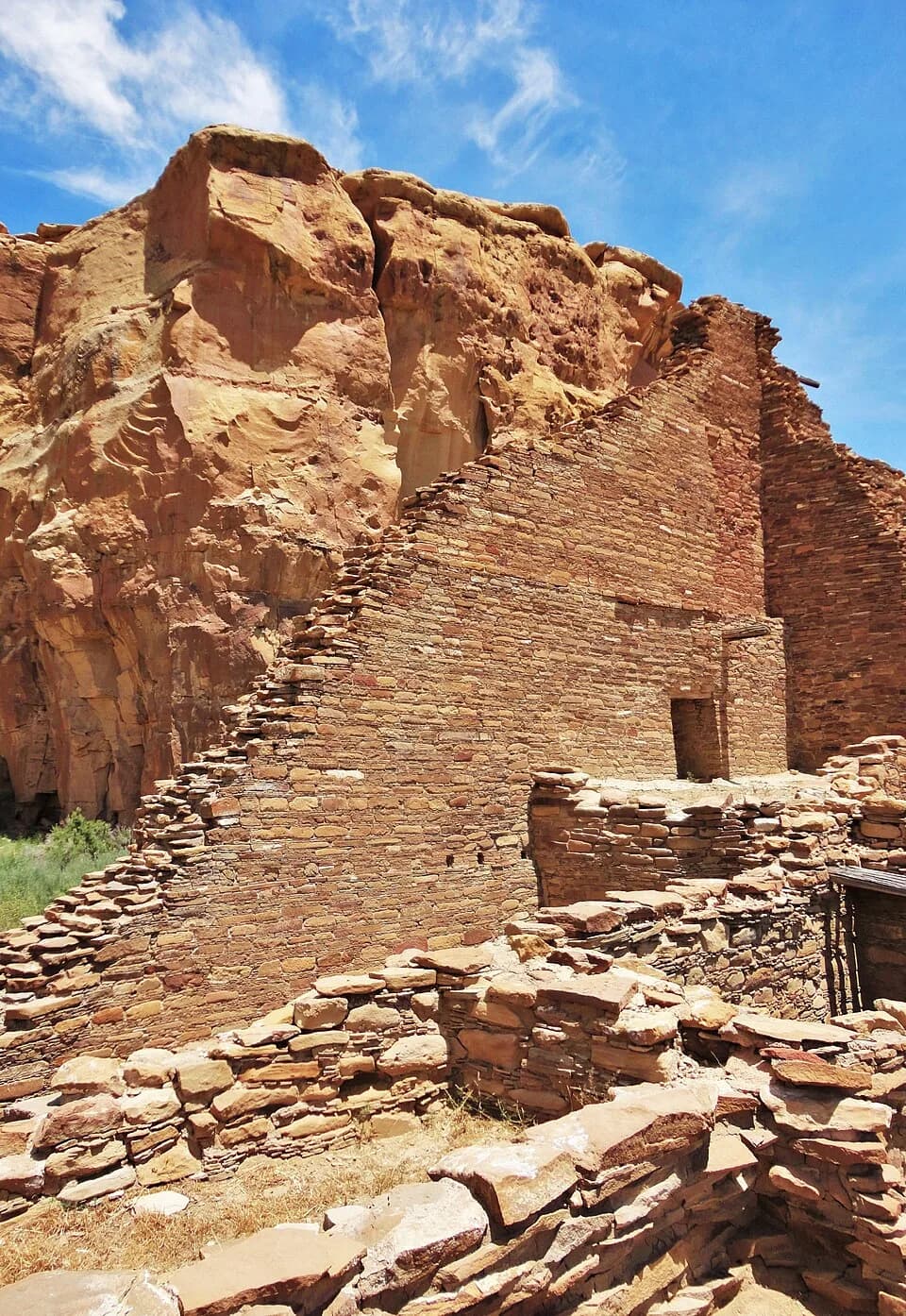
Pueblo Bonito is a sandstone building in a dry canyon in northwestern New Mexico. Crown and Wills count about 600 rooms in it and about 37 kivas.
Archaeologists have worked there for more than a century. They still do not agree on how many people lived in it, what it was for or when it was finished.
The traditional view
UNESCO inscribed Chaco Culture in 1987. It describes "a network of archaeological sites in northwestern New Mexico" that dominated much of the southwestern United States "from the mid-9th to early 13th centuries." It says Chacoan society "reached its height between about 1020 and 1110." It adds that the sites were linked by "an elaborate system of carefully engineered and constructed roads."
The National Park Service says Pueblo Bonito was planned and constructed in stages "between AD 850 to AD 1150 by ancestral Puebloan peoples." It says the building "was the center of the Chacoan world."
Crown and Wills describe two large excavations. The Hyde Exploring Expedition dug around 200 rooms between 1896 and 1899. A National Geographic Society project under Neil Judd excavated much of the rest between 1921 and 1927. They also write that the "poorly documented and, in some cases, unethical excavations" at the site make its history harder to interpret.
They also report that tree-ring dates put the start of construction in the ninth century. The NPS history of Chaco says tree-ring dating was applied to Pueblo Bonito in 1928 and 1929.
The same NPS history says that between 1150 and 1250 people stopped building great houses and began moving away. It says they became "the Pueblo Peoples of New Mexico and the Hopi of Arizona" and that "many maintain their connections with Chaco today."
The NPS page on history and culture records what descendants say. It states that "Pueblo descendants say that Chaco was a special gathering place where many peoples and clans converged to share their ceremonies, traditions, and knowledge." It adds that "Chaco is central to the origins of several Navajo clans and ceremonies."
The Network Question
In Earthly Enigmas I write that history books treat the ancient world as a series of isolated experiments. In Chapter 3 I describe Cahokia and ask whether the American mound cities came from independent invention, shared knowledge or something else. In Chapter 5 I write that solar and lunar alignments at Stonehenge, Carnac, Callanish and Newgrange show the same long-cycle awareness in seven countries.
Pueblo Bonito sits inside those questions, because the archaeological literature itself argues about outside influence, long-distance trade and the sky.
The Building Nobody Finished
The record leaves several questions open. Three of them stand out.
Who lived in it, and what was it for?
Crown and Wills open their 2018 paper in Antiquity with a plain admission. They write that the site's "origins, construction sequence, size, occupants, function and abandonment remain topics of debate."
Stephen Lekson edited the volume that summed up the National Park Service's Chaco Project. He writes that its chapters offer views "ranging from a centralized political hierarchy to a ceremonially based pilgrimage center, or even a hierarchically organized rituality." His own reading is that "Chaco had rulers, leaders, centralized hierarchical decision makers." He also writes that "Few researchers would claim one to the exclusion of the other; it is a matter, rather, of degree."
The NPS history says the Chaco Project's work led to "changing ideas about the Canyon and drastically reduced population estimates for the Great Houses." I have not found the numbers on either side.
In 2017 Kennett and colleagues published a paper in Nature Communications on nine people buried in Room 33. The authors place that small crypt in the first construction phase, in the ninth century. They report identical mitochondrial genomes and conclude that an elite matriline lasted about 330 years. They also write that "There is little agreement, however, regarding the exact nature or basis of political hierarchy."
The same paper says "the relationship between prehistoric people from Chaco and specific modern Native American groups remains uncertain."
Descendant communities answered the study sharply. Michael Balter reported in SAPIENS that some tribal officials were very angry that the work went ahead without consulting them. He quotes Leigh Kuwanwisiwma, director of cultural preservation for the Hopi Tribe, as saying "The tribe never gave any kind of permission or support."
Balter also quotes George Perry, the paleogeneticist who ran the main DNA analyses for the team. Perry says "I personally wish that as authors we had communicated earlier on in the study with potentially interested Native American pueblos and tribes." Kennett told Balter that his team had deferred to the American Museum of Natural History on questions of cultural affiliation. A 2021 paper in the Journal of Social Archaeology uses the episode as a case study and calls for an "ethical revolution." I have read only its abstract.
In 2025 Picuris Pueblo published its own study in Nature. The authors write that tribal leadership helped draft the research agreement and that "publication of results continues to be the sole decision of Picuris leadership." They report that "no other sampled population, ancient or present-day, is more closely related to Ancestral Puebloans from Pueblo Bonito than the Picuris individuals are." They add that DNA sampling in the region "is very limited and includes no other Pueblo communities."
What evidence would the hierarchy reading and the pilgrimage reading both accept?
What did it look like on any single day?
The room count moves with the source. Crown and Wills give about 600 masonry rooms. Kennett and colleagues give about 650. Crown and Hurst write of "an estimated 800 rooms."
Crown and Wills explain part of the problem. They write that "Chacoans reused wood from old structures when building new structures, refurbished older rooms with new pieces of wood and remodelled tirelessly." They add that "There are, however, problems with all of these dating techniques."
Tree-ring dates show a gap in building between about 975 and 1040. The authors say people "may have abandoned part or all of the site during this interval." They then cite Windes and Ford for at least 80 new rooms between 1040 and 1050. The same source gives 24 more between 1050 and 1070 and perhaps 160 to 170 more between 1070 and 1100. I have not read Windes and Ford.
Crown and Wills conclude that the history of Pueblo Bonito "may never be fully understood" in part because "its builders never considered it to be finished."
The timber adds a second puzzle. Guiterman, Swetnam and Dean call the origin of more than 240,000 construction timbers across the great houses "an enduring mystery." They tested 170 timbers from seven great houses. They found the Chuska and Zuni Mountains, more than 75 kilometers away, "the most likely sources, accounting for 70% of timbers."
They also report that before 1020 "nearly all timbers originated from the Zunis" and that by 1060 "the Chuskas eclipsed the Zuni area in total wood imports." Their findings, they write, "corroborate the long-standing but recently challenged interpretation" that the timbers came from distant mountains. I have not read the challenge.
UNESCO puts the height of Chacoan society between about 1020 and 1110. The NPS dates the building from 850 to 1150. What did Pueblo Bonito look like on any single day?
Where did the ideas and the goods come from?
Crown and Hurst reported theobromine, a biomarker for cacao, in fragments of vessels from Pueblo Bonito that are likely cylinder jars. They write that this is the "first known use of cacao drinks north of the Mexican border." They say it indicates "exchange with cacao cultivators in Mesoamerica in a time frame of about A.D. 1000-1125."
Lekson adds that two rooms at Pueblo Bonito held "almost all of about two hundred known cylinder vases." He reports "about thirty-five copper bells and about thirty-five scarlet macaws, all presumably from western Mexico." He also names colonnades at Chetro Ketl as "a Mesoamerican form."
He describes an old split in the field. He writes that many archaeologists, including key Chaco Project archaeologists, concluded that Mesoamerican influence explained the Bonito phase. He adds that "Opinion was sharply divided," and that the New Archaeology of the 1970s and early 1980s favored local adaptation.
The local case has its own evidence. Crown and Wills report that the first architecture at Pueblo Bonito has been described as seeming "to appear fully formed and without precedent." They also report a suggestion by Windes and Van Dyke that migrants from the San Juan River area, about 190 kilometers north, built it.
Crown and Wills answer that there is "currently no independent archaeological evidence" for an influx of northern populations in the ninth century. They write that Pueblo Bonito "was probably established on an extensive earlier settlement" and that its early rooms show "a lack of a unified architectural style."
Both accounts are on the page. Where did the ideas behind Pueblo Bonito come from?
The questions I can't put down
Some questions need more room than one article gives them. Two of them keep pulling me back.
What was the Sun Dagger for? On Fajada Butte three sandstone slabs let beams of light fall on two spirals carved in the cliff. The NPS says this interplay of light and shadow "appears to have functioned as a calendrical marker." Sofaer, Zinser and Sinclair wrote in Science in 1979 that the assembly appears to be the deliberate work of the Ancestral Pueblo builders. Newman, Mark and Vivian answered in Science in 1982 that the slabs "appear to be the result of a natural rockfall." They thought the spirals were designed afterward by people who watched the light for several annual cycles. I have read only both abstracts. The NPS restricted access to the butte in 1982 and found in 1989 that two of the three slabs had shifted. In Chapter 5 I write that solar and lunar alignments take generations of observation. You can follow that argument through Earthly Enigmas.
Is Pueblo Bonito on a line? Lekson argued in 1999 that Chaco Canyon, Aztec Ruins and Paquimé were set on one meridian. David Phillips calls the argument "novel, provocative, and wrong" in an analysis hosted by the University of New Mexico. He reports that Aztec lies 3.7 kilometers west of the meridian over a distance of 86 kilometers. I have not read Lekson's book and take its claims from Phillips. In Chapter 5 I follow Jim Alison's great circle through 17 sites, and I write that anyone can check the fit. The Paquimé article covers the macaws and the dating fight at the southern end of Lekson's line.
You can read a free sample of the book before you decide. The articles section has more subjects in the same format, including Cahokia's Monks Mound.
Sources
- UNESCO World Heritage Centre: Chaco Culture
- National Park Service: Pueblo Bonito
- National Park Service: A Brief History of Chaco Culture National Historical Park
- National Park Service: Chaco history and culture
- National Park Service: Fajada Butte Solstice Marker brochure (hosted on npshistory.com)
- Crown and Wills, The complex history of Pueblo Bonito and its interpretation, Antiquity 92 (2018)
- Crown and Hurst, Evidence of cacao use in the Prehispanic American Southwest, PNAS (2009)
- Guiterman, Swetnam and Dean, Eleventh-century shift in timber procurement areas for the great houses of Chaco Canyon, PNAS (2016)
- Lekson, Chaco Matters: An Introduction, in The Archaeology of Chaco Canyon (SAR Press, 2006), excerpt hosted by the Western National Parks Association
- Kennett et al., Archaeogenomic evidence reveals prehistoric matrilineal dynasty, Nature Communications 8 (2017)
- Balter, The Ethical Battle Over Ancient DNA, SAPIENS (2017)
- Cortez et al., An ethical crisis in ancient DNA research, Journal of Social Archaeology (2021) (abstract only)
- Adler et al., Picuris Pueblo oral history and genomics reveal continuity in US Southwest, Nature (2025)
- Sofaer, Zinser and Sinclair, A unique solar marking construct, Science (1979) (abstract only)
- Newman, Mark and Vivian, Anasazi solar marker: the use of a natural rockfall, Science (1982) (abstract only)
- Phillips, The Chaco Meridian: A Skeptical Analysis (University of New Mexico)