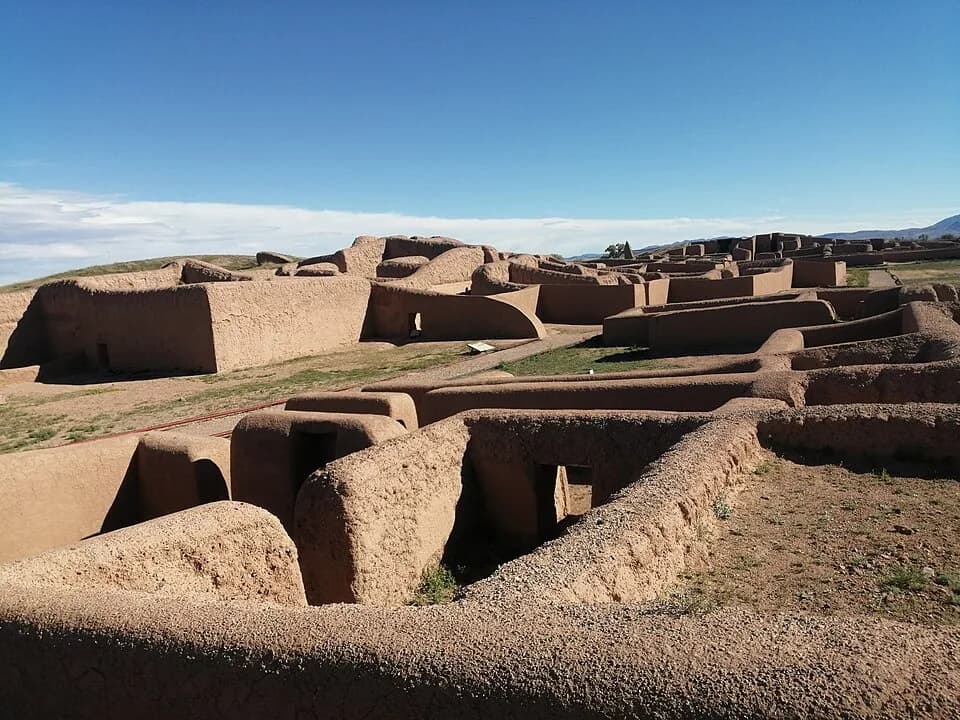
Paquimé is a city of adobe in northern Chihuahua, Mexico. UNESCO says it holds the remains of some 2,000 rooms. A 2024 paper in Antiquity counts about 1,100.
The room count is not the only number that moves. Depending on whose work you read, the city began anywhere from about 1060 to about 1300.
The traditional view
UNESCO inscribed the Archaeological Zone of Paquimé, Casas Grandes in 1998. It says Paquimé "played a key role in trade and cultural contacts." It names two sides, "the Pueblo culture of the south-western United States and northern Mexico" and "the more advanced civilizations of Mesoamerica." It dates the development to "700-1475" and the apogee to "the 14th and 15th centuries."
The site was excavated in the late 1950s and early 1960s by the Joint Casas Grandes Project under Charles Di Peso. Sedig and colleagues write in Antiquity that the project "and subsequent analyses form the foundation of archaeological understanding about Paquimé." They list a serpent mound about 113 meters long, a large cruciform mound and at least two ballcourts. They also list an aqueduct that carried water about six kilometers from a spring. Over four million pieces of marine shell were stored there. Paquimé was also a macaw breeding community with macaw pens and hundreds of macaw burials.
UNESCO describes buildings of "earthen architecture" that "originally must have been several stories high," with doors in a "T" shape. It states that the site "has remained largely unexcavated."
Most specialists now place the city between 1200 and 1450. Sedig and colleagues give the dates as AD 1200 to 1450 and call it "undoubtedly the political and ceremonial centre of the region."
The Network Question
In Earthly Enigmas I write that history books treat the ancient world as a series of isolated experiments. I also write that Stonehenge, Carnac, Callanish and Newgrange share the same long-cycle awareness in seven countries not in contact by any route mainstream archaeology accepts.
Paquimé is a different case. UNESCO itself describes a city that sat between the Pueblo world and Mesoamerica and moved goods and ideas between them.
The Dates They Cannot Settle
Both views lean on questions the evidence cannot yet answer. Three of them stand out.
When was the city built?
Gamboa Carrera, Medina Villalobos and Solís Rosales of INAH Chihuahua say that one of the main discussions since Di Peso's work has been "la temporalidad del sitio." They report that Di Peso considered the occupation continuous from 1060 to 1261. Later reevaluations of his data placed the development between 1200 and 1450.
Stephen Lekson explains why in a working draft hosted by the University of Arizona. He writes that Di Peso's chronology "was based almost entirely on tree-ring dating" and that Di Peso accepted "non-cutting dendrochronological dates" as construction dates. He adds that carpenters shaved the beams, so the outer rings were gone. In his reading Di Peso pushed the city back into the eleventh century because he believed Paquimé and Chaco overlapped. Lekson calls that his own opinion.
Dean and Ravesloot revisited the tree rings in 1993. Lekson quotes them saying the Paquimé phase "was a fourteenth-century phenomenon whose inception can be placed very near A.D. 1300." Michael Whalen and Paul Minnis later dated four sites in the region with 84 radiocarbon dates. Lekson quotes them as finding that "the Medio period clearly is underway by A.D. 1200, although there are hints in the Casas Grandes area and elsewhere that it may have begun a little before this date." Lekson answers that he fears their dating "suffers from flaws almost as serious as Di Peso's tree-rings."
The new INAH dates come from accelerator radiocarbon work in the House of the Pillars. The authors write that the results support construction of the excavated rooms in the thirteenth and fourteenth centuries and occupation until about 1400. They add that they found no sign of cultural activity at Paquimé after 1450. That last line is my translation of their Spanish abstract.
David Phillips notes in a conference paper that "Paquimé yielded no cutting dates." Which new dates would every camp accept?
Who built it, and where did the knowhow come from?
Di Peso's own answer was a Mesoamerican one. A University of New Mexico overview page puts it this way. "Mesoamerican merchant-warriors (which he modeled after the Aztec pochteca) first manipulated the historical trajectory of the culture area, then established Paquimé in order to control that area more directly." I have not confirmed who wrote that page.
Sedig and colleagues say that archaeologists "have revised many of Di Peso's hypotheses, especially that Mesoamerican pochteca traders founded Paquimé." They list the options still debated. One is migration from the Mimbres-Mogollon region to the north. Another is influence by an elite lineage from the Chaco Canyon and Aztec Ruins region. The others are local population growth and the allure of socio-religious leaders.
The same UNM page quotes Whalen and Minnis, who see Paquimé as "one of prehistoric North America's few examples of indigenous complex society development." UNESCO's own wording for criterion (iv) speaks of "the blending" of adobe architecture "with the more advanced techniques of Mesoamerica."
Lekson sees a gap. He writes of "a missing century from 1125 to 1250" between the end of the Mimbres culture and the rise of Paquimé. He allows that Paquimé may have been "fundamentally local" and then asks whether that is likely. He points to the "I"-shaped ballcourts, the T-shaped doors and the quantities of exotic shell and pottery.
Was the city grown at home or brought in from outside?
What does "ended" mean?
UNESCO says the culture "suddenly vanished at the time of the Spanish Conquest." The University of New Mexico paper by David Phillips says something different. He writes that "Beyond a reasonable doubt," Paquimé was abandoned by 1450. He notes that when the Spanish reached it in the 1560s, "it too was abandoned." Phillips marks his paper as a draft to check with him before citing.
Phillips reports that Di Peso believed Paquimé "succumbed to an attack in A.D. 1340." Sedig and colleagues write that "there also is no consensus on Paquimé's end, though evidence suggests it was unpleasant." They report close to 100 human skeletons from the final occupation left unburied, which scholars have attributed to violence, disease or starvation. The Suma people the Spanish met may have descended from Paquimé's residents, according to Douglas and Brown, whom Sedig and colleagues cite. I have not read that work.
Phillips says "Something Bad Happened in the early 1400s." He adds that the people did not disappear overnight and that a native account collected by the Spanish says they moved north after a conflict with people to the west. On the cause he writes "we don't have any answers yet."
What happened to the city, and where did its people go?
The questions I can't put down
Some questions need more room than one article gives them. Two of them keep pulling me back.
Where were the macaws bred? George, Plog and colleagues write in PNAS that "Clear evidence for scarlet macaw breeding within this network is only known from the settlement of Paquimé." They date it to the years 1250 through 1450. Hundreds of macaw skeletons turn up more than 1,000 kilometers outside the bird's home range, including at Chaco Canyon in birds dated 900 to 1200. The authors say excavations have not revealed breeding centers from before Paquimé. They propose a colony "some distance north of their endemic range" that supplied the Southwest for nearly three centuries. In Chapter 5 I write that history books treat the ancient world as a series of isolated experiments. I follow that question through Earthly Enigmas.
How much of the city have we seen? UNESCO says only part of Paquimé has been excavated. Lekson writes that Di Peso "excavated about one-third of Paquimé" and that new excavations there are "unlikely in our lifetimes."
The people Paquimé traded with in Mesoamerica left books too. In Chapter 16 I write that of an estimated 400 Mesoamerican codices, fewer than 20 survive. You can read a free sample before you decide. The articles section has more subjects in the same format, including Teotihuacan.
Sources
- UNESCO World Heritage Centre: Archaeological Zone of Paquimé, Casas Grandes
- Gamboa Carrera, Medina Villalobos and Solís Rosales, Recientes fechamientos en la Casa de los Pilares, Ventana Arqueológica 2 (INAH, 2021)
- Lekson, Black Mountain and Paquimé: Dating the Medio Period of Casas Grandes (working draft, University of Arizona)
- Phillips, The End of Casas Grandes (SAA 2008 paper, revised draft 2009, University of New Mexico)
- Sedig et al., High levels of consanguinity in a child from Paquimé, Antiquity 98 (2024)
- George, Plog et al., Archaeogenomic evidence from the southwestern US points to a pre-Hispanic scarlet macaw breeding colony, PNAS 115 (2018)
- University of New Mexico: Archaeology and Prehistory of Northwest Mexico, Paquimé and Northwest Chihuahua (overview page; author not confirmed)