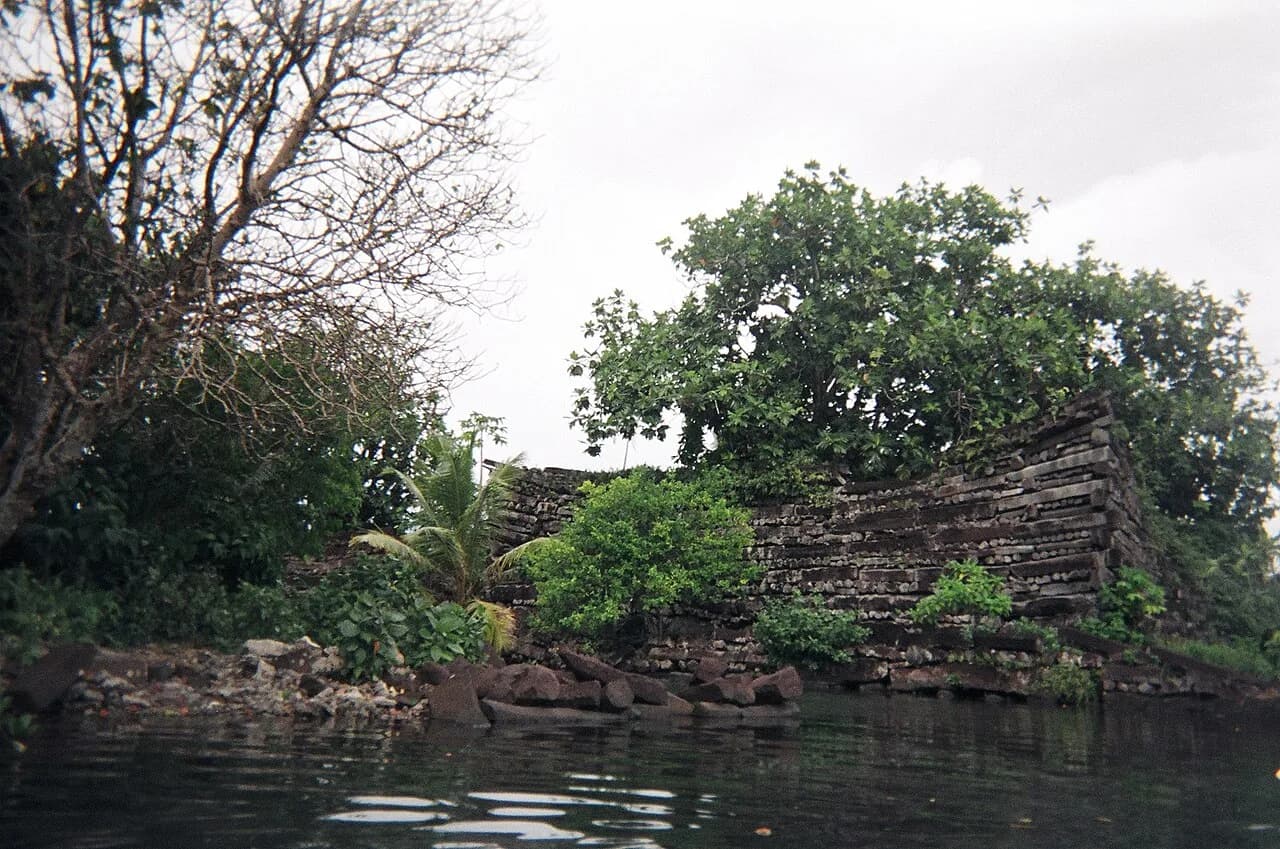
Nan Madol sits on a reef flat off the southeast coast of Pohnpei, an island in the Federated States of Micronesia. Roughly a hundred artificial islets lie there, cut by tidal channels. Walls of black basalt columns surround them, stacked like logs in a cabin.
The name is usually translated as "in the space between things." The space is wide. The columns came from the other side of the island.
The traditional view
UNESCO added Nan Madol: Ceremonial Centre of Eastern Micronesia to the World Heritage List in 2016. It describes more than 100 islets built with walls of basalt and coral boulders. They hold the remains of stone palaces, temples, tombs and residential domains built between 1200 and 1500 CE. UNESCO calls the site the ceremonial center of the Saudeleur dynasty.
UNESCO cites the walls as outstanding monumental architecture. They use "massive columnar basalt stones, transported from quarries elsewhere on the island, and laid using a distinctive 'header-stretcher technique'." UNESCO also lists the site as in danger. Silt and mangroves are undermining the walls.
J. Stephen Athens of the International Archaeological Research Institute excavated there in 1979-80, 1982 and 1984. He reports that islet construction began "at least by AD 900." Megalithic building with columnar basalt began about AD 1200, when the Saudeleur established themselves. He calls the labor of moving and placing the columns "remarkable for a prehistoric society."
A 2016 study in Quaternary Research by Mark McCoy and colleagues dated coral from the tomb of the first chief of Pohnpei. It places the beginning of monument building at Nan Madol in AD 1180 to 1200. The same study used the chemistry of the basalt to trace it to its source.
The Island Builders
In Earthly Enigmas I count 92 islets of basalt columns with a total weight of about 750,000 metric tons. I give the columns as 5 to 50 tons each. I date the main building phase to about 1200 to 1500 CE under the Saudeleur dynasty, with some deeper dates reaching back to 200 CE.
I write that the transport of the columns across 25 to 30 kilometers of open water is not established. I report the 2016 UNESCO listing as noting that the construction method remains unknown. I say that this is the official assessment of the professionals who study the site.
I also see a link to other places. In the book I describe the basalt-stacking logic of Nan Madol and the interlocking geometry of Puma Punku as the same answer to the same question.
Where the Evidence Runs Out
Both views lean on questions the sources cannot yet answer. Three of them stand out.
How did they move the columns?
The sources agree on where the stone came from. UNESCO says it was transported from quarries elsewhere on the island. Smarthistory names the quarry at Sokehs and puts the distance at more than 25 miles. McCoy and Athens used the chemistry of the stone to match it to its source.
Nobody names the method. In Smithsonian Magazine the Pohnpeian archaeologist Rufino Mauricio says "We don't know how they brought the columns here and we don't know how they lifted them up to build the walls." He adds that most Pohnpeians are content to believe magic flew them.
Two published accounts disagree about the tools. Smarthistory says the builders used ropes and levers to stack the columns. Mauricio says they had "no pulleys, no levers and no metal."
How was it done?
When was it built, and for how long?
The published dates do not all mark the same event. UNESCO gives 1200 to 1500 CE. McCoy and colleagues date the start of monument building to AD 1180 to 1200. McCoy and Athens give a building span of A.D. 900 to 1650 in a 2011 paper. I have read only its abstract.
The Remote Sensing survey by Douglas Comer and colleagues says Nan Madol was "constructed over a millennium." It places the Saudeleur dynasty at about 1200 to 1600 CE.
Athens dates the earliest human occupation of the site to about AD 1, on natural sand islets that the artificial islets now cover. In the book I write that some deeper dates reach back to 200 CE. I have not found the source of that date.
When did the building begin, and how long did it run?
How did a small population organize and feed it?
Smarthistory and Christopher Pala of Smithsonian Magazine both give Pohnpei's population at the time as under 30,000. Pala puts the total weight at 750,000 metric tons. That works out to an average of 1,850 tons a year over four centuries. He reports Mauricio's view that this was a much larger effort than the pyramids were for the Egyptians. I have not checked that comparison.
Smarthistory says food and water probably came from the island interior. Comer and colleagues surveyed Temwen Island with airborne LiDAR and found a complex irrigated cultivation system. They say it may have fed the site, if it dates to the Saudeleur period. They have not yet shown that it does.
What kind of society could keep this going for centuries?
The questions I can't put down
Some questions need more room than one article gives them. Two of them keep pulling me back.
What does the oral tradition remember? Smarthistory reports stories of great birds and giants moving the stones, and of twin sorcerers who made a place to worship their gods. It also reports that other parts of the tradition match the archaeology, such as the eel canals and the turtle midden on Idehd. I follow the question through Earthly Enigmas.
Why does the same stacking logic show up on the other side of the world? In the book I treat Nan Madol and Puma Punku as the same answer to the same question. Neither UNESCO nor Smarthistory makes that comparison. I have not checked it against a published source. You can read a free sample before you decide. The articles section has more subjects in the same format.
Sources
- UNESCO World Heritage Centre: Nan Madol, Ceremonial Centre of Eastern Micronesia
- IARII (J. Stephen Athens): Monumental Architecture of Nan Madol
- McCoy et al. (2016): Earliest direct evidence of monument building at Nan Madol, Quaternary Research 86(3) (abstract)
- McCoy and Athens (2011): Sourcing the Megalithic Stones of Nan Madol, Journal of Pacific Archaeology 3(1) (abstract)
- Comer et al. (2019): Airborne LiDAR Reveals a Vast Archaeological Landscape at the Nan Madol World Heritage Site, Remote Sensing 11(18)
- Smarthistory: Nan Madol, "In the space between things"
- Smithsonian Magazine: Nan Madol, The City Built on Coral Reefs