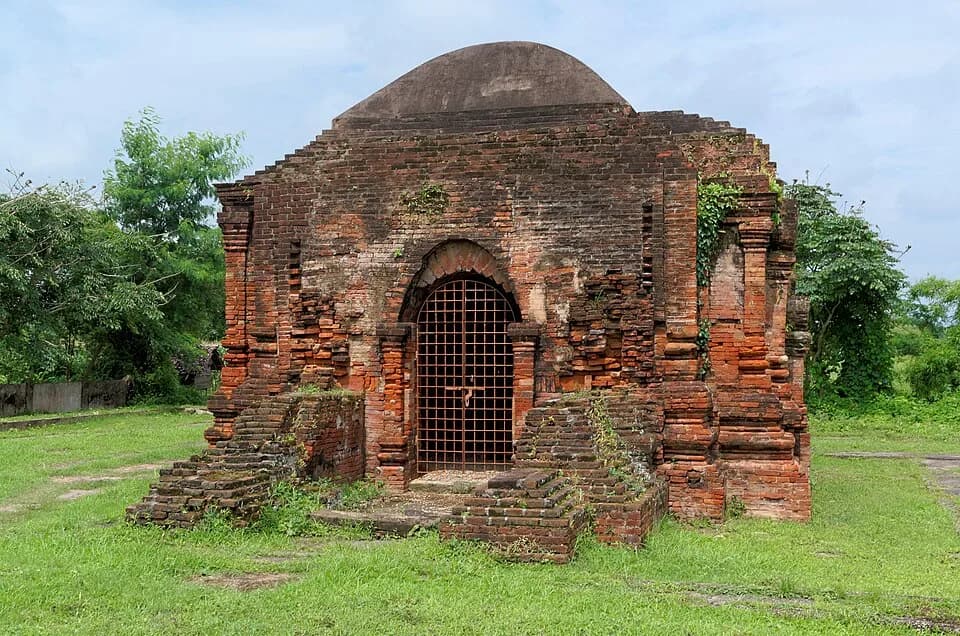
The walls of Sri Ksetra in Myanmar still stand about five meters high in places. Stargardt and colleagues put the area inside them at 1,857 hectares.
UNESCO lists Sri Ksetra with two other brick cities as the Pyu Ancient Cities. Ask how old they are and the answer depends on which paper you open.
The traditional view
UNESCO describes three brick, walled and moated cities called Halin, Beikthano and Sri Ksetra. They sit in "vast irrigated landscapes in the dry zone of the Ayeyarwady (Irrawaddy) River basin." UNESCO says they reflect "the Pyu Kingdoms that flourished for over 1,000 years between 200 BC and AD 900."
The cities are partly excavated. UNESCO lists palace citadels, burial grounds, manufacture sites, brick Buddhist stupas, partly standing walls and water features, "some still in use."
UNESCO calls the cities the earliest testimony of Buddhism arriving in Southeast Asia almost two thousand years ago. Its statement of value adds that the Pyu "created a special form of urbanization, the city of extended urban format, which subsequently influenced urbanization in most of mainland Southeast Asia."
An extended city is a low density layout. The advisory body ICOMOS explains that the walled area holds fields, gardens, canals and water tanks as well as monuments, palaces and dwellings.
ICOMOS also reports that eighth century Chinese records identify 18 Pyu states in the Irrawaddy valley. Archaeologists have so far found six principal walled cities in upper Myanmar. The three nominated cities are said to be the most thoroughly excavated and the best dated.
The cities are not only ruins. UNESCO writes that the old irrigated landscape still shapes the livelihoods of nearby villagers and that Buddhist pilgrims still venerate the religious monuments.
The Global Network
In Earthly Enigmas I write that history books treat the ancient world as a series of isolated experiments. I raise Angkor in Chapter 5 as part of that argument.
The Pyu matter to the argument because of a claim that sits in UNESCO's own text. UNESCO says the extended city spread outward from the Pyu cities. ICOMOS, writing before the inscription, says the same kind of city may have appeared in different places for separate reasons. Both statements are quoted below.
Where The Cities Do Not Agree
Three questions stand out.
How old are the cities?
UNESCO's statement of integrity says that "radiocarbon dates derived from intact architectural features dating back to 190 BCE, provide scientific proof of the entire one-thousand year period of occupation of the cities."
Janice Stargardt and her team describe the base of that evidence differently in Antiquity. They write that "the outline chronology of Sri Ksetra rests on a small number of reliable dates acquired since 2012." In the same paper they call one sample "at present the only reliable date for the Pyu in the late first millennium AD from any site in Myanmar."
The three cities also carry different start dates. ICOMOS says that "from the dates so far achieved" the extended urban format had emerged at Halin by the second to third century CE. It gives the second century BCE to the fourth century CE for Beikthano and the first to third century CE for Sri Ksetra.
A 2024 paper in Antiquity by T.O. Pryce and colleagues reports 94 radiocarbon determinations from Halin. The authors describe "a chronological sequence from the early third millennium BC to the early second millennium AD." They add that "corroboration of the beginning of this sequence would place Halin as the oldest currently dated Neolithic site in Mainland Southeast Asia." I have only read the abstract because the full paper sits behind a paywall.
Stargardt's 2016 abstract adds a note. She writes that "the radiocarbon dates for Pyu urbanism are at present earlier," and that the cities share many features with other urbanizing societies in mainland Southeast Asia.
Does the date of the oldest layer at a site date the city, or only the ground it stands on?
Who dated the canals?
UNESCO says the water management features "underpinned the organized intensive agriculture." ICOMOS describes the Pyu water system as never really abandoned and says farmers still rely on tanks the Pyu built two thousand years ago.
The same ICOMOS evaluation records a limit. It writes that "no complete systematic survey of the water management system has been undertaken and no attempts made to date the various segments of the systems." It adds that "there appears to be very little archaeological data." ICOMOS wrote this in 2014.
Stargardt and Gabriel Amable have remapped Sri Ksetra with remote sensing and ground checks since 2006. The Antiquity paper says they identified "four linked phases of water control and urban development between approximately the second century BC and the ninth century AD." ICOMOS says the system at Sri Ksetra reached its greatest extent from the seventh to the ninth century AD.
I have not checked whether similar mapping exists for Halin or Beikthano.
Which tanks and canals can be tied to which century, and who dug them?
Did the Pyu cities teach Angkor?
UNESCO's text is plain on this point. The extended city "subsequently influenced urbanization in most of mainland Southeast Asia."
ICOMOS did not accept that without question. Its evaluation writes that "not all scholars would agree that this 'extended city' is a phenomenon which was consciously invented at one place and time, and then transmitted as a single unified entity or concept to other parts of the region." It adds that it "cannot be more than surmised" that the pattern first appeared at the three Pyu sites before it developed elsewhere, "most notably at Angkor."
ICOMOS goes further. It writes that "it is however impossible to prove that the later development of similar cities such as Angkor were due to influence from the Pyu sites. Angkor could have arisen independently when similar conditions arose."
Stargardt and her colleagues supply the timeline that makes the idea attractive. They write that elsewhere in Southeast Asia such cities developed later, from about the fifth or sixth century AD. They call Pagan and Angkor "famous later heirs of this urban tradition."
UNESCO and ICOMOS read the same dates. If the same conditions can raise the same kind of city twice, what would show that one city taught the other?
The questions I can't put down
Some questions need more room than one article gives them. Two of them keep pulling me back.
What year are the Payagyi urns? Four burial urns found at Sri Ksetra in 1911 each carry a short Pyu inscription with a death year. Tilman Frasch reviews the debate in a 2024 paper. Scholars have read the dates in the Gupta era, the Saka era or the Myanmar era, which begins in 638 CE. By my own arithmetic from the era start years he gives, year 35 falls in the second century CE under the Saka era and in the seventh under the Myanmar era. Frasch writes that "it still seems the best bet" that the Pyu of Sri Ksetra used the Myanmar era. He also writes that no simple conclusion "that could solve all points" seems possible. In Chapter 4 of the book I follow dating disputes of my own.
Who were the Pyu? ICOMOS writes that "it is not clear who the Pyu people were." Frasch adds in a footnote that the term "may be a misnomer." Hudson, Nyein Lwin and Win Maung report that the Pyu called themselves "Tircul," and they credit that name to Aung-Thwin. You can read a free sample to see how I handle other cases where the name outlasts the evidence. The articles section has more subjects in the same format.
Sources
- UNESCO World Heritage Centre: Pyu Ancient Cities (1444)
- ICOMOS Advisory Body Evaluation, Pyu Ancient Cities, No 1444 (2014)
- Stargardt et al., Early urban archaeology in Southeast Asia: the first evidence for a Pyu habitation site at Sri Ksetra (Antiquity Project Gallery)
- Stargardt, From the Iron Age to early cities at Sri Ksetra and Beikthano, Myanmar, Journal of Southeast Asian Studies 47 (2016) (abstract only)
- Pryce et al., Late prehistoric and early historic chronology of Myanmar: a four-millennia sequence from Halin, Antiquity 98 (2024) (abstract only)
- Frasch, Pyu urns, Indian calendars, and Myanmar culture, Journal of the Royal Asiatic Society (2024)
- Hudson, Nyein Lwin and Win Maung, The Origins of Bagan: New Dates and Old Inhabitants, Asian Perspectives 40 (2002)