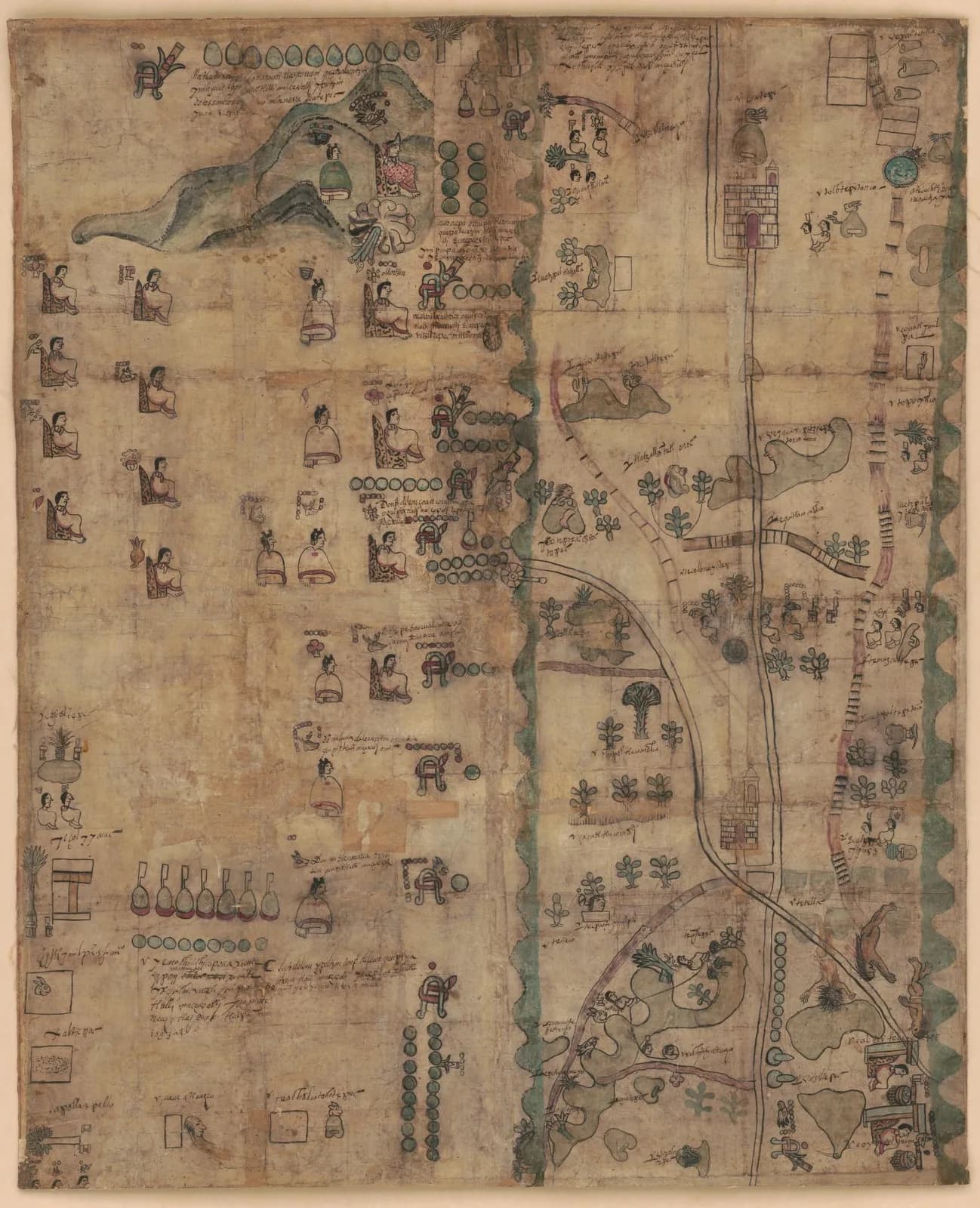
On a sheet of paper 90 by 73 centimeters, a lord sits in a jaguar-fur chair. His descendants run down the left half. Churches and roads fill the right.
The Library of Congress catalog lists the producer as not identified. The title comes from a dealer's publication.
The traditional view
The Codex Quetzalecatzin is a manuscript map in the Geography and Map Division of the Library of Congress. The catalog dates it to 1593. It describes iron gall ink and watercolor on European laid paper, mounted on cloth, with some discoloration and repaired losses.
The catalog says the sheet shows genealogical information and land ownership for the Nahuatl "de Leon" family from 1480 to 1593. Curator John Hessler writes that the family descends from Lord 11 Quetzalecatzin, who "in 1480, was the major political leader of the region."
Mary Elizabeth Haude is a conservator at the Library. In a 2025 paper she calls the codex a genealogy on the left side. She calls the right side a map "showing their territories in the southern Puebla and northern Oaxaca regions of present-day Mexico."
The Library's acquisition blog says the right half shows a community adapting to Spanish law, with churches and Spanish names. It lists Latin-alphabet notes and names such as don Alonso and don Matheo as clues to colonial-era composition. It places the codex in the "Pinome Group" of related pictorial documents, which includes the Tecamachalco Canvas, the Cuevas Codices and the Fragmented Codex.
Hessler says the codex was created when many cartographic histories were being produced as part of a Spanish royal investigation. In those same years, he writes, indigenous families "were trying to reassert their ancient land claims." He adds that only around 450 Mesoamerican pictorial manuscripts survive and fewer than 100 of them pre-date 1600.
The Library bought the codex in 2017 from the heirs of the Paris dealer Charles Ratton. The curator says the heirs had obtained a European Union export permit for it.
What Survived and What Went Missing
In Earthly Enigmas I write about the Church and the books of Mesoamerica in Chapter 16. I name Diego de Landa, who burned Maya books in 1562. I describe an institution that spent the better part of fifteen centuries suppressing and in some cases destroying ancient knowledge systems.
Historians Bradley Benton and Peter Villella make a related point in a Library essay. They write that "the first Spanish clergy confiscated and destroyed many Mesoamerican religious texts."
The Codex Quetzalecatzin was painted under Spanish rule. The Library calls its composition colonial-era.
What Has Not Been Settled
Both views lean on questions the evidence has not answered. Three of them stand out.
Where does the map reach, and when was it painted?
The Library catalog says the map covers southern Puebla. It names the church of Todos Santos, Ecatepec, which it describes as now a suburb to the north east of modern-day Mexico City, and it names Lake Texcoco. Hessler writes that the lands extend "from slightly north of Mexico City, to just south of Puebla."
The philology wiki of the National Autonomous University of Mexico has a different entry. Its base text is by Sebastián van Doesburg. It places the map at Todos Santos Ehecatepec and Santa Cruz Huitziltepec in the state of Puebla. It ties the map to the Tecamachalco region of southern Puebla. Stephanie Wood's lexicon of Aztec hieroglyphs agrees on the region. She writes that the codex covers ruling men and women of Tecamachalco through 1593.
I have not checked whether the Ecatepec in the catalog and the Ehecatepec in the university entry are the same place.
The dates differ too. The catalog says 1593. Hessler writes that the manuscript "dates from between 1570 and 1595." The university entry says approximately 1575 to 1590 (my translation). It says the map's own counting runs from the year 2-Reed, which it equates to 1443, down to 1593. It also says the date 1593 appears added to a gloss in the lower left half (my translation).
Where does the map reach, and when did the painter finish it?
Whose hands are on this sheet?
Haude examined the codex with ultraviolet, infrared and transmitted infrared imaging. She writes that "Since its creation, the codex underwent restoration and revision." She finds thin paper patches on the front, a thick fabric lining on the back and white and off-white paint over many areas. She writes that revisions to the imagery and glyphs were made directly to the paper in those painted areas and on top of the patches.
She dates some of this work to the 19th century. The off-white paint behaves like zinc white, which she says came into use as a paint in 1834. A printed fragment between the paper and the lining carries a date she reads as May 13 or 15, 1891.
One large patch near the top center carries new imagery and writing that matches the style of the rest. She writes "While speculative, this may be an early revision." She adds that analysis is warranted to determine if the patch is contemporaneous with the codex.
The year circles show the same layering. For the ruler 4-Flower she counts nine turquoise circles in visible light and eleven in the infrared images. She quotes van Doesburg, in her translation, "An eleventh circle was added between the first ones."
The catalog notes some discoloration and repaired losses. The university entry says the map is well preserved but cut at the edges to fit a 20th-century wooden frame (my translation).
Haude writes that it is unclear who made the later revisions. They could be the work of a restorer with no connection to the codex. They could also be the work of "a member of the community from which it originated." She calls her paper a "starting point for a more comprehensive research project."
Which lines belong to the painter of the 1500s, and who made the rest?
What happened between the painting and the library?
Haude gives the firm chain. Charles Ratton bought the codex in 1939 from Sotheby and Company and held it until 2017. William Randolph Hearst owned it before 1939. She writes that van Doesburg says the codex was taken out of Mexico in 1906, after the death of the archaeologist Alfredo Chavero. He adds that little is known about its provenance before then.
John B. Glass and Donald Robertson raise the possibility that the codex was in Chavero's collection. The university entry calls it very unlikely that the codex is the "Mapa jeroglífico del Señorío de Quetzala" listed in that collection. It adds that all of Chavero's references could be part of the same manuscript (my translation).
The Library's blog says the provenance is well documented and can be traced into the 19th century, through owners including Hearst and the first Viscount Cowdray. The 1891 newspaper fragment names Veracruz and Progreso. Haude says that suggests the codex was in Mexico in the late 19th century.
A reader asked on the blog what is known of the original discovery. The page shows no reply.
Haude writes that because the manuscript was in private hands until the Library acquired it, "we will never know how it was stored, handled, displayed, or restored."
The painting is from the 1500s and the firm record starts in the 1800s. Where was the sheet before 1891, and who kept it?
The questions I can't put down
Some questions need more room than one article gives them. Two of them keep pulling me back.
How many painted books survive? Hessler gives around 450 surviving Mesoamerican pictorial manuscripts, with fewer than 100 older than 1600. In Chapter 16 of Earthly Enigmas I give the figure for survivors as fewer than 20, out of an estimated 400. I have not checked what each count includes. I follow the question through Diego de Landa and the Church in the book.
What was the sheet for? The catalog lists it as a cadastral map. Hessler names a royal investigation and old land claims. The university entry counts each ruler's reign over the lands and commoners of Ecatepec and Huitziltepec (my translation). I found no source that ties this codex to a named lawsuit. The Library says the Oztoticpac Lands Map was drawn for a court case in Texcoco around 1540. In Chapter 11 I write about how oral tradition carries knowledge forward and I call it a technology. You can read a free sample before you decide. The articles section has more subjects in the same format.
Sources
- Library of Congress catalog record, The Codex Quetzalecatzin (LCCN 2017590521)
- Library of Congress blog, New Acquisition: Extremely Rare Mesoamerican Manuscript (2017)
- John Hessler, The Codex Quetzalecatzin comes to the Library of Congress (2017)
- Mary Elizabeth Haude, The Codex Quetzalecatzin: the Evolution of its Creation Revealed through Multiband Imaging (Conservation 360, 2025)
- Mary Elizabeth Haude, A Conservator's Virtual Examination of the Codex Quetzalecatzin (Library of Congress, 2020)
- UNAM Instituto de Investigaciones Filológicas, Wiki Filología, Ecatepec y Huitziltepec, Mapa de (base text Sebastián van Doesburg)
- Stephanie Wood, Visual Lexicon of Aztec Hieroglyphs, chicompohua xihuitl (CQ)
- Benton and Villella, Myths and Realities of the Pre- and Post-Conquest Indigenous World (Library of Congress, 2020)
- Library of Congress blog, Library Acquires Rare Codex from Central Mexico (2022)
- Wikipedia was not used. I have not read van Doesburg's 2018 study or Glass and Robertson's 1975 census. I know them only through Haude and the university entry.