Dig through the right sediment at a Clovis site in North America and you find a thin dark band. Below it lie the bones of extinct giants and the spear points of the people who hunted them. Above it the bones and the points are gone.
Researchers agree on the dark layer. They disagree about what put it there.
The traditional view
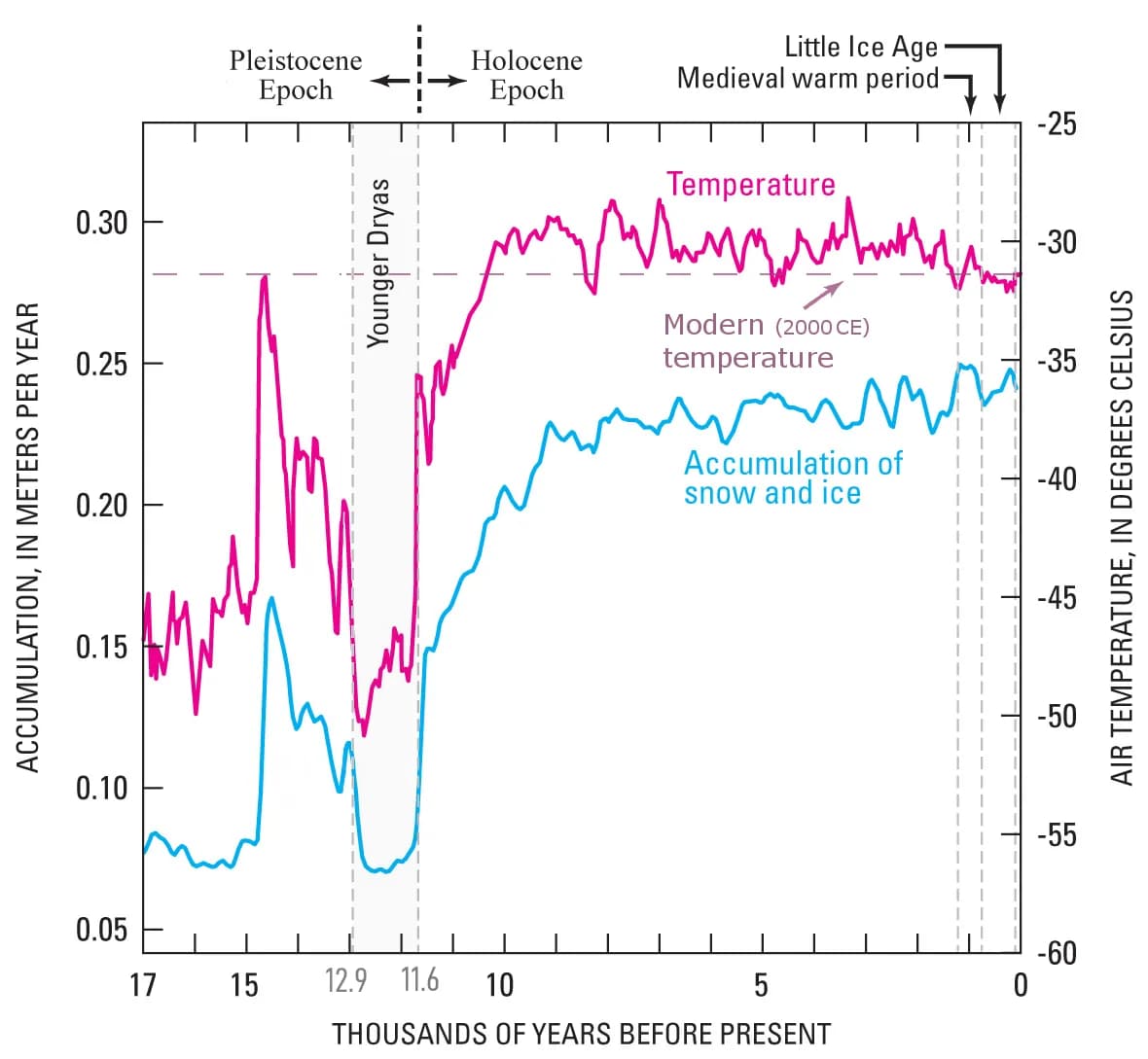
The Younger Dryas was an abrupt cold interval near the end of the last ice age. The mainstream explanation is a surge of fresh water from the melting Laurentide ice sheet. That water could weaken the Atlantic Ocean's overturning circulation.
Murton and colleagues report a flood path from glacial Lake Agassiz through the Mackenzie River system to the Arctic Ocean, in Nature. They date it to shortly after 13,000 years ago, near the start of the Younger Dryas.
Critics of the impact idea have published directly against it. In 2023 Vance Holliday and twelve co-authors published a review in Earth-Science Reviews. Its title is "Comprehensive refutation of the Younger Dryas Impact Hypothesis". Their abstract says no craters have been identified that date to the onset of the Younger Dryas. It concludes that research in numerous fields shows the hypothesis should be rejected.
I have read the abstracts of the papers in this article. I have not read the full texts.
The Event Nobody's Talking About
In Earthly Enigmas I argue that a fragmenting comet hit or burst above the Laurentide ice sheet about 12,800 years ago. I call the dark layer the black mat. I write that it marks a break at that date.
I list nanodiamonds, platinum, spherules, shocked quartz, iridium and fullerenes in the layer. I write that impact markers have been confirmed at over 50 sites across 9 countries on 4 continents.
I answer the first question people ask. Where is the crater? I write that the target was ice and that an airburst leaves no crater. I point to Tunguska, which produced no crater.
I read the cooling as the consequence. I write that the impact was the trigger and the Younger Dryas followed.
I write that the event is not disputed and that only the mechanism remains debated. Later in the chapter I write that the scientific community remains divided. I name three reasons the debate is not settled. They are investment, the gaps between disciplines and the implications. I write that none of this is a conspiracy.
I treat the link to a lost civilization as an interpretation. I write "We are not asking you to believe in Atlantis."
The paper I rely on is Firestone and colleagues in the Proceedings of the National Academy of Sciences. They propose that one or more large, low-density objects exploded over northern North America. They list magnetic grains with iridium, microspherules, charcoal, soot, carbon spherules, nanodiamonds and fullerenes in a thin layer above the Clovis sites.
Kennett and colleagues later modeled 354 dates from 23 sections in 12 countries. They give a range of 12,835 to 12,735 calendar years before present.
Martin Sweatman writes that the "overwhelming consensus of research" by many independent groups suggests the claim of a major cosmic impact should be accepted. He adds that the other claims of Firestone's team are not yet confirmed.
Sweatman, James Powell and Allen West answered Holliday's review in 2024. They write that scores of peer-reviewed articles have corroborated the hypothesis and replicated the key evidence dozens of times.
The survivors are the part I follow furthest. I read the burial of Göbekli Tepe as deliberate, and I ask whether the great sites show what the survivors remembered. That argument has its own article on Göbekli Tepe. The flood stories I tie to the same date are in the article on flood stories.
What Has Not Been Settled
Both sides lean on questions the evidence has not closed. Three of them stand out.
Where Is The Crater?
Holliday and colleagues write that no craters have been identified that date to the onset of the Younger Dryas.
In the book I call this a fair question. Firestone's team proposes objects that exploded over northern North America and partly destabilized the Laurentide ice sheet. That model describes an airburst over ice.
A crater 31 kilometers wide lies under Hiawatha Glacier in Greenland. Kjær and colleagues reported it in 2018 and said its age was presently unknown. In 2022 Kenny and colleagues dated shocked zircon from it to about 58 million years. I have not checked whether anyone in this debate proposed Hiawatha as the Younger Dryas crater.
What trace should an object that burst above the ice leave in the ground today?
One Layer, One Moment?
Meltzer and colleagues examined the dating at the 29 sites where proponents report the layer. They say only 3 of the 29 fall within the window for the start of the Younger Dryas. Holliday and colleagues add that very few sites with high levels of any indicator have accurate dating to about 12,900 years ago.
Kennett and colleagues say their modeled ages are consistent with deposition at one time within the limits of dating uncertainty. In the book I write that the markers sit together in one layer at one moment.
Haynes studied 97 sites that cross the end of the ice age. About two thirds have a black mat. He ties the mats to the Younger Dryas cooling and gives that episode as 10,900 to 9,800 years before present in radiocarbon years. He calls the evidence for an impact "not yet compelling". He also says a remarkable perturbation "needs to be explained".
How tightly does a layer have to be dated before it counts as a single event?
Who Else Found It?
In 2009 Todd Surovell, Vance Holliday and colleagues analyzed magnetic minerals and microspherules from seven sites. Two of the sites were also examined by Firestone's team. They write "We were unable to reproduce any results of the Firestone et al. study." Holliday and colleagues list irreproducible observations among their charges in 2023.
Powell writes that many independent studies have reproduced the evidence at dozens of sites. Sweatman, Powell and West make the same claim. In the book I write that independent research teams have replicated the findings.
Petaev and colleagues are a separate group. They analyzed the Greenland GISP2 ice core and found a large platinum anomaly at the boundary. They say it hints at an extraterrestrial source. They also say the source could have been an iron meteorite that is unlikely to result in an airburst or trigger wide wildfires.
What would a decisive replication look like?
The questions I can't put down
Some questions need more room than one article gives them. Two of them keep pulling me back.
What turned the ocean off? Murton and colleagues quote Broecker's 2006 conclusion that "our inability to identify the path taken by the flood is disconcerting". They then report a flood path they date to shortly after 13,000 years ago. In the book I put the freshwater explanation first and I write that the two explanations are not mutually exclusive. I also write that the ocean was switched off. I follow that thread through Earthly Enigmas.
What ended the giants so quickly? Haynes wrote that the extinction was "seemingly too sudden and extensive" for human predation or climate change to be the primary cause. Holliday and colleagues write that there is "no support" for the premise that species became extinct "due to catastrophe". In the book I say the overkill numbers do not work. I also grant that hunting was sufficient on Wrangel Island. You can read a free sample before you decide. The articles section has more subjects in the same format.
Sources
- Firestone et al., PNAS 2007: Evidence for an extraterrestrial impact 12,900 years ago (abstract read)
- Haynes, PNAS 2008: Younger Dryas black mats and the Rancholabrean termination in North America (abstract read)
- Surovell et al., PNAS 2009: An independent evaluation of the Younger Dryas extraterrestrial impact hypothesis (abstract read)
- Murton et al., Nature 2010: Identification of Younger Dryas outburst flood path from Lake Agassiz to the Arctic Ocean (abstract read)
- Petaev et al., PNAS 2013: Large Pt anomaly in the Greenland ice core points to a cataclysm at the onset of Younger Dryas (abstract read)
- Meltzer et al., PNAS 2014: Chronological evidence fails to support claim of an isochronous widespread layer of cosmic impact indicators dated to 12,800 years ago (abstract read)
- Kennett et al., PNAS 2015: Bayesian chronological analyses consistent with synchronous age of 12,835-12,735 Cal B.P. for Younger Dryas boundary on four continents (abstract read)
- Kjær et al., Science Advances 2018: A large impact crater beneath Hiawatha Glacier in northwest Greenland (abstract read)
- Kenny et al., Science Advances 2022: A Late Paleocene age for Greenland's Hiawatha impact structure (abstract read)
- Sweatman, Earth-Science Reviews 2021: The Younger Dryas impact hypothesis, review of the impact evidence (abstract read)
- Powell 2022: Premature rejection in science, the case of the Younger Dryas Impact Hypothesis (abstract read)
- Holliday et al., Earth-Science Reviews 2023: Comprehensive refutation of the Younger Dryas Impact Hypothesis (abstract read)
- Sweatman, Powell and West, Earth-Science Reviews 2024: Rejection of Holliday et al.'s alleged refutation of the Younger Dryas impact hypothesis (abstract read)