At the end of the last ice age the sea began to climb. It kept climbing for thousands of years.
Coasts where people once lived went under. Nobody has walked them since.
The traditional view
Lambeck and colleagues rebuilt global sea level from about 1,000 observations. They put the main phase of melting from about 16,500 to about 8,200 years ago, at an average rise of 12 meters per thousand years. They report a faster rise from 14,500 to 14,000 years ago and a slower rise from 12,500 to 11,500 years ago, which they tie to the Younger Dryas.
Deschamps and colleagues drilled corals off Tahiti. They write that the fast pulse "started no earlier than 14,650 years ago and ended before 14,310 years ago."
The cold snap that followed is well measured. Cheng and colleagues read cave deposits and put its onset in the North Atlantic at 12,870 ± 30 years before present. They also write that "a precise understanding of its trigger, propagation, and termination remains elusive."
The usual view of the people is continuity. Buchanan, Collard and Edinborough used about 1,500 radiocarbon dates from archaeological sites in Canada and the United States to look for a drop in Paleoindian numbers. Their abstract reports "No evidence of a population decline among the Paleoindians at 12,900 +/- 100 calBP was found." Meltzer and Holliday write that Paleoindian groups "occupied North America throughout the Younger Dryas Chronozone." They add that conditions on the Great Plains and in the Rocky Mountains were "in reality less extreme" than the Greenland ice records suggest.
The genetic evidence points the same way. Rasmussen and colleagues sequenced the genome of an infant buried with Clovis tools, dated to about 12,707 to 12,556 years ago. They write that their data "are compatible with the hypothesis that Anzick-1 belonged to a population directly ancestral to many contemporary Native Americans."
In southwest Asia the cold snap is read as a push toward farming. Moore and Hillman write that the cold snap "led to significant disruptions in culture and settlement over a wide area." They call it "a contributing factor in the subsequent development of agriculture." Their dates are in radiocarbon years. Hillman and colleagues say that at Abu Hureyra a steep decline in wild food plants drove hunter-gatherers to start cultivating cereals.
Whether something from space helped cause the cold snap has its own article on the Younger Dryas impact hypothesis. I will not repeat it here.
What Was Lost
In the book I write "12,800 years ago, something struck Earth, resetting civilization." In Chapter 2 I describe a planet that has been reset "partially or almost completely, multiple times." I write that the debate is over the mechanism and not over whether something happened.
Chapter 8 is titled 12,800 Years Ago, and its section What Was Lost carries the argument to the coasts. I write that "every one of those environments from before the impact is now underwater."
Chapter 10 follows that thread under the heading The Vanishing Coastlines. I give the rise as about 120 meters, or 400 feet, and I say the drowned land equals the continent of South America. I write that it "was not empty wilderness" and that whatever people built there is "mostly gone." Doggerland, the plain under the North Sea, is my example. On the missing evidence I write, "We know we haven't looked."
I hold the lost civilization loosely. I call it "an interpretation informed by the climatological evidence, not unequivocally proven by it alone." I also write "We are not asking you to believe in Atlantis." I do ask whether the story of steady progress fits the ground. My own line for it is "We are not progressing, we are recovering."
Others who use the idea
I am far from the first to write about resets. In the Timaeus, Plato has an Egyptian priest say that "there have been and there will be many and divers destructions of mankind, of which the greatest are by fire and water." The translation is Lamb's.
Graham Hancock states the modern case on his own site. He writes that "the case for the Younger Dryas comet is now so compelling that it is time to widen the debate." He reads Göbekli Tepe as the first trace of civilization returning, 11,500 years ago. He writes that what happened before the Younger Dryas is what "we desperately need to recover."
The Society for American Archaeology has objected strongly. After the Netflix series Ancient Apocalypse aired, it asked Netflix and the producers to "reclassify the series as 'science fiction.'" Hancock had answered the society once before, in 2019. He wrote that its journal devoted 27 pages to an attack on his book America Before.
Where the Sources and the Question Part Ways
The sources agree that the sea rose and the climate swung. They part ways on what that did to people. Three questions stand out.
How Much Went Under After the Break?
In the book I place the rise of about 120 meters after the impact. I give coral reef dating, sediment cores and mapped continental shelves as the evidence. I have not checked which paper the book relies on for the 400 feet.
Lambeck and colleagues put the main melting from 16,500 to 8,200 years ago, with the fastest pulse at 14,500 to 14,000 years ago. Deschamps and colleagues date the start of that pulse to no earlier than 14,650 years ago. Cheng and colleagues put the Younger Dryas onset at 12,870 ± 30 years before present. The book gives the impact as 12,800 years ago.
Lambeck's abstract gives a slower rise from 12,500 to 11,500 years ago. It gives no figure for how much of the total fell after the onset.
How much of the drowned land went under before the break, and how much after it?
Did the People Stop or Move On?
Buchanan and colleagues find no population drop at 12,900 years ago in their dates from Canada and the United States. Their dates measure numbers of occupations. They cover one continent, and they cannot show what people knew or built.
Coles argues for the North Sea plain that coastal people "will have moved with the coast as relative sea-levels changed." Walker and colleagues studied the Storegga tsunami, which hit about 8,150 years ago. They write that "traditional notions of a catastrophically destructive event may need rethinking."
Abu Hureyra shows how the same ground can be read two ways. Moore and Hillman read its plants as a response to cold and dryness. Moore and colleagues later wrote that the evidence there "supports the hypothesis that a cosmic event occurred at Abu Hureyra ~12,800 years ago." A 2025 correction to that paper exists. I have not read it.
What would a break look like in the record, and how would anyone tell it from people simply moving?
What Counts as Having Looked?
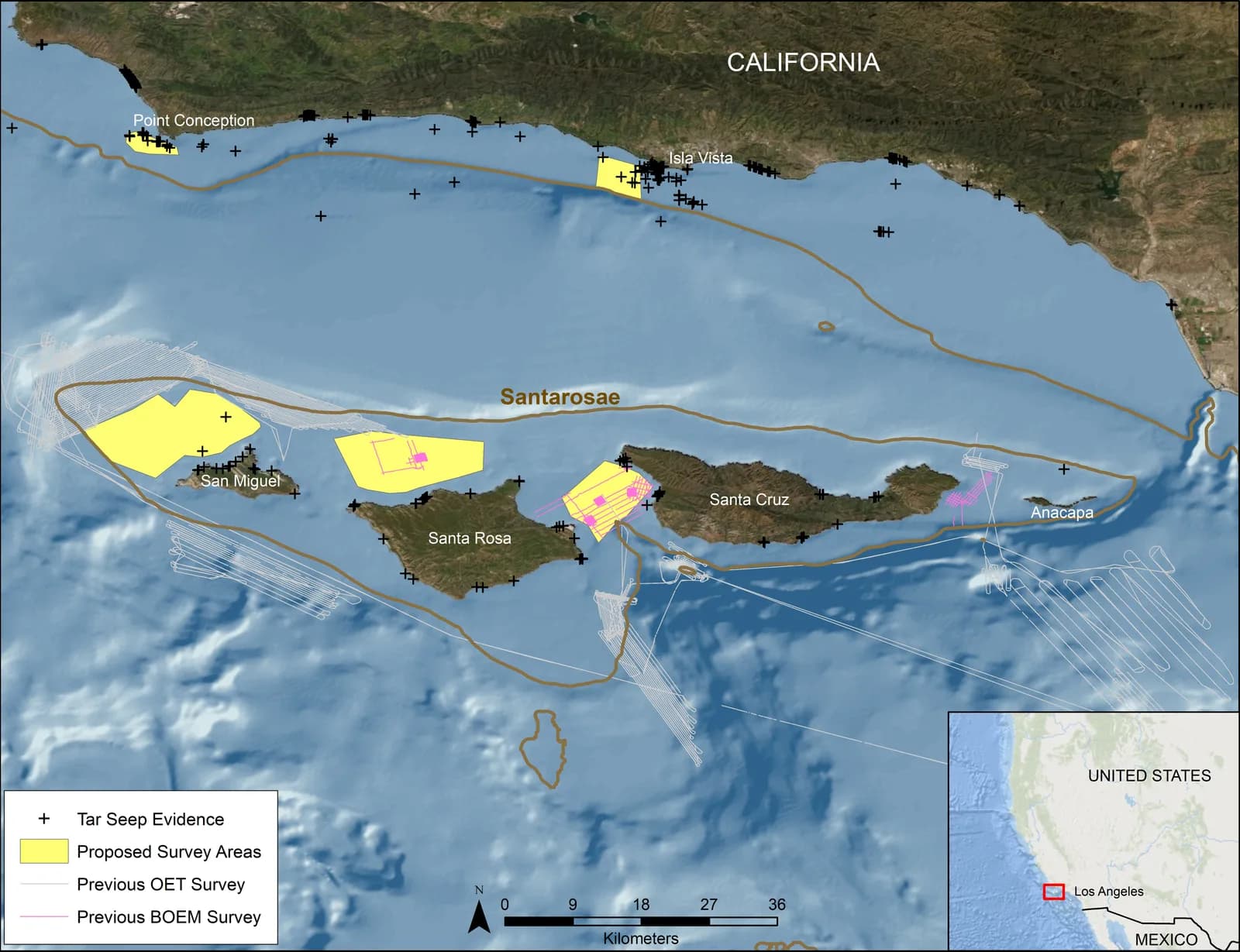
The Springer Encyclopedia of Geoarchaeology says "over 3000 submerged cultural landscapes with archaeological indicators from the Pleistocene/Early Holocene on the continental shelf are known worldwide." NOAA describes a survey off southern California. It says that "post-glacial sea level rise submerged thousands of square kilometers of coastal land." These facts, it adds, "suggest that archaeological deposits are likely located on these submerged landscapes." Its map marks the extent of the island of Santarosae about 16,000 years ago. Erlandson and colleagues report that sites on the Channel Islands hold tools for hunting marine birds, mammals and fish 12,000 years ago.
The Springer entry also says these landscapes lie from the nearshore to about 100 meters below modern sea level. I have not seen a figure for the share of the shelf that anyone has surveyed.
How much of the drowned coast would have to be searched before anyone could say it held nothing?
The questions I can't put down
Some questions need more room than one article gives them. Two of them keep pulling me back.
Do the old stories remember the water? In the book I count 217 flood traditions worldwide. I also cite Nunn and Reid on Aboriginal accounts that match drowned coastlines, and I read them as proof that oral memory can last 7,000 to over 10,000 years. I have not read their paper, so I do not give their figures here. The article on flood stories sets out what scholars say about the tablets. I follow the rest through Earthly Enigmas.
Why would anyone bury a temple? Göbekli Tepe was filled in on purpose. In the book I write that the usual explanations are "oddly incurious about the timing," and I tie the burial to the idea of saving something for later. The article on Göbekli Tepe covers the site itself. You can read a free sample of the book before you decide. The articles section has more subjects in the same format.
Sources
- Lambeck et al., Sea level and global ice volumes from the Last Glacial Maximum to the Holocene (PNAS 2014)
- Deschamps et al., Ice-sheet collapse and sea-level rise at the Bølling warming 14,600 years ago (Nature 2012, abstract read)
- Cheng et al., Timing and structure of the Younger Dryas event and its underlying climate dynamics (PNAS 2020, abstract read)
- Buchanan, Collard and Edinborough, Paleoindian demography and the extraterrestrial impact hypothesis (PNAS 2008, abstract read)
- Meltzer and Holliday, Would North American Paleoindians have noticed Younger Dryas age climate changes? (Journal of World Prehistory 2010, abstract read)
- Rasmussen et al., The genome of a Late Pleistocene human from a Clovis burial site in western Montana (Nature 2014, abstract read)
- Moore and Hillman, The Pleistocene to Holocene transition and human economy in southwest Asia (American Antiquity 1992, abstract read)
- Hillman et al., New evidence of Lateglacial cereal cultivation at Abu Hureyra on the Euphrates (The Holocene 2001, abstract read)
- Moore et al., Evidence of cosmic impact at Abu Hureyra, Syria (Scientific Reports 2020, abstract read)
- Coles, Doggerland: the cultural dynamics of a shifting coastline (Geological Society Special Publication 2000, abstract read)
- Walker et al., A great wave: the Storegga tsunami and the end of Doggerland? (Antiquity 2020, abstract read)
- Archaeology of the Continental Shelf: Submerged Cultural Landscapes (Encyclopedia of Geoarchaeology, Springer, entry definition read)
- NOAA Ocean Exploration, Paleolandscapes, Paleoecology, and Cultural Heritage on the Southern California Continental Shelf
- Erlandson et al., Paleoindian seafaring, maritime technologies, and coastal foraging on California's Channel Islands (Science 2011, summary line read)
- Plato, Timaeus 22c, translated by W. R. M. Lamb (Perseus Digital Library)
- Graham Hancock, Fingerprint of a Global Cataclysm 12,800 Years Ago (his site)
- Graham Hancock, Response to the Society for American Archaeology (his site, 2019)
- Society for American Archaeology, SAA Sends Letter to Netflix Concerning Ancient Apocalypse Series