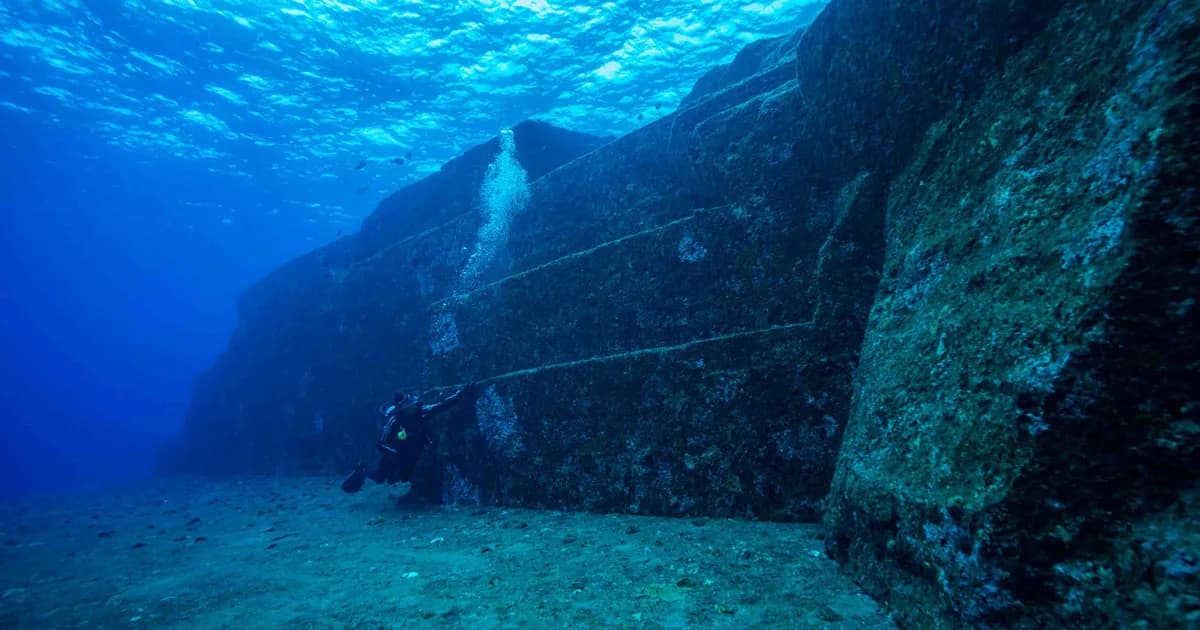
A diver off the southern tip of Yonaguni island, in Japan, noticed stone shapes on the sea floor in 1986. They looked like steps with sharp right angles. The marine geologist Masaaki Kimura began to survey them in 1992.
Two readings have stood side by side ever since. One says people cut the stone. The other says the rock and the sea shaped it alone.
The traditional view
The geologist Robert Schoch of Boston University has dived the site many times. On his own page he says it is primarily a natural structure. He explains that the rocks of the region break neatly along horizontal and vertical planes, and he puts the formation at over 95 percent natural.
Schoch adds that parts may have been touched up by ancient people. He thinks the carved tombs on the island may have been inspired by the natural steps. He told National Geographic that it is basic geology and classic stratigraphy for sandstones.
The same article reports that neither Japan's Agency for Cultural Affairs nor the government of Okinawa Prefecture recognizes the remains as an important cultural property. It says neither has carried out research or preservation work there.
The Wikipedia article on the monument reports a 2019 field study by Takayuki Ogata and colleagues that found natural weathering and erosion of jointed sandstone. It also reports that Patrick Nunn reads similar formations on the island as natural. I have not checked either in the original.
Forbidden Archaeology has its own traditional view to answer. Michael Cremo and Richard Thompson published it in 1993. The folklorist Wade Tarzia reviewed it in the journal Creation/Evolution and said it falls short of a scientific work. He pointed to its use of old sources and its leaps to sensational hypotheses before simpler ones were tested. He also said he hesitated to call it worthless and found it useful as field data on how such arguments are built.
Yonaguni: The Monument Under the Sea
In Earthly Enigmas I describe a stepped stone structure with right angles under the sea off Yonaguni. A diver named Aratake documented it in 1986. Kimura spent fifteen years diving it.
I write that Kimura holds that the regularity cannot be natural alone. I write that if any of it is man-made it is at least 10,000 years old. I put the submergence between 10,000 and 12,000 years ago.
I also say the debate misses the more important question. When was it above water? I write that the mainstream has spent thirty years trying to explain it away. I write that Kimura's reading has been disputed and has not been disproven.
If any part is man-made, I say it pushes human building in the Pacific back to a date mainstream archaeology does not acknowledge. In the same chapter I call the mainstream position a legitimate one that should be heard. I report that most geologists who reviewed the site say natural and that Schoch argues primarily natural with possible human modification.
In the chapter on why evidence stays hidden I list the reception of Michael Cremo among the cases of a four-stage pattern. I describe that pattern as an ecosystem of incentives that needs no conspiracy. I list Forbidden Archaeology under suggested further reading but I do not cite it in the text.
The Steps Nobody Can Settle
Both sides lean on points the evidence has not settled. Three of them stand out.
Is it cut or is it broken?
Kimura wrote in a 2004 paper that the layers of sandstone and mudstone could separate naturally. He lists reasons he thinks nature falls short. The main structure is surrounded by flat terraces. A fan-shaped pool on its top has cut walls. No fallen rock lies at its foot, and a road about six meters wide turns at a right angle.
He also reports funnel-shaped depressions spaced 20 to 30 centimeters apart. He says marine biologists confirmed from plaster casts that sea urchins did not make them. He calls tool marks the strongest evidence so far for a man-made origin.
Schoch gives the opposite reading in the National Geographic article. He says underwater eddies scoured the holes and that marine creatures working a seam in the rock made the lines of smaller holes. He says the right angles and symmetry do not add up in many places. He says photographs make the lines look more regular than they are.
Toru Ouchi, a seismologist at Kobe University, told the same reporter that he had dived there. He said it is easy to tell the relics were not caused by earthquakes.
Kimura says he wants to analyze the paint on one relief and carry out research below the surface. Ehud Galili and colleagues wrote in a paper on other submerged sites that there is no substitute for direct, visual assessment by an underwater archaeologist. I have read only the abstract.
Which of the marks came from a tool and which came from the sea?
When was it above the water?
Kimura's 2004 paper gives about 10,000 years, based on carbon-14 and beryllium-10 measurements on more than 40 samples. He reads the structure as built on land and submerged by the rising sea after the last glacial period.
In a 2006 summary of his work, in Japanese, Kimura gives a new estimate. As I read it, he says the main structure was built on land some time between about 5,000 and 2,000 years ago. He says a sudden crustal movement may have sunk it, not rising seas. He adds that this does not rule out older ruins. I have not had my reading checked by a native speaker.
In 2007 he told National Geographic that he believed the ruins were at least 5,000 years old and that an earthquake sank the city about 2,000 years ago. Schoch writes that sea levels rose by a hundred meters or more after the glacial period ended about 12,000 years ago. He says a human-made structure would date to around 10,000 or 8000 BCE and that he would have loved to find one.
When was it last above the water?
Who decides what gets tested?
National Geographic reports that no government agency has researched Yonaguni. Cremo and Thompson describe a knowledge filter in the study of human origins. They write that they mean an ongoing social process and not scientific conspirators. They say they discuss the reports critical of their findings at length.
As an example they report that a US Geological Survey team dated the tool-bearing layers at Hueyatlaco, Mexico, to about 250,000 years. They quote the geologist Virginia Steen-McIntyre as saying the work was rejected because it contradicts the prevailing theory. I have not checked that dating.
Tarzia notes that the authors had not aired their arguments in professional journals first. He says this leaves validation of the mass of detail as a career in itself. Tom Morrow of the National Center for Science Education says in a review of a later Cremo book that peer review should have come first. He adds that some reviewers should have taken the claims more seriously. I have not read either of Cremo's replies to them.
Who should test a claim that nobody official has examined?
The questions I can't put down
Some questions need more room than one article gives them. Two of them keep pulling me back.
What did the sea take? Schoch writes that sea levels rose by a hundred meters or more after the last glacial period. In the book I put the rise at about 120 meters and ask what stood on that land. I follow the question through Earthly Enigmas, in the chapter that also returns to the burial of Göbekli Tepe.
How many more are down there? Galili and colleagues examined two suspected sites in the Sicilian Channel and concluded both are natural. They say only an underwater archaeologist who sees a site directly can verify it. In the book I follow the Gulf of Khambhat and the formations off Cuba, and I call Cuba genuinely open. You can read a free sample before you decide. The articles section has more subjects in the same format.
Sources
- Robert Schoch: Research Highlights, Yonaguni, Japan
- National Geographic News: Japan's Ancient Underwater "Pyramid" Mystifies Scholars (Julian Ryall, 2007)
- Masaaki Kimura: Ancient Megalithic Construction Beneath the Sea off Ryukyu Islands in Japan (Oceans '04)
- Masaaki Kimura: lecture summary on the underwater ruins of Okinawa (2006, in Japanese)
- Wade Tarzia: Forbidden Archaeology, Antievolutionism Outside the Christian Arena (Creation/Evolution 34)
- Tom Morrow: review of Forbidden Archeology's Impact (NCSE Reports)
- Michael Cremo and Richard Thompson: Forbidden Archeology, The Hidden History of the Human Race (Internet Archive text of the abridged edition)
- Galili and colleagues: Identifying Anthropogenic Versus Natural Submerged Prehistoric Landscapes (abstract only)
- Wikipedia: Yonaguni Monument (secondary, for the Ogata and Nunn points)